
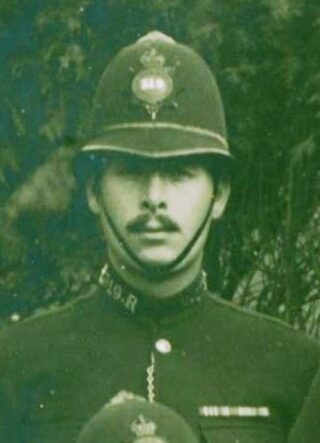
PC 319 William Henry Whyman
William Henry Whyman was born on the 25th June 1894 at Rumbold Road, Hoddesdon and he was baptised on the 2nd September 1894 at Hoddesdon. His father was also William Whyman, he was a Farm Labourer who was born in 1869 at Clavering, Essex. He married Lucy Amelia Carter, William Henry’s mother, on the 5th April 1891 at Aston. She was born on the 3rd November 1871 at Bishops Stortford and baptised there on the 31st December 1871. The 1911 census records that they had seven children but sadly one died before the 1911 census. The children were as follows:
1. William Henry. 2. Frederick born 18th June 1896 at Hoddesdon. He served as Fred Whyman Private 36517 initially in the Hertfordshire Regiment but later in 6th Battalion, Princess Charlotte of Wales’s (Royal Berkshire) Regiment and was killed in action on the 31st July 1917. He has no known grave and is commemorated on the Ypres (Menin Gate) Memorial, Belgium. 3. Albert George born 27th May 1898 at Hoddesdon. Registered and Baptised as Albert George but known as George and believed to have been PC 304 George Albert Whyman who joined Hertfordshire Constabulary in 1920. 4. Nathan born 17th June 1900 at Stocking Pelham. 5. Edward born 19th October 1902 at Stocking Pelham. 6. Lucie Annie born 1905 died 1906 at Braughing.
Despite the 1911 census showing that there were 7 children it has not been possible to identify the seventh.
At the time of the 1901 census the family were living at Mill Hill, Stocking Pelham. William’s father was employed as a Cowman on a farm. During the 1911 census they had moved to Haven End, Braughing. William, his father and brother Frederick, were all employed as Farm Labourers.
Marriage.
On the 26th September 1914 at Hertford William Henry Whyman married Helen Evans known as Nellie or Ellen. She was born on the 26th December 1893 at Barking, Essex.
They had four children: 1. Lucy Esther Helen (Nellie) born 5th July 1915 at Buntingford. 2. William Henry John born 19th February 1921 at Bishops Stortford. 3. Thomas Frederick Edward born 14th June 1922 at Bishops Stortford. 4. Nathan Archibald George born 27th March 1924 at Bishops Stortford.
The next event in William’s story was when he enlisted into the Army following the outbreak of WW1.
Army Service During The First World War.
William’s Army Service Record has not survived. The only surviving records are his Medal Roll Index Card, Medal Roll and his Military Medal Index Card. He also supplied some conflicting dates for his Military service when he later applied to join the Hertfordshire Constabulary.
William stated that he enlisted into the Bedfordshire Regiment as Private 6167 on the 5th October 1914. Under later reorganisation his service Number was changed to 201509. He joined the 5th (Territorial) Battalion which suggests that he was possibly a member of the Territorial Army prior to the start of the war. The 5th Battalion was redesignated at the 1st/5th Battalion in 1914.
The 1st/5th (Territorial) Battalion was mobilised in August 1914 and initially provided home defence in East Anglia as part of the East Midland Brigade, East Anglian Division. In August 1914 they were based in Gwyn Street, Bedford. During August 1914 they moved to Romford and then to Bury St Edmunds. Then in May 1915 they moved to St Albans. Also, in May 1915 they joined the 162nd Brigade, 54th (East Anglian) Division.
In July 1915 the Regiment sailed for Gallipoli. They landed at Mudros on the island of Lemnos, Greece on the 10th August 1915 and at Suvla Bay, Gallipoli, on 11 August, taking part in the Gallipoli Campaign.
They withdrew back to Egypt in December 1915 before serving in Egypt and Palestine.
William provided two different dates for when he left the Army the 25th June 1919 and the 22nd July 1919.
Medals Awarded.
William was awarded the Victory Medal and The British War Medal as well as a Military Medal. His Military Medal was Gazetted in the Supplement to the London Gazette published on the 18th October 1917 and the Supplement to the Edinburgh Gazette on the 22nd October 1917 the entry read:
His Majesty the King has been graciously pleased to award the Military Medal for bravery in the Field to the undermentioned Non-Commissioned Officers and Men: 201509 Sjt. W.H. Whyman, Bedfordshire Regiment, (Hertford).
Hertford was his shown as his home town.
It is not known for what action he was awarded the Military Medal, it could have been in Gallipoli or Egypt, unfortunately the Citations for all the Military Medals were destroyed during the Blitz of WW2. William’s Military Medal Index Card is stamped Egypt, where many others awarded at the same time are stamped France. This may infer he was serving in Egypt when the action took place.
What it does show is that he was a Sergeant at the time his Military Medal was awarded. By the time he was awarded the Victory Medal and British War Medal he is shown as being an Acting Colour Sergeant and by the time he applied to join the Police he stated he was a Colour Sergeant.
Like every returning soldier William would have been granted 28 days leave and he used this time to apply to join the Hertfordshire Constabulary.
Police Service.
William’s Police Service Record has survived and has three principal documents: A Hertford County Constabulary Form 1 Conditions of Entrance, a Hertford County Constabulary Form 2 Conditions of Service and a Hertford County Police Personal Record. Originally when William was Appointed his Hertford County Police Personal Record would have been a Form 3, a foolscap size 4-sided document. This has been replaced by the Personal Record, an A4 sized 2-sided document, and the Form 3 has been destroyed. This is unfortunate as the Form 3 contained much more information, particularly a more detailed explanation of his Military Service, which was not transferred to the new document. There are also a number of General Orders where William features.
Form 1.
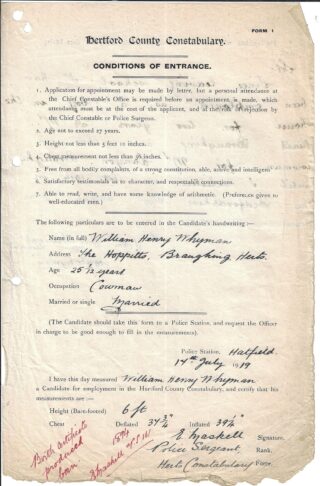
William’s Form 1 read as follows:
1. Application for appointment may be made by letter, but a personal attendance at the Chief Constables office is required before an appointment is made, which attendance must be at the cost of the applicant and at the risk or rejection by the Chief Constable or Police Surgeon. 2. Age not to exceed 27 years. 3. Height not less than 5 feet 10 inches. 4. Chest measurement not less than 30 inches. 5. Free from all bodily complaints, of a strong constitution, able, active and intelligent. 6. Satisfactory testimonials as to character, and respectable connections. 7. Able to read, write, and have some knowledge of arithmetic. Preference given to well-educated men.
The following particulars are to be entered in the candidate’s handwriting.
Name (in full). William Henry Whyman
Address. The Hoppitts, Braughing, Herts.
Age. 25 1/12 years.
Occupation. Cowman.
Married or Single. Married.
(The candidate should take this form to a Police Station and request the Officer in charge to be good enough to fill in the measurements).
Police Station Hatfield. 17th July 1919.
I have this day measured William Henry Whyman Candidate for employment in the Hertford County Constabulary, and certify that his measurements are:
Height (Bare-footed) 6ft.
Chest. Deflated 37 ¾ inches Inflated 39 ¼ inches.
E. Maskell. Signature. Police Sergeant. Rank. Herts Constabulary. Force.
Written in red ink at the bottom of the form was: Birth certificate produced born 1894 (signed) E. Maskell APS 161.
On the rear of the form is the following:
The Candidate will write a brief account of his employment since leaving school.
Sir, since leaving school I have been employed as a boy in the house for two years at Mr. Keast, Braughing and then as cowman for Mr. Lanyon, Braughing until I enlisted in October 1914 in the Bedfordshire Regiment, I was demobbed on 22.7.19. Sir, I am your obedient servant W.H. Whyman.
Form 2.
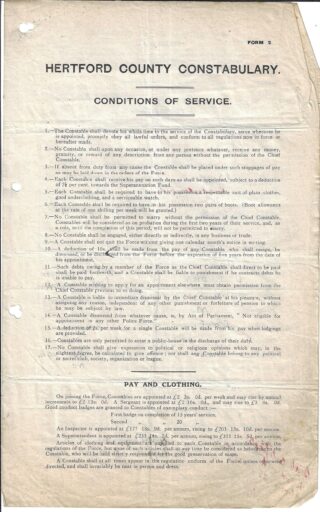
William’s Form 2 is a four-sided document. The first side comprises a list of all of the conditions of his service and his pay and clothing. The second side lists privileges he was entitled to and rates of House Rent. He then had to complete a Declaration of Candidate. The following information was recorded:
Age: 25 yrs. Place and date of birth: Hoddesdon, Herts. 25 June 1894 (written in red ink). Height: 6 ft. Chest: 37 ¾ inches. Complexion: Dark. Eyes: Hazel. Hair: D. Brown. Marks: Vaccination left arm. Married or Single: M. Religion: C. of E. Children: 1 female. Nationality: English. Benefit Society: Prudential. Where and with whom last employed: Mr. C. Lanyon, The Warren, Braughing. Occupation: Cowman. Duration of Service: 4 years. Date of discharge: Sept 1914. Whether rejected from any cause by any other Constabulary Force: No.
He then completed the following declaration: I hereby declare at the above answers are in my handwriting and were inserted by me on the 17th day of July 1919 and that they all true and full replies to the several questions above specified, and that I have read the Conditions of Service, and, if appointed, I hereby agree to serve the Standing Joint Committee of the Quarter Sessions and the County Council as a member of the Constabulary for the County of Hertford, under the conditions before mentioned, and subject also to all Statutory conditions now made, or hereafter to be made, in that behalf.
W.H. Whyman Signature. The Hoppitts, Braughing. Address.
Again, written in red ink at the bottom of the page was: Birth certificate produced born 25th June 1894. (signed E.M. PS161)
The third side lists four Testimonials of people known to William and who were recommending him for employment as a Constable.
Dated 17th July 1919.
We the undersigned, certify that William Henry Whyman a candidate for employment in the Hertford County Constabulary, has been known to us during the periods stated opposite our respective names, and we consider him sober, honest, good tempered, and a person we can conscientiously recommend as likely to make an efficient Police Officer, and we recommend him accordingly.
1. Charles James Longman, Upp Hall, Braughing. 1901-1919. 2. Edwin Lanyon, Warren, Braughing. 1901-1919. 3. H. Martin, Green End, Braughing. 1901-1919. 4. T. Harrison Brown, Causeway, Braughing. 1901-1919.
The following declaration was then signed:
Police station, Buntingford. 21st July 1919.
I certify that the signatures of the above persons no/. 1 to 4 are genuine and that their recommendations are worthy of confidence. Signed: Edward J. Barrister Police Sergeant no/. 222A, Hertfordshire Police.
Following this was a Medical Certificate which reads:
I hereby certify that I have examined W.H. Whyman as to his health and physical strength and that I consider him fit for the duties of the Constabulary. (Signed) Lovell Drage Surgeon M.D. Dated at Hatfield, this 15th day of July 1919.
Finally, is the Approval and Appointment by Chief Constable which has not been completed. The fourth side of the form is blank.
Personal Record.
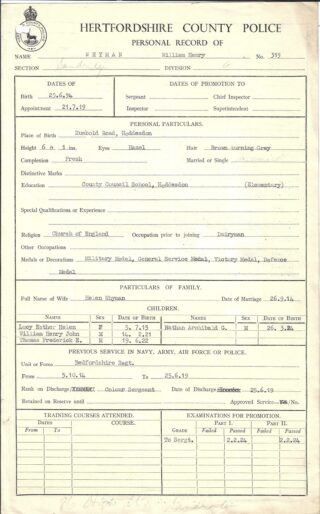
William’s Personal Record has details taken from both his Form 1 and Form 2 together with other information on events in his career. These will be described at the appropriate times. One thing of note was in his physical description his hair was now described as being brown turning grey.
William was Appointed as Constable 319 on the 21st July 1919 and posted to R Division Police Headquarters, Hatfield where he underwent his Probationer Training as part of the 16th Probationer Class. During their training they would at some points have been Attested before local Magistrates.
Shown in the photograph below, which was taken at Police Headquarters Hatfield, is the 16th Probationer Class who had as their Instructors Acting Sergeant 161 Ethelbert Maskell and Constable 280 George Thomas Sharp DCM, MM. This is known as the Form 3 Service Record belonging to PC 231 Hales has survived and it has been endorsed to that effect.
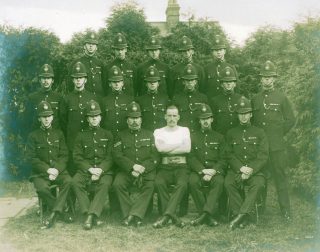
Class 16 of 1919
Every member of the Class has been identified owing to the following General Orders. General Order 216 of the 18th October 1919 announced that 14 Recruit Constables having been brought on to the Roster, would be transferred from Headquarters to Divisions for duty. General Order 230 of the 20th November and General Order 244 of the 9th December 1919 similarly announced that PC Ives and PC Wiggs, respectively, had also been brought onto the Roster and posted. Those pictured are:
Back Row left to right:
1. PC 253 George Hemmings. 2. PC 233 Arthur Howe. 3. PC 188 Reginald Henry Wiggs. 4. PC 231 Joseph Hales. 5. PC 318 Alexander Williams.
Middle Row left to right:
1. PC 319 William Henry Whyman. 2. PC 181 Harold Calcutt. 3. PC 173 John William Berry. 4. PC 283 George Alfred Voller. 5. PC 155 Frank Bavister. 6. PC 206 Jack Hales. 7. PC 98 Harry Bateman.
Front Row left to right:
1. PC 218 Robert Charles Offord. 2. PC 309 F. White. 3. Instructor Acting Sergeant 161 Ethelbert Maskell. 4. Instructor Constable 280 George Thomas Sharp DCM, MM. 5. PC 268 Arthur James Saunders. 6. PC 257 Alfred James Ives.
First Posting.
As previously stated, General Order 216 of the 18th October 1919 announced that 14 Recruit Constables having been brought on the Roster for duty would be transferred from Headquarters to Divisions. William was shown as PC 319 W.H. Whyman who was posted to B Division at Bishops Stortford from the 20th October 1919.
The Electoral Roll of 1920 shows William living at 60, Portland Road, Bishops Stortford. By the time of the 1921 census, he was living alone at 31, Crown Terrace, Hockerill Street, Bishops Stortford. His wife and their 4-month-old son, William, were living with his widowed father at Oldfield Cottages, Braughing. His mother had died in 1919. Furthermore, their daughter Lucy was shown as being a visitor at 35, Crown Terrace, staying with a family called Radley.
In December 1920 William passed his St. Johns Ambulance First Aid Certificate which entitled him to wear a badge on the lower left sleeve of his tunic. It was also a step in the completion of his Probationary period and a necessary requirement to qualify him for a pay award.
Pay Rise.
General Order 131 of the 31st July 1921 informed William that he would receive an increase in his pay from £3/12/0 to £3/14/0 per week from the 21st July 1921. William would have had to apply for this award in pay, and his application would have had to have been approved by his Inspector and his Superintendent before the final approval by the Chief Constable. Every pay award would follow the same process. Awards always followed the anniversary of the date of Appointment or promotion if applicable.
A Misdemeanour.
On 15th November 1921 he was reported by Superintendent Prior for Misconduct Discipline Code 1 – Discreditable conduct that is to say he acted in a manner prejudicial to discipline by endeavouring without just cause to criticize the duties performed by a superior officer. On the 2nd December 1921 he was severely reprimanded by the Chief Constable.
Pay Rise.
General Order 109 of the 18th August 1922 informed William that he would receive a pay rise from the 21st July 1922.
Another Misdemeanour.
On 18th June 1923 he was reported by Acting Inspector King for Misconduct – Neglect of duty that is to say he failed to parade for duty at 5.45 a.m. on 18th June at Bishops Stortford. On 27th June 1923 he was cautioned by the Chief Constable.
Pay Rise.
General Order 135 of the 31st July 1923 informed William that he would receive a pay rise from the 21st July 1923.
Promotion Exam.
On the 2nd February 1924 William’s Personal Record shows that he passed both part 1 and Part 2 of his Promotion to Sergeant exams, although there is no record of him ever being promoted. However, it would count in his favour whenever he applied for a pay rise.
Yet Another Misdemeanour.
On 13th July 1924 he was reported by Superintendent Wright for Misconduct Discipline Code 3 – Disobedience to Chief Constables Orders that is to say he did without good and sufficient cause enter Licensed premises to wit the Coach and Horses P.H. Bishops Stortford at 9.30 p.m. 13th July 1924 and consumed intoxicating liquor therein contrary to Standing Order No. 6 of the Force. On 8th August 1924 he was severely reprimanded by the Chief Constable.
Pay Rise.
General Order 118 of the 1st August 1924 informed William that he would receive a pay rise from the 21st July 1924.
Transfer.
General Order 138 of the 20th August 1924 instructed William that he was being transferred from B Division at Bishops Stortford to D Division at Sandridge on the 27th August 1924. It was probably not coincidental that this happened so soon after his misdemeanour. The 1925 to 1930 Electoral Rolls show William and his family living in the Police Cottage at Sandridge which is believed to have been in the High Street.
Another Misdemeanour – Apparently Not!
On 22nd March 1925 he was reported by Superintendent Stacey for Misconduct
1) Neglect of duty, for that he did without good and sufficient cause omit promptly to enquire with the case of a dog alleged to have been maliciously shot and injured at Sandridge on 21st March 1925. Discipline Code 4a.
2) Discreditable conduct likely to bring discredit on the reputation of the Force by inducing George Andrews to make and sign a statement that was not true. Discipline Code 1.
3) Did wilfully make a misleading and inaccurate report of a dog shot at Sandridge by an entry in the Guardroom Occurrence Book at St. Albans such entry not being a correct account of what had transpired. Discipline Code 5b.
On the 15th April 1925 the first case was dismissed by the Chief Constable. Charges 2 and 3 were not proceeded with.
Pay Rise.
General Order 120 of the 2nd August 1925 informed William that he would receive a pay rise from the 21st July 1925 and General Order 116 of the 25th August 1926 informed William that he would receive a pay rise from the 21st July 1926.
A Royal Visit – Mutual Aid to Luton Borough Police.
General Order 156 of 14th November 1926 announced orders for an Inspector, two Sergeants and 18 Constables with regard to the visit of HRH The Prince of Wales to Luton on the 17th November 1926. William was listed as one of those detailed to attend. In command of the Hertfordshire contingent was Inspector G.T. Sharp of R Division who would act under orders as laid down by the Chief Constable of the Borough of Luton. The detachment was instructed to report at the Borough Police Station Luton at 9 a.m. The men were ordered to take the following dress and equipment: Great Coats 1925 issue, Cloth jackets 1926 issue, Dress trousers 1926 issue, Cloth helmets 1926 issue, Whistle and chain, Handcuffs, Pocket Book, Truncheon, Black woollen gloves and Capes.
Commendation.
On the 12th November 1928 at St. Albans Coroners Court William was Commended by the Coroner, and later by the Chief Constable, for the attention he gave to an injured person.
Commendation.
On the 16th October 1935 at St. Albans Coroners Court William was Commended by the Coroner, and later by the Chief Constable, for his action at a fatal accident.
In the 1939 Register William and most of his family were still living in the Police Cottage at Sandridge. They remained there until he retired.
William’s daughter Lucy was being paid for carrying out domestic duties whilst living with Arthur Morris and his family at 7 Kingsbury Avenue, St. Albans. She married Arthur’s son William A. Morris in 1940.
Commendation.
On the 17th October 1941 at St. Albans Coroners Court William was Commended by the Coroner, and later by the Chief Constable, for his investigation into a death by gas.
Unfortunately, no further information has been found concerning any of his commendations.
Defence Medal.
At the end of WW2 William was awarded the Defence Medal. This medal was awarded for non-operational service in the UK or certain overseas territories during the war. Many Police Officers, including those in the Special Constabulary, qualified for the medal due to their service on the home front.
In September 1946 William qualified for a St. Johns Ambulance Voucher, a higher First Aid qualification.
On the 1st April 1947 under the Police Act 1946 the Force was reorganised with the amalgamation of the St. Albans City Police into the Herts Constabulary. It affected William in that Sandridge now became part of F Division.
Retirement.
On the 15th August 1949 William Henry Whyman, Constable 319F, Sandridge, F or St. Albans Division submitted a report entitled, Application to be Allowed to Retire on Pension.
Sir. Having completed 30 years service with the Hertfordshire Constabulary, on the 20th July 1949, also having reached the age for Compulsory Retirement, being 55 years of age, on the 25th June 1949, I respectfully ask to be allowed to retire on Pension, on Wednesday 28th September 1949, as per Police Pension Regulations 1949, Reg. 50, (1)(a)(iii).
If the above application is granted, I shall be able to vacate the house now occupied by me, within two days.
(Signed) William Henry Whyman. Constable 319 “F”.
The application was recommended by William’s Superintendent and Approved by the Chief Constable.
On 31st March 1971 William’s wife Ellen died at the Normandy Road Hospital, St. Albans.
On 15th December 1982 William died at the St. Albans City Hospital from Ia. Ischaemic and Hypertensive Heart Disease, b. Benign Essential Hypertension, II. Chronic Obstructive Airways Disease. His home address was recorded as Flat 1, 150 St. Albans Road, Sandridge. His death was reported by his son William Henry John Whyman.
His funeral was held at 2.30 p.m. on Tuesday 21st December 1982 at St. Leonard’s Church, Sandridge.




Add your comment about this page