
Background
The Afghanistan War 2001-2021 was primarily triggered by the September 11 attacks of that year, resulting in the US led invasion after the Taliban refused to surrender Al-Qaeda leaders, in particular Osama Bin Laden. This was the start of a lengthy phased conflict supported by a coalition of countries, notably including the United Kingdom. The war saw the initial overthrow of the Taliban, followed by efforts to stabilise the country and, subsequently, a return to counterinsurgency, with the Taliban reclaiming power in 2021.
The War followed years of instability in the region, a vicious Taliban totalitarian regime, a recent civil war and the Russian invasion of 1979.
As part of the effort to stabilise Afghanistan’s rule of law, Police Officers from coalition countries were deployed to the region to;
Train and mentor the ANP (Afghan National Police)
Develop a legal framework for investigations
Develop the criminal justice system.
My Role
Volunteers were sought to join the European Policing Mission (EUPOL) from across UK Policing and I volunteered for a role as Mentor in intelligence led policing in 2008.
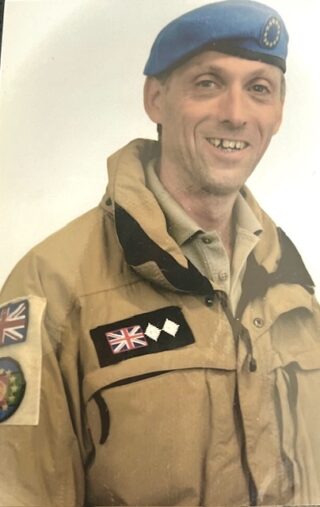
The nature of the deployment and threat environment required officers to undergo additional training before deployment. first had to undertake an intensive firearms course with Warwickshire Police. The training was specifically designed for the hostile environment we could face and emphasised situations in which those you were training might turn against you, accurate shooting up to 25 metres, but mainly close quarter draw and fire with multiple quick reloads, changes of hand, and even a strip down and timed rebuild of your weapon in the dark, all good fun and certainly put us under pressure. We were using the Glock17 with which I struggled at first, but the one-to-one training was excellent and I passed the final qualification shoots and tests.
Following this we were sent on our first hostile environment training course down in Bordon, Hampshire, which was near my old army barracks, so a trip down memory lane.
This concentrated on situational awareness in theatre, the current general intelligence picture, how to avoid becoming a hostage and combat first aid including an introduction to tourniquets, quick clot and wound packing, a brief escape and evasion exercise, how to behave in the event of capture and proof of life ‘safe words’.
The trainers were all ex special forces and shared many interesting stories.
Having completed the pre-deployment training, we all had full medicals and vaccinations before being issued with uniform and equipment at MOD Wethersfield in Essex.
With very little notice we were flown from Heathrow to Dubai on a very nice commercial Emirates flight before transferring to a UN flight from Dubai into Kabul International Airport (KIA) … then the fun began!
In Theatre – Afghanistan
From the outset it was clear that the situation, imagined during our training, was markedly different on the ground. As international airports go, KIA left a little to be desired; we were processed in a shed and the main object of the ANP appeared to be garnering financial tips (bribes) to speed up the process. My first proper introduction to the bribery and corruption which was endemic in the ANP and most Afghan institutions at the time.
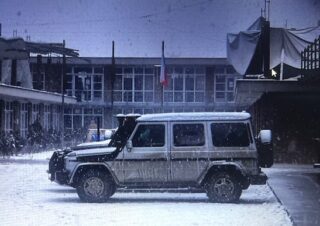
Once we had cleared customs we were picked up by EUPOL colleagues in the vehicles we were to go on to use in theatre, the B6 armoured Mercedes G Wagon.
This was to be a year long deployment with staged R&R (Rest and Recuperation leave) every 4 to 6 weeks during which I maintained a blog detailing my experiences and what follows is my personal perspective.
We collected our weapons and ballistic body armour from a container in KIA and then went to our accommodation at the, optimistically named, Heetal Hotel, which looked like something out of the set of Casablanca and about as secure. The place was surrounded by a near impregnable garden wall topped with sniper screens and barbed wire that wouldn’t have stopped even a moderately determined attack. We had local Guards at the entrance and a British team managing security.
There was no armoury facility and operationally we kept our weapons on us at all times and in close proximity when sleeping, so we were permanently armed. It wasn’t a bad place just a little exposed; on at least two occasions I awoke to the sound of rockets being fired, although nothing came near.
We travelled daily through Kabul to the EUPOL HQ on the Jalalabad Road, known for its numerous roadside-bomb attacks.
We would eventually move into the EUPOL base once the accommodation was finished but for this initial phase of the deployment we enjoyed the drive through Kabul’s rush hour, dodging donkey carts, vehicles coming at you against the flow, American convoys threatening to shoot anything that got near them, beggars laying in the road and generally chaotic driving from all, including us, if you can’t beat them join them!
Instructions were, if you hit anything or anyone you do not stop, it is far too dangerous, just keep moving.
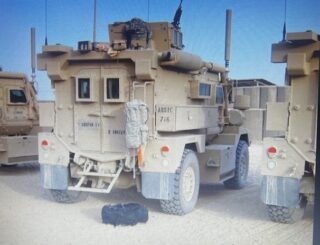
The Cougar (MRAP – Mine Resistant Ambush Protected) vehicle was also used for vehicle movements providing protection from mines and IEDs.
Once at EUPOL I was introduced to Sverre Hoyland, Norwegian Detective Chief Inspector with a background in intelligence and counter terrorism; a superb officer with whom I would be working. Sverre had been in country about a month so was my contact and introduction to all the people we’d be working with.
Over the next twelve months we worked together on developing the intelligence functions within the Afghan Ministry for Police Intelligence (MoI). The role of EUPOL was to work with coalition partners in mentoring senior Afghan leaders, building capability and supporting training, for the Afghans to take over and run operations and enabling the gradual draw down of international support. I worked closely with US Army Combined Security Transition Command, and we devised joint training packages to allow us all to deliver a standardised intelligence led policing model.
I was assigned to Mentor General JAMALUDDIN from the Ministry. We met regularly to discuss his needs in setting up intelligence led policing, which always involved Chai, green or black tea, introductions and pleasantries, and then discussions which invariably involved requests for support and more equipment. The ministries had a large desire for new kit, which somehow had all vanished the next time you met and they required even more. We regularly found that the Americans had already supplied equipment, for example surveillance cameras, but they would ask us for them as well, when we questioned where the other cameras were responses were vague.
That aside the General was a man with a mission to rebuild his country and defeat the Taliban, he’d been in exile during the previous Taliban regime only escaping with the shirt on his back, and returning after the US led invasion. My most memorable moment was walking hand in hand with him in the garden at the MoI, strange, you might ask, but in Afghan society this was a sign of trust and acceptance, something our western attitudes find awkward.
Sverre and I along with our US and European allies also conducted training in initial crime scene investigation what we’d call Golden Hour principles, training for public prosecutors and even took part in running a surveillance course. Basically, once in theatre what you were assigned to do and what you did where often very different things, each of us had a mission objective as I’ve said mine was building intelligence led policing capacity, but I needed help so I’d pull in others, to assist and they would do likewise. Whilst I was in Afghanistan, I had the pleasure of working alongside Norwegian, German, Dutch, Danish, Swedish, Romanian, French, Italian Police officers. Someone would hear about your expertise and the next thing you’d be helping them devise some training or assisting on a course.
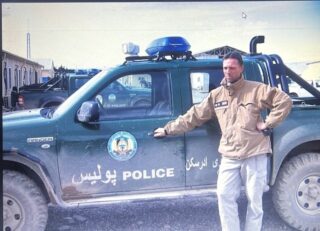
Over the time I was deployed in Afghanistan I worked in Kabul, Herat, Kunduz, Mazar-I-Sharif and Kandahar, we travelled around the Country by military flights usually in a C160, the twin Engine version of the Hercules, these are not designed for passenger comfort but are excellent for short runways dropping out of sky firing off chaff counter missile measures as required.
Getting a military flight was always a lottery you turned up with your International Security Assistance Force (ISAF) ID and booked in on a first come first served basis prioritised by need, you never knew if you’d get a flight and sometimes you just had to wait. On one occasion we couldn’t get an ISAF flight but we got a lift in an old Russian transport jet which proved eventful. After take-off the aircraft was severely rattling and shortly after levelling up the load master informed us the under carriage gear door had not closed properly causing the rattling so we were going to land at Kandahar ‘hopefully’ to get it fixed! It was a thought-provoking landing but thankfully without incident. Having de-bused we waited for the potential repair only to see two large gentlemen displaying at least two inches of bum cleavage wander out to plane. They proceeded to hit the door with a large hammer and, having successfully ensured a ‘safe repair’, unbelievably we all got back onboard and flew back to Kabul without further problems.
During my tour I moved from the Heetal Hotel to the Green Village, a barracks further up the Jalalabad Rd, and finally to the EUPOL base. Interestingly while developing the EUPOL base the area we parked in every day was excavated, only to find we’d been parking on a load of unexploded ordnance left behind by the Russians, fortunately none of it had gone off!! Unexploded ordnance was a constant threat in Afghanistan, the countryside had been extensively mined by the Russians in particular using small plastic butterfly mines, many were still active and causing injury and death to locals, the streets were full of maimed victims, often begging with small children, as well as heroin addicts, another big problem in Kabul. During the winter temperatures dropped to minus 30 and beggars literally froze in the streets, in fact Kabul has one of the greatest variations in temperature from over 30 in the summer to 30 below in the winter.
Food on the tour was pretty awful and at EUPOL was mostly locally sourced and not all dinners were to be trusted; everyone had at least one bout of dysentery, proper gut wrenching and at both ends. One colleague was hospitalised but most of us made it through with a lot of Dioralyte and no food for several days.
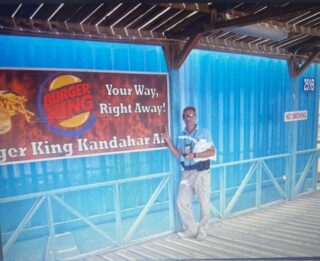
To avoid this, we mostly ate at US bases which were fully supplied with everything an American abroad could need, ice cream by the bucket load, steak and lobster and of course Burger King.
Other threats that we faced besides, IEDs, missile strikes, Afghan Police negligently discharging their weapons, I also discovered earthquakes, the first one I think we all mistook for a large explosion, but we soon realised Afghanistan is prone to frequent earthquakes most of which are little more than a minor tremor.
In terms of bombs the biggest one whilst I was in Kabul was the one that hit the German Embassy, the blast shook our windows and we were some distance from it, it practically evaporated the command post outside the Embassy.
IEDs were a daily risk and it came to a head for me when two of my American colleagues were killed on their way to deliver training at the college of policing. Another American friend rang to ask if we could cover the training that day, only later explaining the reason why, so we jumped in our vehicle and drove the same route down to the police college to deliver the training for them. At the time it seemed normal but with the benefit of hindsight it was anything but.
I attended their memorial at Camp Eggars and their ramp ceremony and wrote a letter on behalf of EUPOL to offer our condolences.
It was not too many months after this, with only weeks to go to the end of my mission, that I had the opportunity to visit Bagram Air Base, which required another trip up the Jalalabad Road, I decided I had pushed my luck far enough and politely declined the offer.
I could write so much more about what we saw and did, the people we met, the laughs (and there were plenty), most bases had a ‘two can’ limit for alcohol, except US and UK bases on which alcohol was not permitted, but we had a bar called the ‘Grumpy Inn Afghanistan’ where we had some great nights.
Sverre left about two weeks before me and I finished with a round of goodbyes to my Afghan and military colleagues before flying home for the final time.
Adjusting to life back at home was more difficult than I thought it would be and for months I remained hyper-vigilant and lacked patience with the minor worries of my colleagues, but gradually I adjusted, although I’ve not quite left Afghanistan behind.
I remain in group chats with my EuPol colleagues, and stay in touch through Facebook and LinkedIn, occasionally meeting up with my UK Police Afghan Vets.
Even now I do not think I’ve properly addressed how I feel about my deployment and even writing this short overview has bought back many feelings.
We went into Afghanistan to defeat the Taliban and to give the Afghans a better standard of living by building capacity, hospitals, training rule of law, we lost lots of lives. Whilst I was deployed, the Afghan National Police lost, on average, 9 officers KIA (Killed in Action) every day, we were in receipt of the reports for each fatality. Overall the Afghan National Security Forces (ANSF) deaths were estimated to be around 66000 not to mention the loss of civilian life.
Like many veterans, I was incensed when, after all this sacrifice, we left the Afghans to the totalitarian regime of the Taliban. Many of our Interpreters and staff were left behind, many of whom were women, and left to fend for themselves. I watched in disappointment as the fall of Kabul played out, reminiscent of the fall of Saigon.
Even now Afghanistan is a contentious topic amongst veterans, for good reasons some never trusted the Afghans, others who worked with them more closely feel we let them down. It was always a complicated relationship but for my part, my Interpreter in Kabul was an honest hardworking guy who just wanted the best for his family, and I couldn’t have done my job without him, and I trusted him implicitly.




Add your comment about this page