
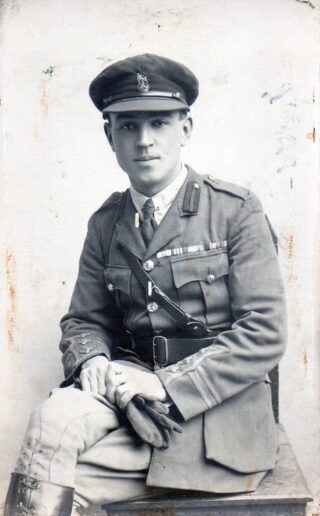
Captain Ernest Bernard Spicer
Early Life
Ernest Bernard Spicer was born on the 8th November 1894 at Watton at Stone and baptised in the Parish Church there on the 27th January 1895. His father, William James Spicer was born in 1863 at Watton at Stone and at the time of Ernest’s baptism he was employed as a labourer. He married his mother, Alice Louisa Hall in 1884 at Watton at Stone. She was born in 1865 at Bennington. They had nine children, all born in Watton at Stone, of which 2 had died before the 1911 census.
1. William James was born in 1885. He served as Constable 67 in the Hertfordshire Constabulary between 8th April 1909 and 7th April 1934. 2. Alice Louisa was born in 1887 and died aged 23 in 1910. 3. Eleanor Ethel was born in 1890. 4. Herbert Edgar was born in 1892. 5. Ernest Bernard. 6. Murial May was born in 1897 and died aged 2 in 1899. 7. Reginald Victor was born in 1898. 8. Wallace Frederick was born in 1900. 9. Evelyn Maud was born in 1903.
In the census returns of 1891 and 1901 the family were recorded as living in Village Street, Watton at Stone. Ernest attended the Elementary Church of England School in Watton at Stone. Sadly, his mother died in 1906 aged 41. During the 1911 census the family were still living in Watton at Stone and Ernest was employed as a Harness Makers Improver.
We know from Ernest’s Police Service Record that he worked as a Harness Maker and later was employed as a Chauffeur by a Dr. Barnes of Whitwell. Then following the outbreak of war he enlisted in the Army.
Military Service.
Ernest’s Army Service Record, if it has survived, has not yet been digitised and is only available at The National Archives, but from his Medal Roll Index Card, Medal Rolls, the London Gazette and a summary account of his military service recorded in his Police Service Record we know the following.
Ernest enlisted as Private 14922 in the 1st Bedfordshire Regiment on the 5th September 1914 and arrived in France on the 9th April 1915. He served on the Western Front from the 10th April 1915 until August 1917. He appears to have been promoted quickly as his Medal Roll Index Card and 1915 Star Medal Roll show him as a Corporal.
Mentioned In Despatches.
During 1915 Ernest received a Mention in Despatches. The details of these are kept at the National Archive but have not yet been digitised so without visiting the Archive it is unknown what he did to earn it. The fact he received this award, which takes the form of a Certificate and an Oakleaf which is fixed to a medal ribbon, was announced in the London Gazette as follows:
The London Gazette. Publication date: 31st December 1915. Supplement: 29422 Page: 38, 1st January 1916. War Office. The following despatch has been received by the Secretary of State for War from the Field Marshal Commanding-in-Chief the British Army in France: Sir, General Headquarters, 30th November, 1915. In accordance with the last paragraph of my Despatch of the 15th October, 1915, I have the honour to bring to notice the names of those whom I recommend for gallant and distinguished service in the field. I have the honour to be, Sir, Your obedient servant, J. D. P. French, Field-Marshal, Commanding-in-Chief The British Army in France. Amongst the many names listed is Spicer, No. 14922 Corporal E. B.
Military Medal.
Ernest’s Mention in Despatches resulted in him being awarded a Military Medal. Unfortunately, all the citations for the award of Military Medals were destroyed during the blitz in World War Two, but what follows is Ernest’s own account of the action as remembered by his grandson Bob Barton who kindly has given his permission to reproduce it here:
“On the 5th of May 1915 Ernie, already a corporal, was in a front-line trench near Hill 60. The Germans launched a gas attack and while most of the men abandoned the trench, Ernie and one other stayed behind. Ernie’s mother had just sent him half a dozen red flannel handkerchiefs. Having already used one, he dipped the remaining five into the tea in his billy can and put them over his face until the gas had blown past. Ernie and the other men then sent rapid rifle fire at the Germans who were attacking following the gas. They succeeded in driving the Germans back and held the trench. The upshot of this was that Ernie was mentioned in dispatches and the other man was recommended for the VC. Ernie said that it was a lottery who was given which. There is, however, no record of a VC being awarded to any 1st Bedford’s soldiers on that date. It is possible that the VC was downgraded to a CGM (Conspicuous Gallantry Medal) or a DCM (Distinguished Conduct Medal) but without a name it has not been possible to verify this. Sadly, the soldiers who abandoned the trench ended up running in the gas which affected them very badly.”
This is supported by a typed note in Bob Barton’s possession which reads: No. 14922 Sergeant (A/C.S.M.) E.B. Spicer 1st Battalion, The Bedford Regiment. Awarded Military Medal (France). Conspicuously gallant conduct in Gas attack – May 7th, 1915. (Clearly the date is erroneous.)
The award was also announced in the London Gazette. Publication date: 10th November 1916 Supplement: 29819 Page: 10931, 11th November 1916. It states: His Majesty the King has been graciously pleased to award the Military Medal for bravery in the field to the undermentioned Non-Commissioned Officers and Men: 14922 Sjt. (Actg. Coy. S./M.) E. B. Spicer, Bedford Regiment.
As can be seen Ernest was now a Sergeant and acting Company Sergeant Major. He had also been transferred to the 2nd Bedfordshire Regiment.
Wounded.
From the account of his Military Service contained in his Police Service Record it states that he had been awarded a wound stripe. It has not been possible to find out any details of when, how or how severe his wound was but it is possible he received it during the action that lead to the award of his Military Medal.
Promoted To 2nd Lieutenant And Transferred To The Norfolk Regiment.
Again, from the account of his Military Service Ernest states that on 18th December 1917 he was gazetted as a 2nd Lieutenant in the Norfolk Regiment. It was announced as follows: The London Gazette. Publication date: 11th January 1918. Supplement: 30473 Page: 788, 12th January 1918. The undermentioned Cadet to be temporary 2nd Lieutenant from 18th December 1917, Norfolk Regiment, Ernest Bernard Spicer.
Promoted Acting Captain And Back To The Western Front.
Ernest states that he was promoted Acting Captain in September 1918 and then returned to the Western Front on the 5th September 1918 until the 31st October 1919. This promotion was again announced in the London Gazette. Publication date: 8th November 1918 Supplement: 31003 Page:132822, 11th November 1918. Norfolk Regiment Temporary 2nd Lieutenant E. B. Spicer, M.M., to be acting Captain with pay and allowances of Lieutenant while employed as acting Adjutant from 14th September 1918.
Published in the Hertford Mercury and Reformer on the 26th October 1918: Lieut. Ernest B. Spicer, Norfolk Regt., of Watton, has been promoted to the rank of Captain. Before the war he was chauffeur to Dr. Barnes, Whitwell, and was scoutmaster at Stevenage. He is 23 years of age and won the Military Medal in May, 1915. He was formerly in the Beds. Regt. and has been wounded.
Awarded The Military Cross.
Ernest was awarded the Military Cross which was announced in The London Gazette. Publication date: 7th March 1919 Supplement: 31219 Page: 3246, 8th March 1919. Awarded the Military Cross, Temporary 2nd Lieutenant (Acting Captain) Ernest Bernard Spicer, M.M., 9th Battalion, Norfolk Regiment.
The citation for his Military Cross was announced in The Edinburgh Gazette. Publication date: 8th October 1919 Issue: 13510 Page: 3308, Temporary 2nd Lieutenant (Acting Captain) Ernest Bernard Spicer, M.M., 9th Battalion, Norfolk Regiment: Near Holnon, on 18th September, 1918, when acting adjutant, he did excellent work in collecting and helping to reorganise, under heavy shell fire, companies that had become disorganised in the thick mist, and whose officers had become casualties. His total disregard of personal danger was a fine example to all.
Another source puts the location as near Holnon, north-west of St. Quentin. Also, it is clear that he was serving with the 9th Battalion Norfolk Regiment at the time and the action took place only 13 days after his return to the Western Front.
After The War.
With the ending of hostilities many men were sent home and demobilised, but Ernest remained in France. The following changes which affected him were announced in the London Gazette.
The London Gazette Publication date: 4th April 1919 Supplement: 31272 Page: 4502 Norfolk Battalion Temporary 2nd Lieutenant E. B. Spicer, M.M., relinquishes the acting rank of Captain on ceasing to be employed as acting Adjutant, 9th Battalion from 7th January 1919.
The London Gazette. Publication date: 15th July 1919 Supplement: 31460 Page: 9101. Norfolk Regiment. The undermentioned temporary 2nd Lieutenant to be temporary Lieutenant: E. B. Spicer from 18th June 1919.
A Special Appointment.
In his last few months in the Army Ernest was Staff Captain for the Civil Administration in IX Corps.
The London Gazette. Publication date: 12th August 1919 Supplement: 31502 Page: 10308 Special Appointment. Cl. FF. [Cl means Class and FF is a particular pay grade for a Staff Officer. Ed.] and to be temporary Captain whilst so employed: 2nd Lieutenant E. B. Spicer, M.C., M.M., Norfolk Battalion from 2nd July 1919.
Ernest stated that he was de-mobilised on the 31st October 1919 and the following announcement appeared in The London Gazette Publication date: 5th December 1919 Supplement: 31675 Page: 15147. Special Appointment. Cl. FF. to relinquish the temporary rank of Captain: Temporary Lieutenant E. B. Spicer, M.C., M.M., Service Battalion, Norfolk Regiment from 31st October 1919.
The London Gazette. Publication date: 14th December 1920 Supplement: 32164 Page: 12374 dated 15th December 1920. Norfolk Regiment Temporary Lieutenant E. B. Spicer, M.C., M.M. relinquishes his commission on completion of service, 16th December 1920, and is granted the rank of Captain.
Ernest had served for a total of 5 years and 1 month and received the following awards: Military Cross, Military Medal, 1915 Star, War Medal, Victory Medal, Mentioned in Despatches and a Wound Stripe. He was later to receive the King George V 1937 Coronation Medal, Defence Medal, Queen Elizabeth II 1953 Coronation Medal and the Police Long Service and Good Conduct Medal.
On leaving the Army Ernest moved back to Watton at Stone where he is recorded in the 1919 Electoral Roll as living with his brothers Herbert and Reginald. Then, probably influenced by his brother William, he applied to join the Hertford County Constabulary.
Police Service.
Ernest was appointed as Constable 68 [Clearly someone thought it to be appropriate as his brother was Constable 67. Ed.] on the 8th January 1920 on £3/10/0 per week. However, the process of applying started some weeks before that. His Form 3 Hertford County Constabulary Record Sheet has survived and records the following.
Having submitted his application enquiries would have been made to verify information he had supplied. He would then have been invited to attend Police Headquarters at Hatfield to be interviewed. Normally on the same day he would also have undergone a medical examination. From his Form 3 we know Police Surgeon F.C. Alton signed the following certificate on the 12th December 1919. I hereby Certify that I have examined the above Candidate as to his health and bodily strength and consider him fit for the Constabulary of this County.
His Form 3 shows that his age on joining was 25 2/12 years, he was born at Watton at Stone on the 8th November 1894, and he was 5 feet 9 inches tall, his chest was 36 inches, he had a fresh complexion, brown eyes, dark hair and no identifying marks. He stated his Religion was Church of England and his next of kin was his father. He said that he could ride a cycle but could not swim.
He provided details of his earlier employment and his Military Service as previously described.
Training.
Ernest started his Probationary Training at Police Headquarters, Hatfield as part of the 17th Class of Recruits under Instructor Sergeant 280 Sharp. On the 23rd February he finished his training and was Approved of and Sworn in before us: W.F. Halsey J.P. and J. C. McCowan J.P. at Hatfield.
First Posting.
General Order 37 of the 20th February 1920 announced that the undermentioned Recruit Constables having been brought on the Roster for duty, are transferred from Headquarters to Divisions as follows:
PC 68 Spicer E.B. E Division Baldock from 23rd February 1920. PC 6 Innes N.J.B. R Division Headquarters from 23rd February 1920.
The Electoral Roll of 1920 shows Ernest Bernard Spicer lodging with an Ernest and Louisa Charter at 4 Icknield Way, Baldock. The same address is recorded on the rear of his Medal Roll Index Card.
Criminal Investigation.
Sometime during 1920 Ernest attended and passed a C.I.D. Course held at New Scotland Yard and, it would seem from his occupation recorded on his marriage certificate, that he had become a plain clothes Detective.
Pay Rise.
Ernest was awarded an increase of pay from the 8th January 1921 from £3/10/0 to £3/12/0 per week.
Marriage.
On the 19th April 1921 at St. Peter’s Church, Berkhamsted Ernest Bernard Spicer aged 26 a bachelor employed as a Detective of 4, Icknield Way, Baldock married Kathleen Elizabeth Janet Newman aged 25, born on the 4th October 1895 at Berkhamsted, a spinster of 105, High Street, Berkhamsted. [In some of the Electoral Rolls she is referred to as Janet. Ed.] His father, William Spicer was a farmer and her father, James Thomas Newman was a Professional Photographer.
They had two children:
1. Hazel Mary Janet born on 2nd February 1922. 2. Barbara Evelyn Janet born on the 12th April 1923.
In the 1921 census Ernest and Kathleen were living at 14, Icknield Way, Baldock and were being visited by Reginald Spicer.
St. John Ambulance Qualification.
On the 11th December 1921 Ernest passed his St. John Ambulance Certificate which entitled him to wear a badge on his lower left tunic sleeve which showed he was trained in First Aid. This was an important qualification which was often linked to achieving a pay increase. He was later to receive the St. John Ambulance Voucher in April 1946, the Medallion in January 1947 and a 1st Label in January 1948.
Pay Increases.
Ernest was awarded pay increases from the 8th January 1922 and the 8th January 1923 from £3/12/0 to £3/14/0 and from £3/14/0 to £3/16/0 per week respectively.
Promoted To Acting Sergeant And A Transfer.
On the 30th March 1923 Ernest was promoted to Uniform Acting Sergeant and received a pay increase from £3/16/0 to £5/0/0 per week. He was initially moved to E Division at Hitchin, then on the 13th April 1923 he was transferred to A Division at Bishops Stortford. Ernest is recorded on the Electoral Rolls of 1923 to 1926 as living at 90, Nursery Road, Bishops Stortford.
Commendation.
General Order 15 of the 25th January 1924 announced that Ernest had been commended by Dr. E. Collins Coroner, Bishops Stortford on 21st January 1924 for the intelligent manner in which he carried out the duties of Coroners Officer. Which was endorsed by the Chief Constable.
Published in the Essex Newsman on Saturday 19th January 1924 under the headline: Stortford Fatality. An inquest was held at Bishop’s Stortford on Monday on Arthur Prince, 16, an Enfield lad, who died in the Infirmary on Friday from injuries sustained in a collision between motor vehicles. Dr. E.D. Agnew said deceased had sustained extensive injuries to his right leg, with compound fractures to both bones. Walter Sidney Everitt, Station Road, Saffron Walden, said he was driving a lorry from London to Saffron Walden, and in passing through Stortford near the forked roads, about 6.30 p.m., he noticed a car or van coming towards him from the left fork. He drew as far as possible to the right fork. The van collided with his near side front wheel, knocking round the steering, he got out and walked round the van, and saw the deceased lying on the ground. He put a coat under his head and sent for doctor and the police. Nurse Maxwell said the driver of the van was still in the Infirmary and was not in a fit state to give evidence. The inquest was adjourned until Jan. 21.
Confirmation Of Promotion And Pay Rise.
General Order 64 of the 11th April 1924 confirmed that Ernest was to be a substantive Sergeant and he also received a pay rise from £5/0/0 to £5/2/6 per week from the 30th March 1924.
Qualified For Promotion To Inspector.
General Order 27 of the 25th February 1925 announced that Ernest had passed the promotion examination to the rank of Inspector which he had taken on the 7th February 1925.
On the 30th April 1925 Ernest received an increase in pay from £5/2/6 to £5/5/0 per week.
Training.
Ernest attended a week long Police Sergeant Refresher Class held at Police Headquarters Hatfield starting at 9 a.m. on Monday 15th February 1926.
On the 30th April 1926 Ernest received an increase in pay from £5/5/0 to £5/7/6 per week.
Transfer.
On the 26th April 1926 Ernest was transferred from A Division Bishops Stortford to C Division Rickmansworth. The Electoral Rolls of 1926 to 1929 show Ernest and his wife living at 179, High Street, Rickmansworth.
Inquest Into Death Of Baby.
Published in the Buckinghamshire Examiner on Friday 27th August 1926 under the headline: Startling Evidence At An Inquest In Chorley Wood Area. Some startling evidence was given at an adjourned inquest held by the Watford Coroner (Mr. J.K. Riggall) at Rickmansworth on Monday, on the body of the newly born child of Jessie Louisa Swanson, a young domestic servant employed by Major Charles Gordon Ross and Mrs. Ross, at “The Haven,” Chorley Wood Road, Chorley Wood.
The evidence showed that Mrs. Ross, upon looking in Swanson’s trunk, found a bundle of what she believed to be dirty linen. She gave it to her gardener, who attempted to burn it, and finding that it would not burn, buried it. The bundle actually contained the body of a child.
At the opening of the inquest on August 3rd, Iris Jefford Ross, wife of Major Charles Gordon Ross, of “The Haven,” Chorley Wood Road, Chorley Wood, said she had in her employ as a cook general a girl named Jessie Louisa Swanson. Some time ago witness had cause to speak to her on a certain subject owing to her appearance, and a little later witness began to get uneasy about her, so she asked her companion, who was an older woman, to speak to the girl. The result of the conversation was brought to her, and she was satisfied. Swanson always had an awkward way of holding herself, which witness thought was due to carrying heavy weights.
On July 26th about 6 p.m., the girl fainted in the scullery. Witness noticed that she looked tired throughout the day. Witness went into the scullery, helped her to get up, and asked her whether she had tripped against anything. She replied, “I just came over faint. I am quite all right now; I have had a headache all day.” Witness sent her to bed, and the next day witness called in Dr. Harvey, who came and examined Swanson and made a communication to witness, in consequence of which she went the following day and spoke to the girl, asking her whether she would rather go home or go into the Infirmary. She preferred to go into the Infirmary, and witness took her there by car.
On that occasion, also, the jury decided that they could say, on the evidence before them, that the child was the child of Jessie Louisa Swanson.
The following evidence was given on Monday, when Mr. Matthew Arnold appeared on behalf of Major and Mrs. Ross, and the gardener. Mrs. Ross, recalled, said that the evidence she had given at the previous hearing was quite correct. When she drove the girl Swanson to the Infirmary, she (Swanson) said nothing to her relating to a child.
By Mr. Arnold: When Swanson fainted, she told witness she had been unwell that morning. After Dr. Harvey had examined her, witness still had no reason to believe the girl had given birth to a child. The Coroner said, he thought the jury believed implicitly in the evidence given by Mrs, Ross. The foreman said that was so.
In answer to Superintendent Maskell, Mrs. Ross said that Swanson occupied a bedroom by herself. On July 26th, from 3 p.m. to 6.30 p.m. approximately, the girl was upstairs alone. Witness thought she was in her bedroom dressing. Fannie Mabel Stanwell, companion to Mrs. Ross, said that, although Swanson went about and cycled as usual, and also went to the Swimming Bath, she felt uneasy about her, and on Friday, July 23rd, she spoke to her. Swanson said she was perfectly well, and there was nothing the matter with her. Witness was with Mrs. Ross when she opened the girl’s trunk, which had been taken out of her bedroom into the garden and laid on the grass. Mrs. Ross fetched out a bundle, which was wrapped round with what looked like a black skirt or dress. Inside the dress was a bundle of soiled linen. Mrs. Ross did not touch it again; she called the gardener and told him to take it away and burn it. Witness did not know it contained the dead body of a child.
Charles Gordon Ross, a solicitor, residing at “The Haven,” Chorley Wood Road, Chorley Wood, said that on July 26th Dr. Harvey reported to him the result of his examination. Witness knew the girl was taken to the Infirmary on the morning of July 27th. On July 31st Mrs. Ross told him about ordering the gardener to burn the bundle of linen, and he thought no more about it until about 3 p.m. the same day, when the gardener spoke to him and made some remark about “Jessie’s baby.” Witness asked him what he was talking about, and he said it was in the bundle Mrs. Ross gave him to burn that morning. Witness immediately asked his wife if she knew what was in the bundle, and she said she did, but when witness informed her there was a baby inside the bundle, she nearly fainted. He also informed Miss Stanwell, and then asked the gardener whether the child was a fully developed child, and he said he did not know; he had endeavoured to burn it and had buried the remainder. Witness told him to dig the body up at once. He did so, and witness could see it was charred. He went to Dr. Harvey, who came and examined the body. Witness then went to the police and made a full report of everything.
William Harry Plowman, employed as a motor driver and gardener, said that on July 27th he was informed by Mrs. Ross that Jessie Swanson had been taken ill the previous day, and Dr. Harvey had ordered her removal to the Infirmary. She asked him to have the car ready, and about 11 a.m. Mrs. Ross drove off with Swanson in the car. On July 28th Mrs. Ross discovered some rubbish in the scullery and asked witness to burn it. He did so. The following Saturday he was called in the house and asked to carry a tin trunk from Swanson’s bedroom. He carried the trunk out into the garden, and then went on with his work. Later Mrs. Ross asked him to burn a bundle which lay on the grass. Witness picked it up, and placed it on the rubbish heap, and loosened it with a stick, as he thought it was wrapped up too tightly to burn properly. At that time, he had no idea what was inside the bundle, but when he loosened it with a stick he saw what he thought was the body of a child. He asked Mrs. Ross if she knew what was in the bundle, and she said “Yes.” He asked her if Dr. Harvey knew, and she again answered “Yes.” Witness put some petrol on the bundle to get it to burn, but it would not burn, so he asked Mrs. Ross if he should bury it, and she gave him authority to do so. After burying the bundle, he went to dinner, but the matter worried him, so he went and spoke to Mr. Ross about it. He asked him if he had better get some acid to destroy the bundle, and Mr. Ross said, “What, are you afraid of a murder committed?” Witness said it was not very nice for a body to be dug up, and then he knew there had been some misunderstanding, because Mr. Ross said, “What body?” in a very surprised voice. Witness told him what he had seen, and he was ordered to dig it up at once.
By Mr. Arnold: Mrs. Ross had not told witness anything about the girl’s condition.
By Superintendent Maskell: Witness buried the bundle with a spade, and probably he touched part of the body with it.
Police Sergeant Spicer deposed that on July 31st, about 8.15 p.m., in consequence of information received, he went to “The Haven,” Chorley Wood Road, where he saw the body of a child lying on the rubbish heap. The body was badly charred, and the right leg was off at the knee. Witness had the body removed to the mortuary. On August 4th witness saw Swanson at the Infirmary, and spoke to her about the matter, and she made the following statement : “I put it there. The baby was born on Monday (July 26th) afternoon in my bedroom. Mrs. Ross and Mrs. Stanwell were in the house; they were downstairs. I did not say anything to Mrs. Ross. It was before I fainted that the baby was born. I am sure the baby was not alive when born. The baby I was delivered of was the baby found in the trunk. I had not told anyone I was likely to become a mother, and no arrangements had been made for the birth of the child. I did not know when the baby was going to be born; I knew about last February I was to become a mother. When I put the baby in the trunk, I wrapped it up in paper and an old black dress. After the baby was born, I put it in the washstand cupboard. I dressed, went downstairs, and later fainted. I was taken upstairs by Mrs. Stanwell, and it was after this that I put the baby in the trunk.
Dr. George Francis Smith, Police Surgeon, Watford, who made a post mortem examination of the body by order of the Coroner, said the body was that of a female child. The body had been burned in varying degrees, but it bad been burned everywhere sufficiently to make a post mortem of little value. There was no evidence to prove whether the child had had a separate existence. There was a fracture of the skull which might have been caused at birth, or in the burying and burning of the body. He could not say the cause of death, because he did not know whether the child had ever lived.
By Superintendent Maskell: He had no reason to doubt the statement made by the girl that she was sure the baby was not alive when born. The girl Swanson, after being warned by the Coroner, was asked if she would like to give evidence. She preferred to say nothing.
The Coroner said that he did not think a lengthy summing up was desirably it was not a pleasant story. Some time ago Mrs. Ross noticed that her servant was not quite what she would expect her to be, and she spoke to her, and here (the Coroner) could say that he believed everything Mrs. Ross had said in that respect. He did not think there had been any attempt on the part of Mrs. Ross or Major Ross to withhold anything from the jury. She said she was satisfied with the girl’s answer. Later the matter became more suspicious, but still she believed in the girl’s answer. That brought them to the time when Swanson was spoken to a little more seriously perhaps by Mrs. Ross’s companion, but even then the girl succeeded in putting them off. She denied everything, and that had been the position throughout. On July 26th, Swanson retired upstairs in the afternoon, and Mrs. Ross thought she was dressing. She came down later, and fainted, and Mrs. Ross sent the girl to bed, and called in Dr. Harvey the next morning, when she was given the opportunity of going to her home or being taken to the Infirmary. Still there was that attitude of denial, and she preferred to go to the Infirmary. Even then it was not known that she had given birth to a child. In fact, it was not until July 31st that Mrs. Ross found in the trunk what she considered was dirty linen. She had the trunk removed to the garden, opened it, and pulled out a bundle and told her gardener to burn it. When Plowman asked Mrs. Ross if she knew what was in the bundle she said, “Yes.” She did not know but thought she did. He (the Coroner) thought it was his duty to get Dr. Smith to make a post mortem examination of the body. Dr. Smith, however, could not say whether the child had ever lived. Therefore, the jury could not return a verdict of infanticide. They would have to say that the evidence was insufficient to record the cause of death. The jury returned an open verdict, there not being sufficient evidence to determine the cause of death.
Gas Meter Theft.
Published in the Buckinghamshire Advertiser on Friday 24th September 1926 under the headline: Rickmansworth. Francis Edwin Gristwood Norfolk Road, Rickmansworth fishmonger’s assistant was charged at Watford with stealing £2 10s the monies of the Rickmansworth District Council. He was further charged with stealing £2. Defendant pleaded guilty. Police Sergeant Spicer deposed that he questioned defendant who said did take some money from (defendant’s) mother’s gas meter and also about 5s from Mr Oakley’s meter. Witness saw defendant’s mother who handed him the key (produced) with which defendant had opened the meters. The Bench considered the case a serious one, but defendant would be placed on probation for 12 months and would have to pay £4 10s damages.
Grievous Bodily Harm.
Published in the Buckinghamshire Examiner on Friday 26th November 1926 under the headline: Alleged Housebreaking Case Further Charge Preferred. At the Watford Petty Sessions on Tuesday, before Mr. Henry Brown (chairman) and other magistrates. Frederick Preston (59). Guildford Street, Bloomsbury, W.C. was charged with loitering on the London and North Eastern Railway at Chorley Wood, with intent to commit a felony on November 16th. He was further charged with being concerned in housebreaking with intent to commit a felony, at Chorley Wood, on the same date. Most of the evidence in this case was given at a special court at Watford last week and appeared in our last issue. It was to the effect that when Mr. Reginald John Lindsay Oldham, of Chorley Wood, was passing “Kingsbury” Chorley Wood, the residence of Henry John Sampson Ryman, he saw a man go along the back way. Knowing that Mr. Ryman was away, he followed into the house and heard someone shut a door upstairs. He then heard Mr. Ryman return and try the front door. Mr. Oldham shouted to him and then a hand appeared between the banister of the stairs, a pistol was pointed at Mr. Oldham, and liquid, which smelt like ammonia, ejected into his face. Some drops went into his eyes, blinding him for some time. Mr. Ryman was about to go round the back way when his attention was drawn to a man leaving by the front door. He ran after him and flung his arms round him, but another man who was with the defendant (Preston) pointed something at him and said, “Let go or I shall fire.” Mr. Ryman naturally let go and the two ran down the road. Mr. Ryman followed and secured assistance. He pursued them for some time across the common and the railway, but ultimately lost them, so he communicated with the Police and prisoner was eventually detained by PC Wray, who found him walking on the line. When spoken to defendant said, “I reserve all I have to say.” The evidence relating to the above was read over, and the following additional evidence given. Vera Rose White, Hillview, Chorley Wood Bottom, employed as a day maid by Mrs. Ryman, said that on November 16th she was at the house. Mrs Ryman left about 11 a.m. and witness left about 5 p.m. She secured the doors in the house except the back door, which she left unlocked for Mrs. Ryman; there was no glass in the front door broken. She did not bolt the front door. There was no one in the house when she left. Mrs. Phyllis Ryman said that she arrived home with her husband by car. The car was left in the road. They walked up to the front door. He tried the door but could not open it. He looked through the glass and then went round to the back of the house. She remained at the front and heard footsteps in the hall, and then heard Mr. Oldham shout, “Who’s upstairs?” There was then a light shuffling noise, and a stranger said, “Shoot him.” She heard Mr. Oldham shout as if he had been hurt. Witness turned with the intention of going round the back, but after taking a few steps the front door was opened, and she heard two men talking. She did not see them because her back was towards the door. She stood still until she heard the men reach the front gate, and then she shouted to her husband. Mr. Ryman followed them in the direction of the railway. Mr. Oldham stood in the doorway of the house with his hands over his eyes. He appeared to be in pain and could not see. He groped his way into the house, found the telephone, and rang up the police, after which witness bathed Mr. Oldham’s face, upon which she could smell ammonia. Witness noticed that the glass in the door was broken near the latch.
By the Defendant: Witness did not see either of the men.
Sergeant Spicer deposed that on November 16th he went to Chorley Wood and arrived at Mr. Ryman’s house at 6.38 p.m. He found that an entrance had been effected by breaking the glass of the front door and releasing the catch. At 10.10 a.m. that morning he charged the defendant with causing grievous bodily harm to Mr. Oldham by discharging ammonia at him with intent to disable him. In reply to the charge defendant said, “I am absolutely innocent.” Upon this evidence defendant was remanded until next Tuesday’s Petty Sessions.
Pay Rise.
On the 30th April 1927 Ernest received an increase in pay from £5/7/6 to £5/10/0 per week.
A Fowl Theft.
Published in the Hertfordshire Express on Saturday 10th September 1927 under the headlines: Stevenage Sessions. Theft of Fowls. Bench Compliment Policeman on his Smartness. Thursday, before Lieut. Col. Gilliat D.S.O. (chairman), Miss Annie Villiers, Messrs. J.W. Smith, C.A. Day, and T.W. Ellis.
Fowl Tell – Tale Feathers.
Jesse Russell, 9, Bevan Cottages, Croxley Green, a builder’s labourer and William Meacham, 60, Ebury Road, Rickmansworth, said to be a bricklayer, were charged with stealing two white Wyandotte fowls, valued together at 6/-, the property of James Surridge, builder’s labourer, Great Munden. James Surridge said that on Friday, September 2, he locked his fowl house up at 8 o’clock. There were five fowls.
May Surridge, wife of the last witness, said that in consequence of what her little boy told her the next morning when he went to feed the fowls, she went to the fowl house herself. She found the wire had been pulled down and two fowls were missing.
PC Wright, stationed at Little Munden, said the fowl house stood about 50, yards from the house on an allotment. The hen house looked as if an attempt had been made to tip it over and that the effort had failed. The wire had been cut sufficiently to enable a man’s hand to go through and take out fowls singly. He traced several feathers across the road and into some buildings in course of erection. There he found further feathers, one in a water tub. In one of the partly furnished bedrooms, he saw several feathers of which he took possession. He suspected three persons, the defendants being two of them. The two defendants were employed by a Watford firm who, were building at Great Munden. Later, Meacham, when interviewed, said that he was with Russell on the Friday night, but did not know exactly what did happen as they had been drinking together. Russell made no reply.
Sergeant Spicer, Rickmansworth, said in consequence of a telephone message he saw Meacham, who said, “I know, chickens were taken. I was not far away at the time. Two of us were drunk.” Russell, whom he next saw, said, “I know nothing about thein.” Witness then informed; him , that he had seen his workmate and that he believed he had the fowls. Russell then said, “That is right. They are in the bag.” Witness asked defendant to produce the bag and he took from a cupboard under the stairs the sack and two chickens (produced). Russell was apprehended and taken to Watford Police Station and detained. Meacham was summoned. Speaking in his own defence, Russell said he was under the influence of drink, otherwise he would not have done it. Meacham, who seemed to feel his position, said he was ever so sorry it should have happened like that. Sergeant Spicer said Meacham had been a master man who had come down and was now working as a bricklayer.
The Bench retired and on their return the Chairman said both Russell and Meacham had pleaded “Guilty.” In the opinion of the Court there was a distinction in the matter. Meacham had not previously been convicted of any offences of the kind they were dealing with that day, and they had heard from the Police Sergeant at Rickmansworth that he had had misfortune. The Court believed that. In the present case it was very likely defendant, was led away in a kind of drunken frolic and he had not benefited, the chickens not being found in his possession. They had decided to bind him over to be of good behaviour for one year. The case of Russell was somewhat different. In his case he had already been bound over under the First Offenders Act for larceny and it was lucky for him his term had expired or he would certainly have gone to prison. As it was the Court would not send him to prison, but he would be fined forty shillings, the alternative being one month’s imprisonment.
Addressing Inspector Bolton, who was in charge of the Court proceedings, the Chairman said: “It is the unanimous wish of the Bench. We should compliment your Police Constable (PC Benjamin Wright), for his smartness in this case. He showed great initiative and intelligence all through, and we are very pleased to notice it. We hope our remarks will be conveyed to the proper quarter’s.” Inspector Bolton thanked the Bench for their remarks and said the remarks would be communicated to the proper quarter.
Pay Rise.
On the 30th April 1928 Ernest received an increase in pay from £5/10/0 to £5/12/6 per week.
Indecency.
Published in the Buckinghamshire Examiner on Friday 31st May 1929 under the headline: Chesham Man Sentenced. At the adjourned Quarter Sessions for the county of Hertford, held on Monday, before Sir Joseph Priestley, Edward Gordon Mills (23), bricklayer, Chesham, was indicted for an alleged act of indecency at Rickmansworth, on May 2nd 1929. Mr. F.D. Levy appeared on behalf of the prosecution and Mr. Oppenheimer represented the defendant, who pleaded “guilty.”
Police Sergeant Spicer proved previous convictions at Watford, Beaconsfield, and Chesham. Defendant, he said, was a native of Latimer. He was a married man, his wife residing at Chesham. Dr. Watson, medical officer of Brixton Prison, stated that defendant had told him that he had suffered from sleepy sickness. His was a suitable case for treatment as a mental defective. The Chairman, passing sentence of six months imprisonment said the public must be protected against such offences at the same time, the Court hoped that the treatment and care defendant would receive in prison would be good for his own sake, and enable him to be on his guard in the future.
Promotion To Inspector And A Transfer.
On the 1st April 1930 Ernest was promoted to the rank of Acting Uniform Inspector and received a pay increase to £310 per annum. On the 9th April 1930 he was transferred from C Division at Rickmansworth to E Division at Letchworth. The Electoral Roll of 1930 shows him and his wife living at the Police Station in Broadway, Letchworth.
On the 1st April 1931 Ernest was confirmed in the rank of Inspector and received a pay rise from £310 to £320 per annum.
Ernest received further pay increases on the 1st April 1932 and the 1st April 1933 from £320 to £330 and £330 to £340 per annum respectively.
Transfer,
On the 11th May 1933 Ernest was transferred from E Division at Letchworth to C Division at Watford.
On the 1st April 1934 Ernest received an increase in pay from £340 to £350 per annum.
King George V 1937 Coronation Medal.
On the 12th May 1937 Ernest was presented with the King George V 1937 Commemorative Coronation Medal.
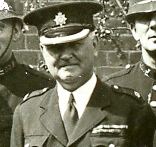
Superintendent Ernest Bernard Spicer
Promotion To Acting Superintendent And A Further Transfer.
On the 1st October 1937 Ernest was promoted to the rank of Acting Superintendent and received an increase of pay from £350 to £400 an annum. On the 20th October 1937 he was transferred from C Division at Watford to B Division at Hertford.
On the 1st October 1938 he was confirmed in the rank of Superintendent and received an increase of pay from £400 to £447/10/0 per annum.
Burglar Arrested.
Published on the 4th August 1939 in the Hertford Mercury under the headline Alleged Housebreaking at Welwyn: “I should like bail. My wife is not well she is going to have a baby. I have some money I want to give her.” Said Leslie Hornett aged 23 of 70, Wendell Road, Shepherds Bush, W. at a special court at Welwyn on Friday, when he appeared on a charge of housebreaking and larceny at Welwyn om July 12. Supt. E.B. Spicer said that in view of certain other enquiries he must object to bail. He had told the Governor of the prison that he had no objection to Hornett sending any money that was his own property to his wife. Hornett was then remanded in custody until Welwyn Sessions today (Friday). The only evidence taken was that of arrest. PC Hull of Bayford said that on Saturday July 22 he saw Hornett detained at Notting Hill Police Station. He brought him to Hertford Police Station. In reply to the charge Hornett was alleged to have replied, “I did it.”
In the 1939 Register Police Superintendent Ernest B. Spicer, his wife and daughter Barbara were all living at 155, Ware Road, Hertford. Their other daughter Hazel was employed as a Civil Service Clerk in the Air Ministry and was lodging with the Bryant family at 9 Wayside Crescent, Harrogate.
Pay Increases.
Ernest was awarded increases of pay on the 1st October of the following years. 1939 to £460 per annum, 1940 to £480 per annum, 1941 to £500 per annum, then on the 1st January 1942 he was awarded £540 per annum and on the 1st April 1945 £645 per annum.
Application To Become Chief Constable.
Another document provided by Bob Barton is a copy of a letter from Superintendent Spicer to P. Elton Longmore Esq., Clerk to the Standing Joint Committee, County Hall, Hertford, dated 11th June 1944, in which he applies to be considered for the position of Chief Constable, it reads as follows:
Sir,
I respectfully apply to be considered for the position of Chief Constable for the County of Hertford, and in support of my application, beg to state as follows:
I am forty nine years of age and was born on the 8th November 1894, at Watton-at-Stone, Herts. Where until the age of fourteen 1 attended school, and night school until I was sixteen.
I joined Kitchener’s Army on the 5th September 1914, being posted to the Bedfordshire Regiment.
In April 1915, as a Corporal, I was drafted to the 1st Battalion in France and remained with the Regiment until December 1917, reaching the rank of Company Sergeant Major. During the time I was with the Bedfordshire Regiment I was mentioned in despatches and awarded the Military Medal. I was also promoted Company Sergeant Major for Gallantry in the field.
On the 18th December 1917 I was gazetted 2nd Lieut. in the Norfolk Regiment, and on the 15th April 1918, again went to France where I joined the 9th Battalion of the Regiment.
On the 5th May 1918 I was appointed Intelligence Officer of the Battalion, and on the 14th August 1918, I was promoted Captain and Adjutant, a position I held until the 7th January 1919.
Whilst with the Norfolk Regiment I was awarded the Military Cross.
On the 7th January 1919, I was appointed Civil Staff Captain of the 9th Corps.
On the 9th Corps being disbanded I remained as Civil Staff Captain to the Civil Administration, until the 31st October 1919, when I was demobilised as I wished to join the Police.
On the 8th January 1920, I joined the Herford County Constabulary and after a course at New Scotland Yard, I passed the examination in the Theory and Practice of Criminal Investigation on the 10th December 1920.
After passing the necessary examinations I was promoted Sergeant on the 30th March 1923 and Inspector on the 1st April 1930.
On he 1st October 1937, I was promoted Superintendent and posted to the B Division, Hertford, where I am still serving.
I attach the name and addresses of three referees in support of my application:
1. Admiral Sir Murray Sueter M.P. House of Commons, London.
2. Lieut. Coln. Sir G.S. Church. St. Michaels, Hatfield.
3. Lieut. Coln. Lovel F. Smeathman D.S.O. M.C. Hemel Hempstead.
I am sir, Your Obedient Servant. Superintendent.
He was unsuccessful in his bid to become Chief Constable.
On the 1st September 1945 Ernest passed his 1st Class Police Driving test.
Police Long Service And Good Conduct Medal.
Published in the Hertford Mercury and Reformer on Friday 29th May 1953 under the headline: Police Presentations at Hertford. Medals For Long Serving Offices The Chief Constable of Hertfordshire Lieut.- Col A.E. Wilcox receiving his Long service award, for 23 years from the Lord Lieutenant the County the Hon. David Bowes-Lyon, at County Hall Hertford last Friday [22nd May 1953. Ed.].
Long service and good conduct medals were presented to 85 regular and pensioner members of the Hertfordshire Constabulary by the Lord Lieutenant of Hertfordshire the Hon. David Bowes-Lyon, at the County Hall Hertford on Friday.
The ceremony was attended by the chairman of the Standing Joint Committee Lord Farrer the chairman the County Council Brigadier E.H.L. Beddington, the Chief Constable Lt.- Col. A.F. Wilcox and members of the Standing Joint Committee.
Lord Farrer said the medals were awarded under Royal warrant to those members of the Force who had rendered long and meritorious service.
He only wished he said that possible to add another name to the list of those receiving awards. That was his predecessor, the former chairman of the Standing Joint Committee Lord Hampden, who served the committee for something like 30 years and was chairman at a time when many of those receiving awards joined the force.
He said that although the medals for long service were for 22 years’ exemplary service, many officers had served even longer, and no less than 15 had been with the police more than 30 years.
Pace Increased.
“Looking back over the past years everyone will agree that the pace of work in the police service has increased to a great degree,” he said. “Never has there been such a spate of legislation as in the last 10 to 15 years and the burden of enforcement has fallen on the Police.” “It is gratifying to note that in the figures presented to the Standing Joint Committee for the third quarter in succession crime shows a decrease.”
Lord Farrer said recruits were given more thorough and interesting training than 20 years ago, but it was experience that enabled the police to turn a blind eye to an infringement where a friendly warning served better than a summons.
Since the war he said a lot of men had joined the Hertfordshire Constabulary but the force was still below strength and the force had to rely on the older men to carry on the work.
Of the medals, he said they were ones of which the recipients might well be proud, and the Standing Joint Committee were glad of the opportunity of adding their thanks for loyal and faithful service the county to those who would be receiving them.
Among the recipients were two women Police Sergeants, both sisters who joined the Force together in Watford and Hitchin respectively.
After presenting the awards the Lord Lieutenant attended a meeting Of the Standing Joint Committee.
The Awards.
Local Police Officers receiving awards (with years of service in parenthesis) were: Superintendents E.B. Spicer, Hertford (33); W. Nicholas, Hatfield (24); Chief Inspectors L. Whittenham, Hatfield (33); R. Farrow, Hitchin (30); Inspectors R. Palmer, Ware (30); E. Childs, Bishop’s Stortford (30); N. Saunders, Hatfield (28);
Sergeants G. Jones, Hatfield (29); W. Clark, Hatfield (28); R. Ray, Stevenage (28); E. Cook, Buntingford (27); J. Pearman, Hatfield (26); S. Carter, Welwyn Garden City (26); F. Smith, Hatfield (26); D. Watson, Hatfield (25).
Constables R. Burgess, Hatfield (33); G. Brain, Much Hadham (32); A. Gibb, Bishop’s Stortford (31); R. Turner, Standon (29); C. Dennis, Welwyn (27); F. Harmsworth, Broxbourne (26); T. West, Buntingford (26).
Det.-Insp. A. Lewis, Hertford (30) Det.-Sergt. P. Perry, Hertford (29); Det.-Constable J. Pegram, Hatfield (33).
Retired Officers, ex-Sergeants J. Parsons, Hatfield; G. Voller, Sawbridgeworth; W. Sales, Bishop’s Stortford; and ex-Constables J. Farr, Watton; G. Hilton, Aldbury; F. Turner, Stevenage; F. Wassell, Little Berkhampstead; V. Watson, Wadesmill.
Queen Elizabeth II 1953 Coronation Medal.
Ernest was awarded the Queen Elizabeth II 1953 Commemorative Coronation Medal.
Retirement.

Ernest Bernard Spicer c.1954
Ernest Bernard Spicer applied to retire on his 60th birthday on the 8th November 1954 having served 34 years ten months electing to be compulsory retired owing to his age. The Chief Constable accepted, and Ernest was awarded a pension of £660 per annum. He moved to “Rivelyn,” Willow Way, Radlett.
Ernest died of Coronary atheroma at home on the 18th February 1971 aged 76 years. His funeral was held at Radlett Parish Church at 3 p.m. on Thursday 25th February 1971 followed by cremation at Garston.




Add your comment about this page