
The Mysterious Death of Constable John Rapley
Hertford - 9th November 1856
Andy Wiseman

Introduction
On the morning of Sunday 9th November 1856, the population of Hertford woke to the news that a body had been found in the river Lea in the small hours. For it had been just as the Town Hall clock struck four, that a well kempt, 36 year old man, measuring 5’8″ in height had been pulled from the chilly water by the local police Superintendent. One can only imagine the rescuer’s shock and sorrow upon discovering that the lifeless figure he had hauled onto the bank, was one of his men; Police Constable John Rapley.
As the water seeped from his heavy clothes, Constable Rapley was carried into a nearby house. His shirt and great-coat were thrown open and first-aid was administered. A few minutes later, the local doctor arrived. Upon examining Rapley, he could find no signs of life and only the faintest of warmth around his heart. Death was pronounced and the cause swiftly attributed to suffocation by drowning.
With their rescue effort now abandoned, the forlorn figures stood around Rapley’s body turned their attention to a pertinent question. How had this respected, able bodied figure of sobriety, come to be in the river Lea? Theirs was a question which, despite a detailed investigation and lengthy coroner’s inquest, would never be fully answered; invoking a mystery which remains as intriguing nearly one hundred and sixty years later.
A brief career
John William Rapley was born in Shipley, Sussex on 28th May 1820. Although it is unclear precisely when he moved to Hertfordshire, he married Harriet Amelia Impey of Hertingfordbury, on 29th July 1843 at All Saints & Saint John’s church, Hertford. Shortly after their wedding the couple moved into a rented house, on Victoria Place, in the centre of the town. Seven years later, Harriet gave birth to a daughter who was named Emma. Their first son, John William, was born in 1852, followed by a second named Benjamin in 1855. The couple’s fourth child, a girl named Amelia Elizabeth, was born just a few weeks before her father’s untimely death in 1856.
It is likely that John Rapley joined the police in either 1852 or 1853. Prior to this, he had been a carman (driver of a horse and cart), employed by a Mr. Gripper. The police service he had joined was typical of the small borough forces, formed by local authorities across England in order to comply with the Municipal Corporations Act of 1835. The Hertford borough police force itself had been established on 21st January 1836 and served the county town only. In November 1856 the force consisted of just six men, including the officer in charge, Superintendent Thomas Knight. Knight had already commanded the force for well over a decade and resided with his family at the force’s one and only police station, on The Wash, Hertford.
On appointment, Rapley was allocated warrant number 4. His four colleagues were William Blythe, James Stebbings, Joseph Wray and Charles Dorset. Although his service was brief, there is every reason to believe that Rapley performed his duties well. In one obituary, he was described as a “good, quiet but effective officer”.
The investigation is launched
Rapley’s death had occurred some forty years before detectives, specifically trained in the art of criminal investigation, became a permanent component of policing in Hertfordshire. Consequently, it fell upon the force’s senior officer, Superintendant Knight, to apply his own primitive skills and experience to determine why the man he had pulled from the river had first entered it. Surprisingly, there is no evidence to suggest that the surrounding, much larger, Hertfordshire Constabulary (formed in 1841) offered or supplied Knight with any resources or expertise.
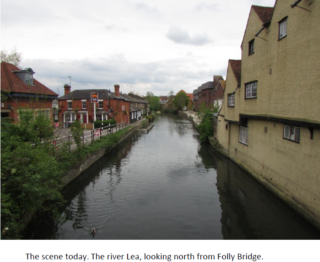
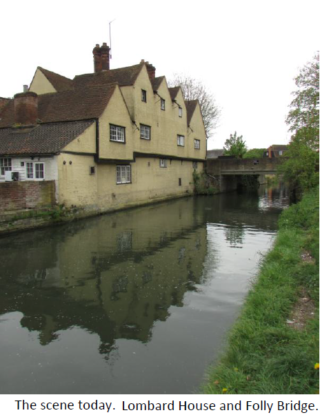
Knight’s own involvement in the case had been triggered by the sounding of a bell, in his private quarters at Hertford police station, at roughly quarter to four in the morning of 9th November. Knight’s sleep had been disturbed by Constable Dorset, alerting him to the fact that a body was in the river Lea. Knight immediately got dressed and grabbed his drag-lines. Waiting outside the police station were Mr. Joseph Pegram and his wife Mary. The couple, who lived in a house next to the river, explained that they had been woken by the cries of a man, who had been splashing around in the water. The Pegrams had initially gone down to the water’s edge, but been unable to see anyone. Having left the police station on Mill Bridge, Dorset and the Pegrams led Knight along Bull Plain and down to the Folly Bridge. The Pegrams then pointed to the spot, just north of the bridge, where Mary had first heard the frantic cries for help. In the absence of anything visible, Knight blindly threw his drag lines into the water behind Lombard House and steadily drew them back towards the bank. Meanwhile a bystander named George Hide, looked-on from the bridge. Incredibly, Knight’s first throw caught Rapley, who had been submerged under the surface for some forty minutes. Rapley was immediately carried into the Pegrams house, but failed to regain consciousness.
With Rapley confirmed dead, Knight reached for Constable Dorset’s police lamp and made his way back to the river bank, in the hope of finding anything which could help explain the tragedy. Knight found it too dark to decipher detail on the ground and quickly abandoned his search. He returned at first-light and immediately spotted a series of indentations in the grassy bank. On closer inspection, they appeared to be footprints. Of the three marks he could find, two were side-by-side, consistent with a man standing still and facing the water. Knight was adamant that they had been caused by Rapley’s boots, and measured them to be roughly a metre from the water’s edge. The third mark was only a partial shoe print, caused by a heel, located right on the edge of the bank.
Knight was certain that Rapley had caused each of these impressions and concluded that the front of his foot had been over hanging the water, when the third and final mark had been made. Knight was equally adamant that there were no impressions between the two footmarks and the indentation by the edge of the river, yet observed that the ground was so soft that even a child walking across it would have left a mark. Knight simply could not comprehend how or why Rapley had come to leave shoe-impressions, a metre apart and so close to the water’s edge.
Knight had been unable to identify anyone who had actually seen or heard Rapley enter the water. Whilst Mr and Mrs Pegram, sleeping in the closest building, had heard his cries and raised the alarm, they had only become aware of his presence once he had been in the water for some time. The nearest vessel on the river itself was a barge, moored roughly 60 yards south of where Rapley had drowned. The occupier reported that he had remained asleep throughout the entirety of the incident. As the weekend drew to a close, Knight’s enquiries had revealed few answers and even more intrigue. Naturally, a series of hypotheses started to take shape as a growing number of people asked, how had John Rapley ended up in the water?
Was it Suicide?
As far as could be deduced, John Rapley was happily married and doted on his four children. Colleagues and peers described him as a “cheerful”, “steady”, “strong”, “well-conducted”, “non-eccentric” man, who generally appeared to live in comfortable circumstances. The only recorded mention of ill-health had been made two years earlier, during a petty sessions hearing into a ditch which ran behind the Rapley household. During the proceedings, John and his wife gave evidence regarding the state of their water supply, which came from the Lea via the offending ditch. Over time, the conduit had become blocked with rubbish, excrement and the fowl waste products from a nearby slaughter house. Unsurprisingly, the Rapley’s reported that their health, and that of their children, had been severely affected. At the time of his death, Thomas Knight concluded that Rapley was of perfectly sound mind and confirmed he had never been known to display any signs of mental illness. In the absence of any evidence to suggest that he had intended to harm himself, the possibility that he had committed suicide seemed unlikely.
Was it an Accident?
Could it be that Rapley had accidentally fallen or wandered into the river? Despite the incident occurring in the dead of an autumnal night, the early hours of 9th November had been relatively light. Features such as paths and water had been easy to distinguish and there had been no fog hanging over the water. Furthermore Rapley’s police lantern was found to still be tucked firmly into his belt. He was no stranger to Folly Bridge or the river, having walked the same beat dozens, if not hundreds of times. Furthermore, the road on which he had been walking lay some distance from the water, with a soft verge in between. Equally, the presence of his shoe impressions, side-by-side, indicated that he had been briefly stood still and not walking. Consequently, the prospect of him simply strolling into the river by mistake seemed equally unlikely.
Could it be that he had fallen asleep whilst walking his beat and stumbled off course? Before joining the police, Rapley had been in the habit of walking long distances with his eyes shut, beside his horse and cart. More recently, he had been known to sleep on his beat, whilst leaning up against buildings. There can be little doubt that he was tired. His weekend of duties had commenced at 10pm on Friday 7th November, with a night-shift. In addition to the usual demands of a Friday evening, Rapley and his colleagues would be policing the town-fair for the entirety of the weekend. Having been on his feet for seven hours, he was relieved at five o’clock on Saturday morning. Having had just four hours rest, he returned to duty at 9am in order to preside over the herding of cattle through the town centre. Upon being stood-down at four o’clock, he was permitted to take more rest, before his Saturday night duty commenced at 9pm. It is unknown how much sleep he actually managed to get, during his brief periods of rest, in a house shared with three small children and a new born baby. Yet despite his long weekend and short breaks, the last person to see him alive reported that he did not seem overly tired; throwing some doubt on the suggestion that he had been asleep upon entering the water.
Was it Murder?
The theory that Rapley had been deliberately pushed into the water, certainly seemed to win favour with Superintendent Knight. Upon completing his assessment of the shoe impressions on the riverbank, Knight quickly concluded that it was a real possibility that Rapley had been pushed-in by someone stood behind him. Such force, exerted by a third-party, may well have caused him to stumble forwards suddenly and could account for the unusually large stride between the two sets of impressions. Rapley had almost certainly not been the victim of a robbery. The thought of a police constable being robbed whilst walking his beat, seemed in itself preposterous, but more importantly his pockets were found to still contain cash amounting to one pound, three shillings and three-and-a-half pence. Equally, there was no sign of a struggle. Rapley had been carrying a wooden staff for protection, which was found to still be in his pocket. Upon close examination, his body had shown no sign of an injury attributable to an assault. Equally, Knight reported that there were no obvious signs of a disturbance on the ground and nothing had been dropped. It is therefore likely that, if Rapley had been approached by a third-party, he had not perceived an imminent attack or offered resistance.
From the outset of his investigation, Knight had a suspect in mind. None other than George Hide; the very man who had been watching-on from Folly Bridge as Knight hauled Rapley’s body out of the water. Hide was a local man who lived with his wife, Eve, in Back Street and was renowned for his excessive drinking and boisterous antics. His staunch dislike of the police was also well known and a popular topic of conversation in the public houses and beer shops he frequented. Rapley had arrested Hide just ten days earlier, on suspicion of being drunk and disorderly and taken him to the police station. Hide had subsequently alleged that Rapley had thrown him into a cell, causing him to land heavily on the cold floor. Hide was later released, without charge. In the run-up to Rapley’s death, Hide had frequently expressed his contempt for him. On more than one occasion, he had turned up outside the police station and Rapley’s house, shouting threats and abuse.
It certainly seemed as though George Hide had the motive, means and opportunity to kill John Rapley. If convicted of murder, he faced almost certain execution. Consequently, the coroner’s inquest would be key in determining not only how one life had ended, but whether another should be taken.
The inquest
Just thirty-nine hours after Rapley’s body had been pulled from the Lea, the coroner, Mr T. Sworder, opened his inquest at the White Hart Inn, Hertford. Sitting beside him was a jury comprising fifteen men of the borough. Messrs Folkard (foreman), Simson, Lines, Sedgewick, Roberts, Roberts, Staples, Shippin, Hillingsworth, Mortlock, Tarrant, Neale, Latter, McMullen and Green commenced their service with a viewing of Rapley’s body.
The first witness to give evidence in the makeshift courtroom was the last person to see Rapley alive; his colleague and friend, Constable William Blythe. Blythe explained that he too had been on duty in the early hours of Sunday morning and had seen Rapley outside the Town Hall at around 1:45am. The two had spoken until 2am, when Blythe’s shift had come to an end. Rapley agreed to walk him home and the pair set off along Bull Plain and crossed the Folly Bridge. They had then carried on towards Hartham and arrived at Blythe’s house at around five past two. The pair smoked their pipes and chatted for a further ten minutes before bidding each other farewell. As Blythe turned to go inside, he saw Rapley heading back the way they had just come. Blythe confirmed that they had encountered no-one else during their walk from the town centre and that Rapley had seemed well. Finally, he described the conditions by the river as quite light, with no fog and the water itself being distinctly visible.
The second witness to give evidence was Mrs Mary Ann Pegram, who had been the first to realise that something was amiss. Pegram described how she had been asleep inside her address, close to the Folly Bridge and been woken at approximately 3am by a voice shouting “Oh pray save me!” This had been followed by a distressed cry of “I am in the river!” a few minutes later. Rooted to the spot with fear, Pegram listened intently and heard a sudden shriek, followed by the sound of paddling in the water. No more words could be deciphered. Now realising that she should act, Pegram attempted to wake her husband, but found him to be in such a deep sleep that it took her several minutes to do so. Eventually the pair clambered out of bed and made their way over to the bedroom window. There they heard the chilling, bubbling sound of Rapley attempting to breathe or talk under the water. Having dressed, the couple went downstairs and headed out into the night. Some fifteen minutes had now passed since Pegram had first woken and the water was silent once more.
In the absence of anything visible in the water, the couple had instinctively rushed to the house of a neighbour, William Stanbridge, and relayed their concerns. Pegram described how Stanbridge had refused to get out of bed, stating he was too unwell to help. Consequently, the couple had run up Bull Plain in order to fetch a constable from the police station. Pegram described how they had then stumbled across George Hide, who was stood on his own in the street. Upon being told that someone was in the river, Hide had discouraged them from fetching the police and recommended instead that they go and look for a hitcher on a barge and pull the person out themselves. The Pegram’s had ignored Hide’s suggestion and carried on to the police station as planned. There they alerted Constable Dorset, who immediately made his way to the scene.
Upon reaching the Lea, neither the Pegrams nor Dorset could see or hear anyone in the water, prompting him to suggest that they go back to the police station and notify Superintendent Knight. Pegram recalled that as they turned to leave, they each heard a voice shout from the other side of Folly Bridge, “Pack of rubbish. I have been round the riverside and it is quite still and there is nothing to be seen”. It was George Hide again, now loitering in the shadows and watching their every move. As the Pegram’s set off for the police station, Hide suggested that they abandon their efforts till morning. Again, his suggestion was rebuffed. Lastly, Pegram confirmed that she had witnessed Rapley’s body being pulled out of the water and estimated that this had been roughly half an hour after she had first heard him.
As his wife stepped down, Joseph Pegram was called to give his evidence. Unsurprisingly, his account largely corroborated that of Mary. Having described the moment he had been woken and the sound of Rapley trying to speak under the water, Pegram portrayed the conditions outside as “quite light” and “enough to distinguish the water”. In addition to Mary’s recount of them seeing Hide on Bull Plain, Pegram recalled that he had a stick in one of his hands and had initially appeared to be dozing.
The next witness to be called was Superintendent Knight, who began by recounting the moment he was informed of the unfolding tragedy. Having taken his drag lines with him down to the water’s edge, Knight had wasted no time in throwing them in, roughly twenty yards from the point where the Pegrams had plotted the last cry for help. Knight described how he had caught Rapley, first throw and pulled him out with the assistance of the Pegram’s and Dorset. Having carried him into the Pegram’s abode, Knight had undone Rapley’s clothes in the hope that it would assist him breathe. Knight had last seen Rapley alive, shortly before 1am, but had not spoken to him. He had also seen Hide, a few minutes past midnight, near to Old Cross. Hide had been singing, prompting Knight to remind him that it was a Sunday. Hide had stated that he would go home and was later seen by Knight to be hammering on his front door for some twenty minutes. Knight had again remonstrated with him, prompting Hide to say “You don’t know anything about my business. Revenge is sweet”. Knight admitted to then calling Hide a “Humbug”.
Knight then went on to describe Hide’s behaviour when he first reached the river with the Pergam’s and Dorset. Hide had initially said to Knight “There is nothing stirring in the river” and at the point when Rapley was pulled out of the water, he had said “That’s the man that locked me up, but there is an end to enmity now”. Knight described being annoyed by this and telling Hide to “Got about your business”. Knight then proceeded to describe to the court, his finding of the shoe impressions on the riverbank. He was then asked by the Coroner if he thought it possible that Rapley had been pushed in, to which he replied “certainly”. Furthermore, Knight explained that he considered it to be much more likely than the other explanation, namely that Rapley had suddenly sprung into the air from where he stood, leaving a gap of a metre between his footsteps. The Coroner himself then remarked that he knew of shaded places, near to where the incident occurred, where a person might hide himself so as to spring out on someone standing or walking by the river.
Realising that this was far from a simple case of drowning, the coroner declared that the matter should be adjourned until such time when all potential witnesses could be heard from. Shortly before the first day of the inquest was brought to close, the coroner asked that Constable Blythe be recalled. As Blythe took to the stand once more, he was asked about Hide’s movements during the evening before Rapley’s death. Blythe recalled that he had been in the police station, sometime between 8 and 9pm, when he became aware of Hide shouting in the street outside. Upon opening the front door, Blythe had been met by Hide saying “It isn’t you I want, it’s that dirty wagoner I want”. The jury were reminded that Rapley had driven a wagon before joining the police.
Having been adjourned for three days, the inquest resumed at 10am on Thursday 13th November, in the packed Council chamber at Hertford’s Town Hall. Sat amongst the teeming crowd in the public gallery was George Hide, who had presumably come to gauge his fate. Having recapped the evidence presented on Monday, the coroner broached the question of timings. By his own calculations, roughly an hour to one hour and fifteen minutes, between the time that Rapley left Blythe and was subsequently heard in the water, remained unaccounted for. The distance from Blythe’s house to the point where Rapley was found, could be covered on foot in just a few minutes. So had Blythe been mistaken over when he last seen him or had Rapley loitered or slept somewhere for an hour? Alternatively, had Rapley performed a complete circuit of his beat, bringing him back to the same place? In the absence of any witnesses to Rapley’s movements after his liaison with Blythe, this was just one of many questions which would remain unanswered.
The first witness to be called on Thursday was a local resident of Bull Plain, named John Chandler. He described being woken by George Hide shouting “my dirty servants”, shortly before a quarter to 4am on Sunday morning. Chandler also heard Hide say “water”, but was unable to say in what context. He had then heard another person running along Bull Plain and presumed that they were female. It is likely that this was Mary Pegram, running to the police station. No further questions were put to him and he was stood down.
Next to be called was Mr Alexander Ross. As the owner of the Highland Chief public house in Honey Lane, he had served George Hide alcohol during the afternoon of Saturday 8th. Ross’ attention had been drawn to a conversation Hide was having with another man, in which he again described Rapley as “The dirty wagoner”. Hide had also been overheard to say that he would “pull his dirty sack on his dirty back before long” and boasted that people would see him hanging with his “head on one side, outside the gaol before the end of March”. Finally he had told those around him that he was going to do “Something to be talked about”. Ross then divulged a piece of evidence that sparked sensation in the court. One day after Rapley’s death, Ross had seen Hide again, this time in The Red Lion public house on St Andrew’s Street. There he had said to Hide, “Well you have got rid of one of your dirty servants”, to which Hide replied that he had, boasting “the heavier the weight, the better they sink”.
With Hide’s comments requiring further probing, the licensee of the Red Lion, William Stevens, was called to give evidence. He confirmed that between 3 and 4pm in the afternoon of Monday 10th, his premises had been alive with talk of Rapley’s death. Hide had suddenly entered the premises, prompting someone to shout “Who murdered the policeman?” Hide had responded by blurting out, “He shoved me into the station house and I shoved him into the water”. As he said this, Hide had stooped and thrust forward his right shoulder, as if to recreate a shove. Stevens explained that Hide had then seemed to contradict his brag, by saying “if I had shoved him in, he would have made a bigger hole in the water than he did”. Hide had then vociferously criticised William Stanbridge for not coming to Rapley’s aid by saying, “If that dirty Stanbridge had got up and let us have the drags we could have got him out and saved his life after shoving him in the water”. Stevens claimed that Hide had said this again and again and again until he had repeated it some ten times. Hide had then allegedly gone on to criticise the Pegram’s for going to the police, rather than fetching a rope from a barge. Finally, he had blurted out, “When I was shoved onto the cold bricks, I did not cry for help, but when he fell in the soft water he called for help”.
If Hide had said this as Stevens claimed, then it could be damning. How would Hide have known that Rapley called for help, unless he had been there when he was still alive? The Pegram’s had stated on oath that Hide had come to the river only after the cries for help had stopped. Furthermore, Hide had told them, Knight and Dorset that the river was “quite still” and that there was “nothing stirring”. Stevens went onto to recount that once Hide had said, “when he fell in the soft water he called for help”, a man named William Welch had shouted across to him, “You won’t sleep with Eve tonight”. Hide had replied “I’ve got over many a job and I shall get over this, if there is no false witnesses in the way. About next March I shall be hung in front of that Gaol and I shall come out with a foot firmer than ever Thurtell did”. Stevens had known Hide for ten years and was certain that he had been sober when making these comments.
Next to be called was Thomas Smith, who had also been in the Red Lion that afternoon. He too stated that he had heard Hide say “The dirty servant pushed me into the station-house and I pushed him into the water” and seen him thrust his shoulder forward, in the manner described by Stevens. Equally shocking was Smith’s recollection of Hide saying to his audience “Boys, you can’t expect to get rid of five all at once. You must get rid of one at a time”. Smith alleged that Hide had repeated this comment at another public house, on Monday morning. Again, Hide was described as being sober on both occasions.
A brazier named William Welch, then took to the stand to describe how he had been in the Red Lion on Monday afternoon. Upon seeing Hide outside, Welch had suggested that he be called in. Once inside, Hide had said “The dirty wagoner shoved me in the dirty station-house and took my songs away. Revenge is sweet. I shoved him in the dirty water”. Welch recounted that he had been the one to say to Hide, “You won’t sleep with Eve tonight”, to which Hide had replied “Yes I shall if it aint for false witnesses”.
With four witnesses now stating that they had heard Hide seemingly admit to pushing Rapley into the water, he was becoming increasingly in need of an ally or at least someone who could divert the finger of guilt. It wasn’t to be George Bonfield; a local grocer who proceeded to describe how he had witnessed Hide hurling threats and abuse outside Rapley’s abode. Bonfield described how Hide had been on Victoria Place, near to where the Rapley family lived, at roughly half past eleven on Saturday night. Hide was drunk and was shouting, “Dirty number four. Where are you? I’ll get you out of that dirty blue jacket and get that dirty long whip into your hand again”. According to Bonfield, Hide’s tirade had lasted several minutes and had included “You dirty number four. I’m sorry for your poor wife and family”. The abuse had taken place roughly four hours before Rapley was found dead.
Superintendant Knight was then invited to present some additional evidence. Firstly, he confirmed that Rapley’s warrant number had been 4, which might explain Hide’s comments as heard by Bonfield. Knight then disclosed that Rapley had arrested Hide just ten days before his death, for drunkenness. Hide had spent roughly an hour and a half in the cells before being released on bail. The case had been heard in the Magistrates’ court, but was dismissed. Constable Blyth was also briefly recalled to offer his own experiences and opinions of George Hide. In doing so, he described him as a “half-madman”, responsible for making as much noise in the morning as he does at night. Blythe also alleged that he had specifically heard Hide shout “I want the dirty wagoner”, just a few hours before Rapley’s death.
Mr Thomas Robert Cullumpton Gooch, a gun maker from Bull Plain, then revealed details of an encounter he had had with Hide on Back Street, roughly five hours after Rapley’s body had been discovered. By which time, news of the tragedy was spreading across the town, prompting Gooch to say to Hide, “George, this is a bad job”. Hide had asked him what he was referring to. Gooch replied, “Poor Rapley”, to which Hide sneered, “Oh my dirty revenge is sweet”. Gooch described to the jury how he had been shocked by Hide’s response and reminded him that a woman was now widowed and four children were fatherless. Hide had responded by saying, “As for that, I feel for them, but the dirty rascal is dead”. Gooch had walked away, only to bump into Hide again twelve hours later, in the Wheatsheaf public house. By now, Hide was drunk and playing-up to an audience of roughly twenty other drinkers. Gooch described how at one point Hide rose to his feet and shouted, “We can play at hoop and shoving”. As he said this, he thrust his shoulder forward, in the same manner previously described by Stevens and Smith.
The next witness would be crucial in assisting the Coroner to conclude how precisely Rapley had died. Dr. Philip Reilly was a local surgeon, who had been called from his bed five minutes after Rapley had been pulled from the water. Having arrived at the Pegram’s house, he had examined Rapley and found there to be no signs of life. Reilly conducted an examination of Rapley’s torso at skin level and decided that any attempt to resuscitate him would be pointless. Rapley was then stripped and examined from head to toe. Reilly concluded that he could find no injury or marks, indicative of an assault but did observe a very small abrasion on his left cheek. Reilly had also observed a small trickle of blood coming from Rapley’s left nostril. Finally, he smelt Rapley’s mouth to determine whether there was any trace of alcohol. He concluded that there was not. Reilly confirmed that, in his opinion, death had been caused by suffocation through drowning. A member of the jury then asked Dr. Reilly, how long someone would have to be under the water, before resuscitation was deemed pointless. Reilly supposed that Rapley’s life may have been saved, had Superintendant Knight attended with his drags from the outset; as he had known of a case where a woman had been drowning in water for twenty-five minutes and survived. In Rapley’s case, the texture of his skin indicated that he had been in the water for almost twice as long and was therefore beyond help.
Then, a witness was called who could potentially throw significant doubt on any suggestion that Hide was to blame for Rapley’s death. Ironically it was a police officer. Constable David Wilbourn was employed by the Eastern Counties Railway and had spent Saturday evening on duty at Hertford (East) railway station. Around 3am, he had observed Hide loitering outside the Railway Tavern. It appeared to Wilbourn that Hide was under the influence of alcohol and was being verbally abused by two or three other people. Wilbourn had watched the group for ten minutes and was adamant that it was 3:10am when Hide finally slunk away. The station itself was located half a mile from the Folly Bridge and it would have taken roughly ten minutes to cover on foot. Wilbourn took his timings from the station clock, which was reputedly ten minutes slower than that on the town hall. Consequently, if Wilbourn’s evidence was accurate, Hide could have only feasibly got to Folly Bridge for 3:30am at the earliest; by which time the Pegram’s were already embroiled in their frantic rescue effort.
Next to be called was William Standbridge; the man whom Mr and Mrs Pegram had first run to for assistance, sometime between quarter and half past three. After confirming that he had told the Pegram’s he was too ill to assist in person, Stanbridge assured the court that he had called out that they were welcome to use his drags. Tragically, it would appear that this offer was unheard, as the Pegrams had left empty-handed. Stanbridge added that Hide had also been present and had taunted him by saying “Are you going to get up? There is a person in the water. If you don’t get up you shan’t have no peace!” As Stanbridge gave this piece of evidence, Hide could contain his silence no longer. Now up on his feet, Hide shouted across the room “No such thing. I was there after Pegram was gone. I could not get the hooks off Stanbridge or I could have got the man out, dead or alive before the police came”. The Coroner advised Hide to stop talking and assured him that he would be permitted to speak in good time. As Hide fell silent, Stanbridge continued and reiterated that Hide had been with the Pegrams, for roughly five or six minutes.
Before releasing Stanbridge, the Coroner asked Hide if he had any further questions for the witness. Hide took the opportunity to dispute Stanbridge’s evidence, saying “I was not there. Here is Pegram and his wife to state that I was not there. That is a proof Stanbridge was mistaken. I was at his house while Pegram was gone”. The only way to settle the disparity was to recall Joseph Pegram, who confirmed that Hide had not been with him when he first called on Stanbridge. Although not mentioned in his earlier testimony, he also revealed that he had called on Stanbridge a second time, after attending the police station. Pegram explained that it was during this latter visit to Standbridge’s house -after Constable Dorset had arrived on the scene- that Hide had indeed been present.
Next to give evidence was Rapley’s colleague, Joseph Wray, who was asked about Rapley’s general level of alertness when working night shifts. Wray confirmed that he had never seen Rapley walk in his sleep, but had seen him leaning up against buildings, apparently asleep. The Coroner was keen to understand more of Rapley’s duties and periods of rest, in the run-up to his death and recalled Superintendant Knight to elaborate on what he had been doing. Knight confirmed that Rapley had worked a seven hour night-shift from Friday, into Saturday. After five hours of rest, he had performed a further six hours of duty between 10am and 4pm. Having rested for another five hours, he had reported for his Saturday night-shift at 9pm. The Coroner refrained from making comment on whether he thought it excessive for Rapley to have worked 19 hours out of 29.
The last witness to be called was George Manser; a night-porter at Hertford (East) Railway station. He explained that on the Friday before Rapley’s death, he had seen Hide in a public house and heard him regaling fellow drinkers with the tale of his recent arrest. During which, Hide had referred to the police station as “The dirty station” and to Rapley as “The dirty wagoner”. Furthermore, he had allegedly said that he should have his “revenge on the dirty black legs” and suggested to his audience that they might see him hanged within six months. Manser was unable to say whether Hide was sober or drunk.
As the last of the sixteen witnesses was stood-down, Superintendent Knight informed the Coroner that two further witnesses were unavailable to give evidence. The first was an engineer on the railway, who had suffered an injury during a recent accident and was therefore unfit to attend the inquest. He had been expected to corroborate the evidence of George Manser. The second was James Chesher, who was otherwise engaged in Cheshunt. His evidence was said to similar to that of Mr Gooch.
Having heard all of the available evidence, the Coroner then turned to George Hide and asked, “I suppose you are aware that much of the evidence we have heard points to you?” Hide responded with “I am. And I can assure you that it will be a warning to me for the future. All I say and have said, only means joking. It has always been so with me, but I’ve been a little better lately. If anything, I’ve been as bad as a man could be to be alive. If I had done anything wrong, I would abide by the laws of my country and suffer any punishment”. Without addressing Hide further, the Coroner instructed the jury to retire and consider their verdict.
Roughly twenty minutes later, the jury returned and asked the Coroner to remind them of the evidence given by the Pegrams and Constable Blyth on Monday. The Coroner obliged and duly read out their testimonies. The jury then requested that Constable Dorset be called to give evidence, as the first police officer to be notified of the unfolding tragedy. Again, the Coroner obliged and called for Constable Dorset.
Having taken to the witness stand, Charles Dorset confirmed that Mary and Joseph Pegram had attended the police station, at approximately half past three on Sunday morning. He had immediately accompanied them to Folly Bridge and arrived there roughly three minutes later. Upon being unable to see anyone in the water, he had then hurried back to the station and woken Superintendant Knight. Dorset confirmed that he hadn’t stayed for any longer than a minute, before leaving the river to fetch Knight.
The Coroner then offered the jury his own calculation of time. It seemed as though everyone was in agreement that Rapley’s body was removed from the water just before 4am. Working backwards and taking into account the timings given by Knight, Dorset, Stanbridge and the Pegram’s, the Coroner concluded that Rapley had entered the water at twenty past three. This submission was disputed by one of the jurors, Mr Tarrant, whose own calculations suggested that Rapley had been in the water for no more than half an hour. Either way, it was agreed that Hide would have had sufficient time to get from the railway station to the riverside, in time to encounter Rapley alive. The jury then left the room to resume their deliberation.
The verdict
After twenty minutes of deliberation, the jury returned to announce their verdict. As the foreman, Mr Folkard, rose he warned the Coroner that they were not unanimous. The Coroner explained that it was not necessary for them to be so, providing at least twelve of them were in agreement. From within the jury, Mr Mortlock announced that more than twelve were in agreement, but this statement was immediately challenged by two other jurors. Sensing discord within the jury, the Coroner ordered that they retire again and confirm their position.
With the jury out of the room, the suspense felt by those left in the Council Chamber was momentarily broken by a chimney fire at the Salisbury Arms, visible through the windows of the Town Hall. Finally, after fifteen minutes of re-deliberation, the jury returned. This time they were unanimous. Having risen for the third and final time, Mr Folkard proceeded to announce the following: “The deceased was found drowned, but there is at present no evidence to show by what means he got into the water”. He added a proposal that the Coroner should lobby the Town Council, with a request for public drags to be kept in accessible places near to the river.
The Coroner agreed with their verdict, adding that it was the most proper judgment they could return, under the circumstances. In addition to there being a glaring lack of eye-witnesses to Hide actually pushing Rapley into the water, certain members of jury, particularly Messrs Sedgewick and Staples were adamant that David Wilbourn had provided Hide with a water-tight alibi; namely that he had been at the railway station when Rapley entered the water. With regards to the words, threats and perceived admissions, allegedly uttered by George Hide, the coroner concluded that they were no more than mere idle words, of little importance, uttered by a man who spoke of such things as part of his general character.
A relieved Hide rose to thank the coroner and was met with the following address: “You are not at all obliged to me. It is really quite shocking that you have placed yourself in so painful a position by the stupid manner in which you have gone talking about the streets, and the dreadful language you have used.” A meek Hide responded, “I never thought it would come to this. I never meant any harm. I had got no more animosity against him than against my own hand. Nor yet against a soul in the borough of Hertford”. At 2pm, the inquest was officially brought to a close and George Hide left the Town Hall without fear of prosecution.
Déjà vu
Barely a month on from Rapley’s death, on Tuesday 18th December 1856, a man named Stevens fell into the river Lea at virtually the same place. Stevens had become disorientated in fog and simply wandered into the water by mistake. Fortunately, he had been able to clamber out immediately and sustained no more than a ‘thorough wetting’. Tragically, not everyone would come out of the same situation quite so unscathed.
If the events of 9th November 1856 were starting to fade in the minds of Rapley’s colleagues and residents of The Folly, they were cruelly brought back to the fore, thirteen months later. For on Tuesday 8th December 1857, Mary Pegram heard the haunting sound of someone screaming and splashing in the river Lea again. Accompanied by her husband once more, Pegram went out into the evening to find that the air was filled with a fog so thick, that it rendered her candle virtually useless. From deep within the opaque haze, somewhere in the river, came three further shouts for help. Pegram called back, but there was no response.
Constable Wray, who was now living near to Folly Bridge himself, had also heard the commotion and gone to inspect. It would appear that the Jury’s previous request that drags be kept near to the river had been heeded, as Wray had some to hand and immediately cast them into the abyss. Wray could not see a thing and despite several throws of his drags, was unable to fish anybody out. Consequently he called on John Stanbridge, who had presumably recovered from his previous affliction. Stanbridge immediately join the rescue effort and threw his own drags into the water. Minutes later, he recovered the lifeless body of a middle-aged man. On closer inspection, the figure was found to be George Fry; a 58 year-old grocer from Hertford. Fry was dead and had drowned at precisely the same point in the river which had consumed John Rapley.
Just as before, the inquest fell to Mr Sworder to orchestrate and was attended by Superintendant Knight, the Pegram’s, John Stanbridge and Constable Wray. Sworder quickly concluded that Fry had drowned, accidentally, having become disorientated in the fog. The witnesses in Fry’s case, particularly Constable Wray, were highly critical of the fact that there was still no fence along the riverbank. Mr Sworder duly lobbied the Town Council, River Trustees and the Commissioner of Paving, to have fencing and a lamp installed at the place where two men had died and a third had nearly drowned. One hundred and sixty odd years on, the location has changed very little; other than the presence of potentially life-saving fence along the water’s edge.
Postscript
At 4am on 9th November 1856, the lives of Harriet Rapley and her four children were irreparably transformed. Harriet was now widowed and Emma, John, Benjamin and Amelia would have to grow up, having hardly known their father. On 16th November 1856 John Rapley was laid to rest in the town’s new cemetery on North Road. The very next day, his youngest child, Amelia was baptised at St Andrew’s church. The following month, Harriet began to receive a monetary subscription, funded by voluntary donations, that was said to exceed all expectations. Amongst the long list of contributors were the local Mayor, Member of Parliament and The Marquess of Salisbury. Further donations soon followed and were collected by Thomas Knight. Harriet later remarried and lived until 1899. Amelia outlived her other siblings and died in 1932.
The Hertford Borough Police force was disbanded on 1st April 1889. On that day, its nine officers, equipment and headquarters were compulsorily absorbed into the much larger, Hertfordshire Constabulary. Despite its size and relatively brief existence, the Hertford Borough police force is still recognized as the first official police service in the county of Hertfordshire.
Having been all but forgotten about for over 150 years, John William Rapley’s name was added to the National Police Roll of honour in 2014. He is now officially recognised as one of twenty-two police officers who have lost their lives whilst serving the public of Hertfordshire. On 10th November 2024, Charlie Hall QPM, the Chief Constable of Hertfordshire, unveiled a permanent memorial to Pc Rapley on Folly Bridge, near to the spot where he died.






Add your comment about this page
We noticed the plaque placed in honour of PC Rapley and were interested to discover more about him and have since read this very interesting and detailed account of his death. We found this very moving and do hope his death was indeed a tragic accident. One wonders what became of George Hide and could current day forensic science have altered the verdict.