
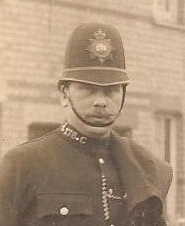
Early Life.
David Augustus Lilley was born on the 23rd January 1887 at Burloes Hall, Barkway and he was Baptised on the 28th August 1887 in Barkway.
His father, also called David Lilley, married his mother, Jemima Ann Gosling at Welwyn on 15th June 1872. They had seven children who were:
1. Edith Elizabeth born and died 1873 in Dunmow. 2. Woolaston John in 1874 at Dunmow. He served in Royal Marine Light Infantry then as Private 41252 1st Battalion, Suffolk Regiment (WW1) and Lance Corporal 1033 Military Foot Police. 3. Louisa Sarah Ann born in 1876 at Welwyn. 4. Ferdinand Whittaker born in 1878 at Hitchin. He served in the Prince of Wales Own (West Yorkshire Regiment) in the Boer War. He was PC 241 in the Hertford County Constabulary between the 10th June 1903 and 10th June 1928. 5. Harriet Robina born in 1880 at Hitchin. 6. Ada Lillian born in 1883 at Royston. 7. David Augustus
At the time of the 1881 census the family were living at Cuckolds Cross, Kimpton with David senior working as a Gamekeeper. He was having to care for Woollaston, Louisa and Ferdinand by himself as Jemima and Harriet were visiting her sister’s home at 3, Park Terrace, Maple Road, Penge, Croydon.
In the 1891 census the family had moved to Whitecroft Road, Meldreth, Royston. David senior is still employed as a Gamekeeper. Jemima is missing and he is shown as a widower which is contradicted by the 1901 census. David senior is certainly caring for Louisa, Ferdinand and Ada by himself whilst his parents are looking after Harriet and the younger David at their home at Cambridge Road, Stansted.
By the time of the 1901 census David senior, who is now a Foreman for the Urban District Council, his wife Jemima and David junior are living at Leicester Cottages, 3, Nightingale Road, Hitchin.
Jemima Lilley died in 1903 at Hitchin and David senior married a Lucy Halworth in 1905 at Hitchin. In the 1911 census they are living at 16, Trevor Road, Hitchin and David senior was employed as a Road Foreman. David junior had left home and joined the Army.
Early Army Service.
On the 10th March 1903 David Augustus Lilley was Attested at Hertford into the Militia as Private 4548 in the 4th Bedfordshire Regiment signing up for 6 years.
The following information was recorded: He stated he was born at Royston and his age was 17 years 3 months. His address was 48, Whinbush Road, Hitchin and he was employed as a labourer by T. Blood of Hitchin. He was not an apprentice, not married, had no children and had never been sentenced to imprisonment. He said he was a member of the 1st Herts Volunteers.
He was medically examined at Hertford on 16th March 1903 where the following was recorded:
Apparent Age: 17 years 3 months, Height: 5 feet 7 ½ inches, Weight: 122 lbs, Chest: 32 ¾ – 34 ½, Complexion: Fair, Eyes: Blue, Hair: Light brown, He had no distinctive marks. Religion: Church of England.
Next of kin was given as his father, mother and brother Ferdinand of 48, Whinbush Road, Hitchin and older brother Woolaston of The Royal Sussex Regiment.
The final entry states that on the 2nd October 1903 he joined the Bedford Regiment.
His main Army Service Record has not survived but from his Police Service Record he must have transferred to the 2nd Battalion, Suffolk Regiment as he stated that he served with them for 7 years and 11 months, in all likelihood having signed up for short service of 12 years. He was Discharged to the Reserves on 1st October 1911.
During the 1911 census Lance Corporal David Lilley, Suffolk Regiment is listed as living at McGregor Barracks, Stanhope Lane, Aldershot.
Perhaps anticipating his move to the Army Reserve David applied to join the Hertford County Constabulary.
Police Service.
David’s Form 3 Hertford County Constabulary Record Sheet has survived but, unlike his Militia Service Record where he used his full name, he dropped his middle name of Augustus, and simply used the name David Lilley.
He gave his age on joining as 24 11/12 years and his place and date of birth as Royston and the 23rd January 1884. His height was recorded as: 5 feet 10 inches, Chest: 38 inches, Complexion: Fresh, Eyes: Blue, Hair: Dark brown, Marks: Tattooed soldier, gravestone and star left forearm. He gave his religion as Church of England and his next of kin as David Lilley 6 Trevor Road, Hitchin which was later amended to his wife. He stated that he could both ride a cycle and swim. Before joining the Army he was employed as a labourer.
He must have been on leave prior to being transferred to the Army Reserve as he was medically examined on 31st July 1911 by the Police Surgeon Lovell Drage who signed the following certificate – I hereby Certify that I have examined the above Candidate as to his health and bodily strength and consider him fit for the Constabulary of this County. He was probably interviewed the same day at Hatfield Police Headquarters.
His interview clearly went well as he started his Probationary Training at C Division Watford, on the 24th August 1911 earning £1/1/7 per week. At this time all training was undertaken on Divisions and not at Headquarters and it appears you had to pass your training before being Appointed as a Constable.
Somewhat oddly though he was Attested, being Approved of and Sworn in before J.F. Watkins J.P. and H.J. Prouse J.P. on the 10th October 1911 at Watford. On the completion of his training he was Appointed as Police Constable 92 on the 26th November 1911. His pay was increased to £1/3/11 per week and he remained at C Division Watford living at St. Albans Road Police Station.
Pay Increases.
On the 30th May 1912 David’s pay was increased from £1/3/11 per week to £1/5/8 per week and from the 1st October 1912 it was increased again to £1/6/3 per week this time as part of a national award.
A Slight Mishap.
On 21st June 1913 David was severely reprimanded and his salary reduced to £1/5/8 per week for failing to attend a Conference Point, contrary to Standing Order No. 6 and for failing to book on and off duty in the Duty Register, contrary to Standing Order No. 26. [As far as the seriousness of these offences are concerned they are relatively low key. Ed.]
Pay Reinstated.
On the 23rd July 1913 David’s pay was reinstated to £1/6/3 per week.
Marriage.
On the 26th July 1913 David married Darnetta Mary Whitlock at Woburn. She was born on the 25th June 1886 at Woburn Sands. In the 1911 census she was employed as a domestic housemaid living with and working for a family by the name of Harper of Nascot Lawn, Langley Road, Watford. They had two sons, David William born on the 15th September 1915 and Reginald John born on the 15th July 1918 both born at Garston.
Transfer.
David’s Police Service Record shows that on the 31st July 1913 he was transferred from C Division Watford to C Division at Garston.
Another Mishap.
On the 14th October 1913 David was again severely reprimanded by the Chief Constable for improper conduct at Abbots Langley on 20th September 1913.
Pay Increase.
David passed his Ambulance Certificate in November 1913. This was important as it was a First Aid qualification which allowed him to wear a badge on his lower left tunic sleeve. Obtaining the badge was often linked as to whether or not you received a pay rise. On the 26th November 1913 David’s pay was increased from £1/6/3 to £1/6/10 per week.
Recalled To Active Service.
Following the start of the First World War, being an Army Reservist, David was recalled to the Colours for active service on 4th August 1914.
General Order 118 of 21st July 1915 is a list of 96 officers which included the Chief Constable, 43 Constables who were Army reservists who were recalled and 50 Constables and 2 Sergeants who volunteered for military service. David is shown as PC 92 Lilley D. C Division recalled to 2nd Battalion Suffolk Regiment on 4th August 1914.
Army Service During The War.
From his Medal Roll Index card and Medal Rolls we know that David, as Lance Corporal 7667, landed in France with the Suffolk Regiment on 15th August 1914.
On the 3rd September 1914 Lance Corporal 7667 D. Lilley, Suffolk Regiment, was listed as being at the Second Southern General Hospital, Bristol. He was entitled to wear a “Wound Stripe” as authorised under Army Order 204 of 6th July 1916. The terms of this award being met by his being named in this list.
His family believe this wound was either caused by a gunshot or shrapnel to a hand at the battle of Le Cateau.
As a consequence, he was also awarded a Silver War Badge the record for which states he was discharged from the 3rd Battalion, Suffolk Regiment as Lance Corporal 7667 on the 24th December 1914. His badge, number 145412, was issued on 10th March 1917 and the cause of his discharge was given as: Wounds Paragraph 392 (xvi) King’s Regulation 1912.
He was also awarded the 1914 Star and the British War and Victory medals. he was Discharged from the Army Reserve on the 30th September 1915. [Almost certainly being the 12th anniversary of his original enlistment. Ed.]
Re-joining The Police.
Before David could re-join the Police, he would have had to have had a medical to ensure that he was still fit enough to perform the duties of a Constable. Whatever the exact degree of his injury was it was clear that he was passed as fit which is proved by the following General Order.
General Order 5 of 6th January 1915 Reservist Police Constable David Lilley 178 of C Division on return from Active Service in the Army, is re-appointed as a Constable, as from 25th December 1914. His Police Service Record shows he resumed his role at Garston.
Something of note in this Order is the change in his Warrant or Collar Number from 92 to 178. Prior to the outbreak of war, it was fairly common to issue the same Warrant Number to more than one individual providing they were posted to different Divisions so that the Divisional letter would differentiate between them. No record of an Order instructing that this should end and that Warrant Numbers should become unique has been found, but it was obviously issued simply by the fact of the number of returning Constables who were not given their old number, as someone else was already using it, and were issued with a new one.
Pay Rises.
The following General Orders informed David that he would receive an increase in the rate of his weekly pay:
Order 32 of 27th February 1915 from £1/6/10 to £1/7/5 from 25th November 1914.
Order 189 of 8th December 1915 from £1/7/5 to £1/8/0 from 26th November 1915.
Order 141 of 28th December 1916 from £1/8/0 to £1/9/2 from 26th November 1916.
Order 1 of 1st January 1918 from £1/9/2 to £1/9/9 from 26th November 1917.
His Police Service Record shows that on the 1st July 1918 he received a rise in his pay to £2/9/0 per week as part of a national increase.
Order 140 of 30th December 1918 from £2/9/0 to £2/10/0 from 26th November 1918.
Again, his Police Service Record shows that on the 1st April 1919 he received a pay rise to £4/4/0 as part of a national increase.
Order 235 of 4th December 1919 from £4/4/0 to £4/6/0 from 26th November 1919. Order 192 of 29th November 1921 from £4/8/0 to £4/10/0 from 26th November 1921.
The Electoral Rolls of 1919 to 1923 list David and Darnetta as living at St. Albans Road, Garston. The 1921 census shows David, Darnetta and their sons living at the Police Cottage, St. Albans Road, Garston.
Transfer.
General Order 1 of 2nd January 1924 informed David that as of the 14th January 1924 he was being transferred from C Division at Garston to D Division at Markyate, to occupy the cottage to be vacated by Constable 270 Lowe.
It was obviously a bad winter as General Order 6 of 13th January 1924 told David that owing to the inclement weather his move was suspended until 28th January 1924. The bad weather obviously lasted longer than anticipated as General Order 21 of 3rd February 1924 advised him that his move will now be carried out on 11th February 1924 and the contractors should be asked if their quotations still stood, if not fresh estimates had to be obtained. His Police Service Record shows that he did in fact transfer on the 11th February.
The Electoral Rolls of 1924 to 1926 show David and Darnetta Lilley living at 57 High Street, Markyate.
The General Strike.
General Order 117 of 29th August 1926 concerned the Emergency Regulations 1926 and instructions for 50 Hertfordshire Police Officers to be on standby should the Secretary of State call upon the County Force to draft men elsewhere. The first 20 named would be required to proceed at 8 hours’ notice or less. These included officers from A,B,C and D Divisions and it would appear to qualify to be amongst the 20 you needed to have a motor bicycle available. David was not one of the top 20 but his entry does show that he either owned or had access to a motorcycle.
General Order 132 of 5th October 1926 instructed David that on the 13th October 1926 he would be moving to occupy a new police cottage at Markyate. The Electoral Rolls of 1927 to 1930 list David and Darnetta as living at the Police Cottage, Pickford Road, Markyate.
Called Out.
General Order 140 of 18th October 1926 declared: EMERGENCY REGULATIONS 1926.
The following detachment of the Hertford County Constabulary is detailed for duty in the County of Derby as from 19th October 1926, inclusive:
There then follows a list of one Inspector, three Sergeants and 47 Constables which included PC 178 Lilley, D. of D Division at Markyate.
The detachment will proceed by nearest railway route to St Pancras, London Midland & Scottish Railway, reporting on the main departure platform at 2 p.m., when Inspector Digby will parade the party and call the roll. The detachment will proceed by the 2.25 p.m. train to Derby. On arrival at Derby, Inspector Digby will report to the representative of the Chief Constable of the Derby County Constabulary who will meet the train and provide omnibus transport to Ripley about 10 miles distant.
Dress: Greatcoats, cape, cloth jacket, 2nd cloth trousers, 1925 issue helmet, leggings, truncheons and handcuffs, woollen gloves, lamps, whistles and chains.
Divisional Superintendents will advance Railway fares if required and an account for same will be rendered to Headquarters Office for repayment. Inspector Digby will render a daily report direct to the Chief Constable’s Office each day, showing state of health of all members of the detachment and any matters of interest which may occur.
General Order 157 of 14th November 1926 THE EMERGENCY POWERS ACT, 1926. THE EMERGENCY REGULATIONS, 1926.
COAL STRIKE
The Chief Constable is gratified to learn that the services of the detachment of the Hertford County Constabulary added temporarily to the Derby County Constabulary, were satisfactory, and he has much pleasure in publishing the following extract from a letter received from the Chief Constable of Derbyshire, under date 11th November 1926:
Begins: “The detachment has done very good work and I will be grateful if you will be kind enough to convey to them my warm thanks for their services. I may say that Inspector Digby did very good work indeed and was of great assistance to my Ilkeston Superintendent. Will you also give him my personal thanks”. Ends.
If this letter from the Derbyshire Chief Constable seems a bit luke warm it transpires 10 of the Hertfordshire Constables suffered food poisoning after eating food which was supplied to them on behalf of the Derbyshire Police Authority. The Hertfordshire Force Surgeon said that their illness should be classed as an injury on duty and the Chief Constable agreed and said no one should suffer any stoppages from their pay.
Pay Rise.
David’s Police Service Record shows that on the 26th November 1928 he was awarded a pay rise from £4/10/0 to £4/12/6 per week.
Murder – Last Sighting Of The Victim.
Alfred Arthur Rouse was known as the Blazing Car Murderer who was convicted and subsequently hanged at Bedford Gaol for the November 1930 murder of an unknown man in Hardingstone, Northamptonshire.
This murder case became known as “the Blazing Car Murder” due to the fact Rouse, seeking to fabricate his own death, burned to death a hitchhiker whom he had rendered unconscious inside his car. The identity of the victim was never established, and despite recent DNA testing, his identity remains unknown.
The following excerpts are taken from the book “Trial of Alfred Arthur Rouse” edited by Helena Normanton, B.A.
Third Day, Wednesday, 28th January 1931 – Constable David Lilley was examined by Mr Elwes.
PC Lilley: I am a constable of the Hertfordshire Constabulary, stationed at Markyate. On 5th November I was on cycle patrol from 7 o’clock to 11.30 at night. I was on Watling Street at 11.15. Just passing the White Flag Tea Rooms, which are a mile south of Markyate, a small saloon car passed me. It stopped on its near side of the road about 160 yards ahead of me. I dismounted from my bicycle when within about 10 yards of the car, and I went to the off side of it. I had noticed that as the car stopped the rear lamp went out. I shone my lamp inside the car, and saw two men sitting on the front seat, the accused being on the driver’s seat. I said to him, Do you know your rear light is out?”
He replied, “I am sorry, officer. I must have put them out by mistake.”
PC Lilley: The lights were immediately switched on. I got on my bicycle again and had gone about 20 yards when I heard the engine of the car start up. The car then passed me and continued on its journey northward. The accused was dressed in a light coat and a trilby hat. The man that was sitting on his left hand side appeared to me to be about thirtyfive to forty years of age. He was a man of small stature, had an oval, pale face, and was dressed in a dark coat and trilby hat. I am not certain as to whether he had a moustache or not, but I think he was clean shaven.
Cross-examined by Mr. Finnemore:
PC Lilley: When I got to the car all the lights were out, the front as well as the rear; but I had not noticed that as I spoke to the man. It was drawn up on the left hand side of the road. Markyate is about 7 miles north of St. Albans, and this was about a mile from Markyate. The road there is called Watling Street.
Mr. Finnemore: That is the road one comes along if one is coming from London up to Northampton, or Leicester, or these towns up here?
PC Lilley: No, it is the main road from London to Birmingham. You turn to your right about 8 miles north of Markyate to get on this road, at Hockliffe. You then get on to the Northampton Road itself and then go pretty straight through. You get on to the Northampton Road about 8 miles from where I saw him. When I saw the lights were out, it was my duty to investigate and, if not satisfied that it was accidental, to make a report to see whether proceedings should be taken or not. I spoke to the accused, but not to his companion. After speaking to him I walked to the back of the car to see if the rear light was alight. I looked at the number, but I did not memorise it, nor did I write it down. I was perfectly satisfied with his explanation that the lights had gone out accidentally. When I spoke to him first and said the lights were out, he seemed to be surprised, and half raised himself in his seat and looked over the front of his car. As I was remounting my bicycle, I heard the two men conversing, but I do not know what was said. I was first asked about this incident on the Sunday following, the 9th November, at 7.16 a.m. I was told that Rouse had said at Hammersmith Police Station that he had been spoken to by an officer near St. Albans, or something to that effect. I did not have to speak to the occupants of any other car that night at all about their lights or anything. The accused was not wearing a hat, although he had one there.
Mr. Finnemore: They were both wearing hats. He did, in fact, have a wound in the war to his head, and I understand that he says that since then he has never driven in his car with a hat on. Do you think it is a matter about which you may be mistaken?
PC Lilley: No, I am quite certain they were both wearing hats.
The significance of his evidence was that David Lilley was the only other known witness, other than Rouse, who saw the victim alive and could describe him.
Pay Rise.
David’s Police Service Record shows that he received his final incremental pay rise from £4/12/6 to £4/15/0 per week on the 26th November 1933.
Retirement And Life After The Police.
David retired on Pension on the 25th November 1936 on completion of his 25 years’ service.
In the 1939 Register David and Darnetta and their son David are listed as living at 116, Chaul End Road, Caddington and he is shown as a Small Holder Poultry Farmer.
On the 11th March 1963 David Augustus Lilley of 116, Chaul End Road, Caddington died at St. Marys Hospital, Luton.




Add your comment about this page