
1980 Rhodesian Election
In 1965, a white separatist minority government led by Ian Smith’s Rhodesian Front unilaterally declared independence as Rhodesia. 15 years of international isolation and a guerrilla war with black nationalist forces culminated in a peace agreement that established universal enfranchisement and de jure sovereignty as Zimbabwe in April 1980. This was enabled by General Elections held in Southern Rhodesia in February 1980 to elect a government which would govern the country after it was granted internationally recognised independence as Zimbabwe, in accordance with the conclusions of the Lancaster House Agreement.
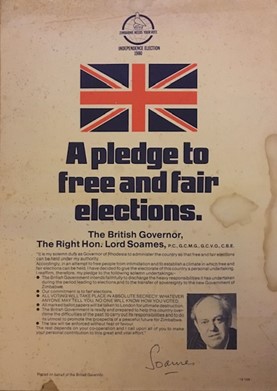


Of increasing concern to the then British Governor of Rhodesia, The Right Hon. Lord Soames, was the number of incidents of crime, banditry and escalating reports of political intimidation and violence in the run up to the election. This led him to request the deployment of regular and reserve security forces from the Commonwealth. Rhodesian Light Infantry units were placed on standby, in the event that Commonwealth Forces based in assembly areas needed support.
British Election Commissioners and Supervisors were sent, along with 581 British police officers to act as Assistant Election Supervisors, to monitor the fairness of the democratic process.
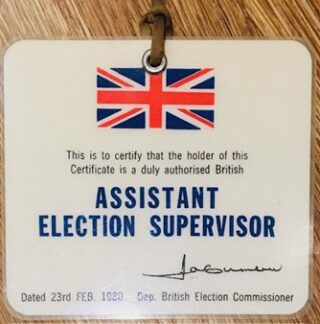
A total of seven officers from Hertfordshire Constabulary deployed with the British policing contingent as follows:
Police Constable 978 Jim BINYON – Rickmansworth Police Sergeant 768 Michael COTTON – Hertford Detective Constable Tom FARRELLY – Berkhamsted Police Constable 807 Colin KELVEY – Western Traffic Base, North Watford Police Constable 153 Chris MOULDER – Hertford Police Constable 1246 Richard PARFITT – Hemel Hempstead Police Sergeant 6 Dennis SMOKER – HQ Operations Room
The general elections were carried out in two stages with polling taking place from the 14th February 1980, and a second, “Common Roll” election scheduled for the 28th, 29th February and 1st March 1980.
The following summarises PC Chris Moulder’s role in the deployment:
On Friday 22nd February 1980 the seven officers gathered at County Police Headquarters, Welwyn Garden City and departed for Central Hall, Westminster where they were documented, issued with equipment and received briefings on the task in Rhodesia. All assembled officers received a personal address from the Home Secretary, The Right Hon. William Whitelaw, described as receiving rapturous applause by the assembled officers.
The first contingent of 300 officers including those from Hertfordshire were conveyed to Heathrow airport and flown to Salisbury, the capital city of Rhodesia (now Harare) via Nairobi, Kenya with impressive views over Mount Kilimanjaro.
On arrival the officers were moved to the Morris Depot, HQ of the British South African Police (BSAP), for further briefings, equipment issue and allocated tented accommodation for the night. Flooded out by torrential rain and following an early morning start the Hertfordshire officers returned to Salisbury Airport and were assigned to duties in the district of NKAI, approximately 160 miles southwest. After a 90 minute flight in an Air Services Botswana Dakota DC3 they were met by the NKAI District British Election Supervisor, Mr John HARRISON.
A tour of the area with local BSAP officers revealed a sparsely populated bush landscape with occasional ‘Kraals’ or small communities of the Matabele tribe. A number of Polling Stations would be established across the district and two Hertfordshire officers would be stationed at each. The living conditions varied and resulted in assigned stations being drawn out of a police helmet! PC Chris Moulder drew the Polling Station at ZWELABO.
An early morning convoy of 3-4 armoured vehicles provided an opportunity to observe the local countryside in which they would be operating, a vast flat bushland with kraals, some inhabited but many abandoned or burnt out.

Zwelabo was a large bungalow and rest camp used by the security forces, surrounded by wooden and earthwork stockade defences and a security fence. In normal times, this was the site of a cattle dipping station. On arrival a platoon of Rhodesian Defence Regiment were vacating the premises and had also removed much of the household equipment!
The staff at this location comprised the Election Presiding Officer from the District Commissioner’s office, Nigel WHITEHEAD, a 22 year old white Rhodesian and two police reservists, a Yorkshireman who had lived in Rhodesia for 23 years and served as the General Secretary of the Railway Workers Union and a South African, living in the country for 25 years.
The remainder of the staff were from the Internal Affairs Department and were responsible for security operations around the post and surrounding area.
Officers quickly established effective working relationships and team morale was high. But as neutral Election Supervisors care had to be taken to maintain the confidence of voters from local communities. As a result during the voting hours they would refrain from talking to the local police officers for fear of presenting a bias or favour towards one section of the community and therefore, suggestion of a political ‘side’.
The officer’s role included:
Preventing intimidation and supporting the welfare of those attending the polling station
Ensuring the party political agents acted lawfully and within the guidelines.
Responsibility for the the security and integrity of the ballot boxes 24 hours a day and their safe, unhindered, delivery back to NKAI
Impartial oversight of the ballot – wax sealing the ballot each evening when polling closed and breaking the seals in the morning to recommence the ballot. Each took place in the presence of party agents, who inspected the seals.
Maintaining order in the process – ensuring there were no repeat visits! Ultra-violet dye was used to mark the fingers of voters, identifying everyone casting a vote.
Wednesday 27th February was the first polling day and officers at Zwelabo were woken just after 0500 hours by the sound of a continuous hum from outside which was found to be several thousand people from across the district standing at the perimeter fence and waiting to cast their vote. Many appeared to have dressed up for the occasion and had travelled by any available means including lorries, tractors, trailers and ox-cart but the majority had walked great distances. Many carried sugar cane, corn on the cob and watermelons to sustain them through their journey and the day.
In the presence of the political party agents, officers unsealed the ballot box to allow the polling station to open for the day. After which the agents were not allowed within 200M of the station to prevent direct political interference or influence.
Voters were then allowed to enter the polling stations in groups of 12 using wooden constructed booths to cast votes in private. This continued each day until 1800 hours when the gates were closed. A long and tiring 11 hour shift for the officers and their first real experience of interacting with the local community.
Outcome
The result was a victory for ZANU, which won 57 of the 100 seats. Its leader, Robert Mugabe became the first Prime Minister of Zimbabwe when the country officially became independent from the United Kingdom in April.
Recognition
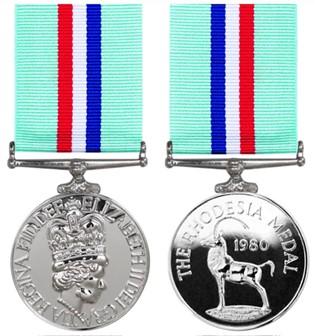
In August 1980 the Rhodesia Medal was initiated by the British Government and awarded to members of the armed forces, police officers and civilians who took part in Operation AGILA, the multinational peacekeeping force monitoring the transitional stages of Rhodesia’s independence in the run up to the elections. The medal was awarded for service between 1st December 1979 and 20th March 1980. The medal was to be worn after the Police Long Service and Good Conduct Medal in the order of precedence.
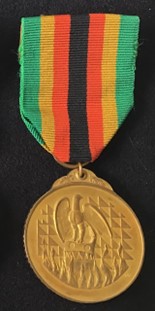
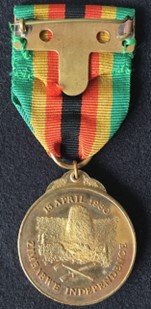
In December 1980 HM The Queen gave restricted permission to wear the Zimbabwe Independence Medal which was conferred upon police officers supporting the operation by the Government of Zimbabwe. This restricted permission allowed the medal or its miniature, to be worn only on occasions linked to the state of Zimbabwe and all occasions within Zimbabwe. On occasions when it may be worn, the Zimbabwe Independence Medal ranked after all United Kingdom and colonial medals..
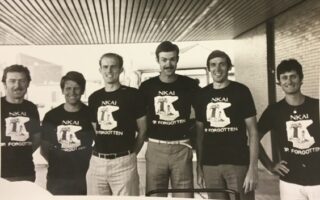
For those members of the District Commissioner’s staff, British South African Police and Rhodesian military personnel deployed to the NKAI area, the deployment was nicknamed as ‘Op Forgotten’. It transpired they felt forgotten in the bush, with no major towns or facilities nearby.
To celebrate this, they commissioned a picture depicting a police/military figure standing in the shade of a tree at the confluence of two rivers that flowed through the district. A t-shirt was produced with the artwork as a memento, which the Hertfordshire contingent can be seen wearing.
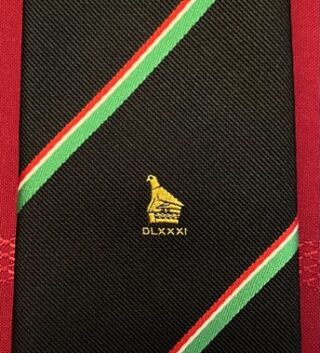
Below can be seen a tie issued to the ‘581’ officers taking part.
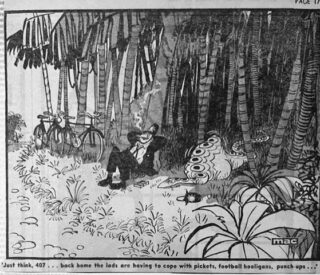
Mac, the Daily Mail cartoonist, probably summed up the view of officers back home!




Add your comment about this page
I was a Police Officer in the British South Africa Police in Rhodesia from 1976 to 1981. The UK Officers were sent on a fools errand as the election was a farce due to the majority of the black population being intimidated by Mugabe’s followers. They would never have realised that the intimidation had been set years previously. They don’t realise how dangerous their predicament was, although we were keeping a close eye on them for their safety however if violence had erupted they would have been sitting ducks!
Thanks, I still remember this deployment. I have a copy of my report relating to ‘my’ polling station, and the Op Forgotten t shirt. I received my medal but never had the tie?