
1802 Highwayman Hanged – James Blackman Snook.
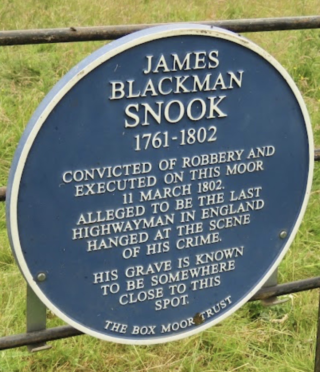
On Tuesday the 9th March 1802, a jury at Hertford Assizes found James Blackman Snook guilty of ‘feloniously assaulting’ and robbing John Stevens, a postboy carrying the Winslow, Wendover, Aylesbury, Tring, and Berkhamstead post bags between Tring and Hemel Hempstead. The robbery had taken place ten months earlier on the night of 10 May 1801.
In a ‘wanted’ notice published by the Postmaster General, Snook was described as about 5 feet 10 or 11 inches high, light brown hair cut short, his face pitted with Small Pox scars and between 30 and 40 years old. The Post Office offered a £200 reward for Snook’s detention, which was over and above the £100 reward provided by Parliament for the detention of highwaymen. The ‘Hue and Cry’ Police Gazette was one of the newspapers carrying the notice.
James Snook was detained in December 1801, after what was described as a ‘stout resistance’ on the road near Marlborough and upon him were found a brace of loaded pocket pistols.
Initially committed to Marlborough Gaol, he was taken for trail in Hertford on 9 March 1802. He was found guilty and ordered for execution on the morning of Thursday 11 March ‘near the place where the robbery was committed’. As a deterrent to others, Snook’s body was ordered to be suspended from a gibbet near the place of his execution.
The London Chronicle, December 1801 Transcript.
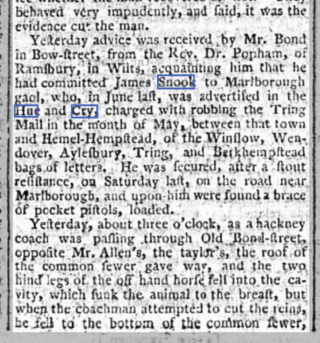
Yesterday advice was received by Mr. Bond in Bow Street, from the Rev. Dr. Popham, of Ramsbury, in Wilts, acquainting him that he had committed James Snook to Marlborough Gaol, who, in June last, was advertised in the Hue and Cry, charged with robbing the Tring Mail in the month of May, between that town and Hemel Hempstead, of the Winslow, Wendover, Aylesbury, Tring, and Berkhamstead bags of letters. He was secured, after a stout resistance, on Saturday last, on the road near Marlborough, and upon-him were found a brace of pocket pistols, loaded.
———-
The Hertfordshire Mercury, Saturday 27th October 1849 Transcript.
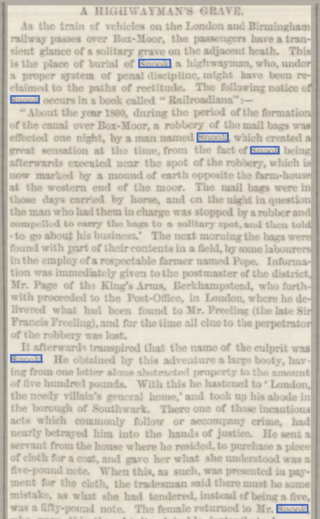
A Highwayman’s Grave.
As the train of vehicles on the London and Birmingham railway passes over Box Moor, the passengers have a transient glance of a solitary grave on the adjacent heath. This is the place of burial of Snook, a highwayman, who, under a proper system of penal discipline, might have been reclaimed to the paths of rectitude. The following notice of Snook occurs in a book called ‘Railroadiana’:
“About the year 1800, during the period of the formation of the canal over Box-Moor, a robbery of the mail bags was effected one night, by a man named Snook which created a great sensation at the time, from the fact of Snook being afterwards executed near the spot of the robbery, which is now marked by a mound of earth opposite the farm-house at the western end of the moor. The mail bags were in those days carried by horse, and on the night in question the man who had them in charge was stopped by a robber and compelled to carry the bags to a solitary spot, and then told to ‘go about his business.’ The next morning the bags were found with part of their contents in a field, by some labourers in the employ of a respectable farmer named Pope. Information was immediately given to the postmaster of the district Mr. Page of the King’s Arms, Berkhampstead, who forthwith proceeded to the Post-Office, in London, where he delivered what had been found to Mr. Freeling (the late Sir Francis Freeling), and for the time all clue to the perpetrator of the robbery was lost.
It afterwards transpired that the name of the culprit was Snook. He obtained by this adventure a large booty, having from one letter alone abstracted property to the amount of five hundred pounds. With this he hastened to ‘London, the needy villain’s general home,’ and took up his abode in the Borough of Southwark. There one of those incautious acts which commonly follow or accompany crime, had nearly betrayed him into the hands of justice. He sent a servant from the house where he resided, to purchase a piece of cloth for a coat, and gave her what she understood was a five-pound note.
When this, as such, was presented in payment for the cloth, the tradesman said there must be some mistake, as what she had tendered, instead of being a five was a fifty-pound note.
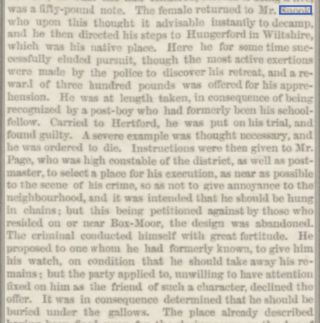
The female returned to Mr Snook who upon this thought it advisable instantly to decamp, and he then directed his steps to Hungerford in Wiltshire, which was his native place. Here he for some time successfully eluded pursuit, though the most active exertions were made by the police to discover his retreat, and a reward of three hundred pounds was offered for his apprehension. He was at length taken, in consequence of being recognized by a postboy who had formerly been his school fellow. Carried to Hertford, he was put on his trial, and found guilty. A severe example was thought necessary, and he was ordered to die. Instructions were then given to Mr. Page, who was high constable of the district, as well as post-master, to select a place for his execution, as near as possible to the scene of his crime, so as not to give annoyance to the neighbourhood, and it was intended that he should be hung in chains; but this being petitioned against by those who resided on or near Box Moor, the design was abandoned.
The criminal conducted himself with great fortitude. He proposed to one whom he had formerly known, to give him his watch, on condition that he should take away his remains; but the party applied to, unwilling to have attention fixed on him as the friend of such a character, declined the offer. It was in consequence determined that he should be buried under the gallows.
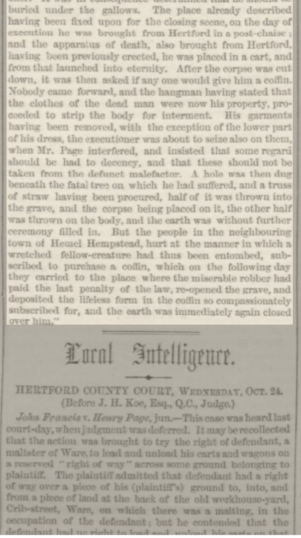
The place already described having been fixed upon for the closing scene, on the day of execution he was brought from Hertford in a post chaise ; and the apparatus of death, also brought from Hertford, having been previously erected, he was placed in a cart, and from that launched into eternity. After the corpse was cut down, it was then asked if any one would give him a coffin. Nobody came forward, and the hangman having stated that the clothes of the dead man were now his property, proceeded to strip the body for interment. His garments having been removed, with the exception of the lower part of his dress, the executioner was about to seize also on them, when Mr. Page interfered, and insisted that some regard should be had to decency, and that these should not be taken from the defunct malefactor. A hole was then dug beneath the fatal tree on which he had suffered, and a truss of straw having been procured, half of it was thrown into the grave, and the corpse being placed on it, the other half was thrown on the body, and the earth was without further ceremony filled in. But the people in the neighbouring town of Hemel Hempstead, hurt at the manner in which a wretched fellow-creature had thus been entombed, sub-seribed to purchase a coffin, which on the following day they carried to the place where the miserable robber had paid the last penalty of the law, re-opened the grave, and deposited the lifeless form in the coffin so compassionately subscribed for, and the earth was immediately again closed over him,”




Add your comment about this page