

Orders and Instructions for the Hertfordshire Constabulary Force
In 1846, Chief Constable Lieutenant-Colonel Archibald Robertson issued his “orders and instructions framed and issued for the constables of the Hertfordshire Constabulary”. These instructions defined the core duties, behaviour and conduct and the powers of arrest of the newly established county force.
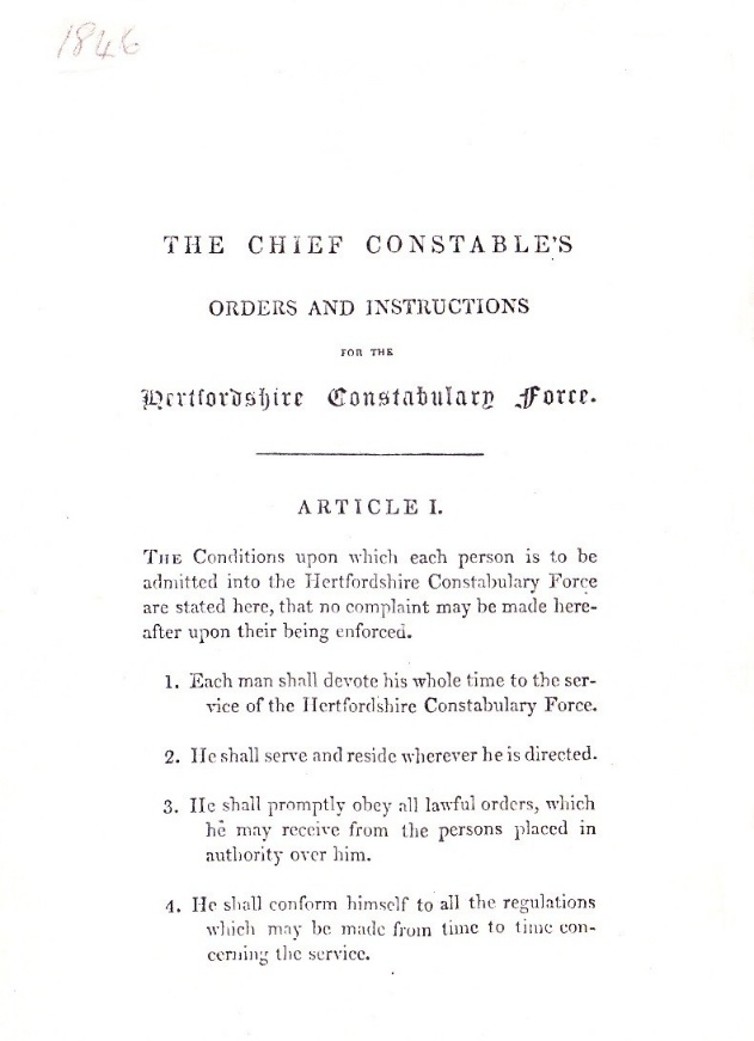
The Chief Constable’s
Orders and Instructions
For the
Hertfordshire Constabulary Force
Article 1.
The conditions upon which each person is to be admitted into the Hertfordshire Constabulary Force are stated here, that no complaint may be made hereafter upon their being enforced.
1. Each man shall devote his whole time to the service of the Hertfordshire Constabulary Force.
2. He shall serve and reside wherever he is directed.
3. He shall promptly obey all lawful orders, which he may receive from the persons placed in authority over him.
4. He shall conform himself to all the regulations which may be made from time to time concerning the service.
5. He shall not on any occasion, or under any preference whatsoever, take money from any person without the express permission of the Chief Constable in writing.
6. He shall receive his pay on such days as shall be appointed.
7. He shall allow a deduction to be made from his pay when lodgings are found for him.
8. He shall not quit the Constabulary Force without giving one calendar month’s notice in writing; in case he quit without such notice, all pay then due shall be forfeited. If he be dismissed the Hertfordshire Constabulary Force, the whole of his pay then due or unpaid is forfeited.
N.B. By Act of Parliament, a Constable is further liable to one month’s imprisonment for quitting the Force without giving a month’s notice.
9. If any member of the Constabulary Force shall be absent from duty in consequence of ill health, the Chief Constable shall exercise his pleasure as to stopping any portion of his pay during such sickness.
10. Such debts owing by any of the Constabulary as the Chief Constable shall direct to be paid, shall be paid by them forthwith.
11. Each person in the Force is liable to immediate dismissal for unfitness, negligence, or misconduct, or the Chief Constable may punish him by suspension or fine.
12. Every member of the Constabulary Force will be prohibited from interfering, directly or indirectly in any election for Members of Parliament.
13. All persons are to consider themselves for the first 56 days after entering the Hertfordshire Constabulary Force on probation, and consequently will not be clothed earlier than the Chief Constable may deem desirable.
14. No member of the force shall keep a dog, pig, fowls, or any description of stock.
15. All clothing, appointments, or stores, which my be lost, damaged, o spoilt, while in the possession of the person to whom they were issued, shall be made good by him out of his pay.
16. Every man dismissed from the Hertfordshire Constabulary Force, or who shall resign his situation, shall, before he quits the service, take and deliver up every article of dress and all appointments which have been supplied to him, into the hands of the Superintendent or Inspector of his own Division at the residence of such superior officer.
Pay and Clothing.
1. Pay will be issued to the Constabulary once each fortnight when all debts due by them must be discharged.
2. Any constable who shall not have received the exact amount for which he has signed the pay-sheet, three days after it is due, must report the same by letter direct to the Chief Constable, or he will be dismissed. The officers of every rank are forbidden on pain of dismissal, to borrow, or to lend money one to the other.
3. Any member of the force who is reported as habitually in debt shall be dismissed.
4. A deduction of fourpence a week is made from the pay of each constable, according to Act of Parliament, towards a superannuation fund.
5. The usual clothing will be issued to the Constabulary once in every year, it is to be understood that no part thereof will at any time become the property of the constable, but all must be delivered over by him should he leave the force, or otherwise disposed of as may be directed.
6. Eighteen-pence a month per man, will be allowed in lieu of boots, and each constable must at all times be provided with two serviceable pairs.
7. All police officers attending Assizes or Quarter Sessions in any capacity, must appear in full uniform and without great-coats; they must be clean and neat and well shaved, they must stand upright in the witness box with their hands down, and never lean or loll against the sides, they will give ready and distinct answers to the counsel on both sides, any laughing or impertinent conduct will on no account be allowed, constables before being called to give evidence in court should refresh their memory from notes of the circumstances taken by them at the time of the examination before the magistrates, but such notes are never to be produced in curt unless called for.
8. Constables are at all times to be dressed in their uniform, unless directed otherwise by a superior officer.
9. Each constable will be required to provide himself with a decent suit of plain clothes to be worn when so ordered.
10. No alteration whatever is to be made in the uniform issued to the Constabulary.
11. The great coat is never to be worn on patrol over the best body coat, and the cape is invariably to be carried by the constable when there is any appearance of wet, or when he has to proceed further than his own beat during the winter months.
12. Each constable will, on the first day of meeting in every month, bring with him to the station, for inspection, his staff, lantern, handcuffs, rattle, and instruction book. He will at the same time, wear his great coat, old body and old trousers. On the second day of meeting in the month, he will come in his new coat, best trousers, cape and belt (without other appointments. The Superintendent or Inspector will minutely examine each article, and report any deficiency, or want of repair.
13. During the night patrol the old clothing and hats are to be worn, and also by day in wet weather.
14. No constable shall use, or allow to be used the button marked “Herts. Constabulary” except on the uniform coat of the force.
15. All members of the Constabulary will have their hair cut, at least, once every month, nothing having a more slovenly appearance than wearing long hair with any sort of uniform.
16. The embroidery on the collar of the coat and great-coat must be kept perfectly clean and white, which can easily be done by using a small soft brush with soap and warm water.
17. No constable will be retained in the force whose appearance and clothing is not neat and clean, and superiority in this respect will give a claim to first class pay, without it no constable can ever hope for promotion.
Article 11.
The following Instructions for the Hertfordshire Constabulary Force are not to be understood as containing Rules of Conduct applicable to every variety of circumstances that may occur in the performance of their duty: something must be left necessarily to the intelligence and discretion of individuals; and according to the degree in which they show themselves possessed of these qualities, and to their zeal, activity, and judgement on all occasions, will be their claim to future promotion and reward. [S.1. Intelligence and Discretion Rewarded].
It should be understood at the outset that the principal object to be attained is THE PREVENTION OF CRIME. [S.2. Objects of the Constabulary].
To this great end, every effort of the Constabulary is to be directed. The security of person and property, the preservation of the public tranquillity, and all the other objects of a Constabulary Establishment, will thus be better effected than by committing the crime. This should constantly be kept in mind by every member of the Constabulary Force as the guide for his own conduct. Officers and Constables should endeavour to distinguish themselves by such vigilance and activity as may render it extremely difficult for any one to commit a crime within that portion of the district under their charge.
When in any division offences are frequently committed, there must be reason to suspect that the Constabulary is not in that division properly conducted. [S.3. Blame attributable.]
The absence of crime will be considered the best proof of the complete efficiency of the Constabulary. In Divisions where this security and good order have been effected, the officers and men belonging to it may feel assured that such good conduct will be noticed. [S.4. Index to, and result of, a proper performance of duty].
[S.5. Protect the public]. The Chief Constable wishes strongly to impress upon the mind of every person belonging to the Hertfordshire Constabulary Force, that it is their imperative duty to protect the liberty of Her Majesty’s subjects, not to outrage it; to defend their legal rights and privileges, not to infringe upon them; to keep the peace and carefully guard against being, even indirectly, necessary to breaking it.
[S.6. How to obtain advancement]. Every Constable in the Constabulary Force may hope to rise by activity, intelligence, and good conduct to the superior stations. He must make it his study to recommend himself to notice by a diligent discharge of his duties, and strict obedience to the commands of his superiors, recollecting that he who has been accustomed to submit to discipline will be best qualified to command.
[S.7. Obey orders]. He must readily and punctually obey the orders of his superiors: if they appear to him either unlawful or improper, he may complain to the Chief Constable, who will pay due attention to him; but any refusal to perform the commands of his superiors, or negligence in doing so, will not be suffered.
[S.8. Read instructions]. He should clearly understand what powers are given to him by law for the efficient execution of his duties; for this purpose he is recommended to read carefully the orders and instructions here given to him respecting the general duties of a constable.
[S.9. Local knowledge]. It is indispensably necessary that he should make himself perfectly acquainted with all parts of his beat.
[S.10. Knowledge of persons]. He will be expected to possess such a knowledge of the inhabitants of each house, as will enable him to recognise their persons he will thus prevent mistakes, and enable himself to render assistance to the inhabitants when called for.
[S.11. Patrol guard]. He is to patrol every part of his beat as often as practicable, unless it be necessary to observe the conduct of any suspected person, or for any other cause; in which case he will be required to satisfy his superior officer that that there was a sufficient cause for such apparent irregularity. He will also attend at the appointed times to make a report to his superior of any thing requiring notice.
[S. 12. Not to quit guard]. He is not to quit his beat during his tour of duty unless under the circumstances already mentioned, or others which may make it necessary; he shall not enter any house except in the execution of his duty; he will pay particular attention to all Public Houses and other places for the sale of liquor [S.13. Public Houses]. in his beat, reporting the hours at which each is closed, and whether they appear to be kept according to good order[1].
On no pretence shall he enter any Public House, shop, room, or other place for the sale of liquors, whether spirituous or otherwise, except in the immediate execution of his duty: such a breach of positive order will not be excused; the keeper of any such house, etc., is subject to a severe fine for allowing him to remain in his house; no liquor of any sort shall be taken from a Public House, etc., without paying for it at the time
[S.14. Nuisances]. If during the tour of his duty he observes in the streets or roads anything likely to produce danger or public inconvenience, or any thing which seems irregular or offensive, he must report it to his superior.
[S. 15. Insolence]. He will be civil and attentive to all persons of every rank and class; insolence or incivility will not be passed over.
[S. 16. Conversation]. While on duty he must not enter into conversation with any one, except on matters solely relating to his duty.
[S. 17. Interference]. He must be particularly cautious not to interfere idly or unnecessarily; when required to act, he will do so with decision and boldness; on all occasions he may expect to receive the fullest support in the proper exercise of his authority.
[S. 18. Command of temper]. He must remember that there is no qualification more indispensable to a constable than a perfect command of temper, never suffering himself to be moved in the slightest degree by any language or threats that may be used; if he do his duty in a quiet and determined manner, such conduct will induce well-deposed by-standers to assist him, should he require it.
[S. 19. Fire]. In case of a fire taking place, the constable on the spot will give immediate alarm by springing his rattle; he should as soon as possible send information to the Division Stations, and, until the arrival of some superior officer, from whom he may receive further orders; he will exert himself in any way likely to be most useful, as in keeping the space near the spot clear; assisting in removing property; sending to the nearest Stations for further aid; giving notice to the Fire Officers, Engine Keepers, Turncocks, etc.
[S. 20. Reward]. For his exertions upon these and other extraordinary occasions, the Chief Constable may recommend him for reward; but upon no pretence shall he receive a gratuity from any person for any thing relating to his duty; this will always be visited with immediate dismissal.
[S. 21. Concealment of number]. Any Constable reported for endeavouring to conceal his No., or refusing to show or tell it when asked, will be dismissed, as such concealment or refusal can only be caused having done something that he is ashamed of.
[S. 22. Not for striking a prisoner]. Constables are cautioned against unnecessary violence by striking a party in their charge; a constable must not use his staff because the party in custody is violent in his behaviour or language; the constable is always to bear in mind that in taking any one into custody, he is not justified in doing more than is absolutely necessary for the safe custody of the parties whilst conveying them o the Station House.[2]
[S. 23. Sticks] Constables will not be permitted to carry sticks or umbrellas.
[S. 24. To take the outside of the path]. Constables are always to take the outward side of the footpath; and it is particularly desired that constables when walking along the streets should not shoulder past respectable people, but give way in a mild manner. The more respectful and civil the Constabulary are, the more they will be supported and respected by the public in the proper execution of their duty.
[S. 25. Limits of guard]. Constables are warned against making known to any person the limits of the beat entrusted to their care.
[S. 26. Declare themselves]. Constables are cautioned to declare themselves before acting, more particularly at night.
[S. 27. Any person intermarrying with the family of a reputed bad character, or lodging in his house, or contracting an improper intimacy with him, will be dismissed the service.
[S. 28. Caution persons against loitering, etc.]. Constables will caution persons against assembling or loitering at the corners or other places in the streets, to the inconvenience or annoyance of the public, and also caution persons against riding or driving on the foot paths, and inform them that they are liable to a penalty for so doing.
[S. 29. Drinking during divine service]. Constables will caution all persons from brawling or making noises in the market-place or elsewhere during divine service, and give information against the keeper of any house for the sale of liquor, who shall permit drinking in his house or premises during divine service.
[S. 30. Instructions for the constable on hearing of a Robbery]. When the report of a robbery reaches a constable, he must forthwith proceed to the spot indicated, and there make every enquiry into the circumstances, taking a note of the description of articles stolen; he will endeavour to ascertain upon whom suspicion rests, and if any strangers have recently called at the house, or ben seen in the neighbourhood. In the case of a house robbery, he will judge from the manner in which it has been effected, whether the thief appears to have been acquainted with the premises, or is a stranger: this he will be enabled to do by observing if an entrance has been at once effected, or if doors or windows have in the first instance been ineffectually attempted to be forced; he must then closely examine the ground under the windows and around the house for foot marks, which are carefully to be observed; and after being measured, must be securely covered over with boards in order to preserve them. The direction taken by the thieves, both in coming to and going from the house is, if possible, to be ascertained; and for this purpose an examination must be made in the fields and lanes around the place, at the distance of 50. 100 and 200 yards. The constable will then enquire at all the beer-shops and public-houses in the neighbourhood as to what persons have called, or been lodging there; and having made a note of all these particulars, he will send a messenger to inform his superior officer fully of the circumstances, he himself continuing hi enquiries on the spot. In the event of very recent information, and where there is likelihood of overtaking the guilty parties, the constable will be justified in hiring a horse or other conveyance and proceeding in pursuit, but it must be remembered that in nine robberies out of ten, the thieves reside in the neighbourhood, and seldom live more than a few miles from the place robbed. In cases of fowl and sheep-stealing, much attention must be given to discover and measure all foot-marks in the surrounding fields and gaps; and in many cases this description of property is in the first instance secreted within a short distance of he place in hedges, covered ditches, woods, faggot, or corn-stacks, and not finally moved for a night or two. In cases where a sheep is slaughtered in the field, and the carcass skinned and carried off, the thieves almost invariably reside close at hand, the constable will therefore consider who are the most likely persons, and unknown to them will set a watch at night upon their houses to discover whether they leave them for the purpose of bringing home a potion of the meat. When sheep are missed, not having been so slaughtered, strict enquiry must be made as to the character of the shepherd, it being no very uncommon practice for sheep to be driven from one flock into another at a little distance; when, if no enquiry is made, or when it is past, the sheep so driven away is disposed of, and the proceeds divided between the two shepherds. The strictest enquiry must in such cases be made of the neighbouring flock-owners to ascertain whether stray sheep have entered their flocks.
The messenger who may be dispatched with the information of a robbery to the superior officer of the division, must be directed to inform all constables stationed on the road, as it is desirable that the intelligence should be spread as widely and as speedily as possible.
The constable is on no account to ask for or accept money to enable him to proceed in pursuit of offenders, from any one, unless a member of the police-force.
[S. 31. On taking a prisoner into custody]. When it is necessary to take a prisoner into custody, he must be conveyed before the nearest Magistrate as speedily as possible, the necessary witnesses being also directed to attend.
As a general rule a prisoner is not to be handcuffed previous to committal; the constable must keep hold of the sleeve of his coat, but in case a prisoner is known to have escaped, or attempted to escape from custody on a previous occasion, or if he has been taken in the act of committing a felony, or has made resistance, or been violent in his conduct when apprehended, or when a single constable has in custody more than one prisoner, it may be necessary to use handcuffs to prevent an escape; but even after committal they may in many instances be dispensed with, especially in cases less serious than felonies.
[S. 32. Lock-up house]. A Lock-up room will be provided in different parts of each Division, in which, in cases of necessity, (from danger of rescue, or the constable being required again to return to his beat to suppress rioting, or capture other offenders, or the like,) a prisoner may be confined.
[S 33. Treatment and subsistence of Prisoners]. Prisoners in custody are to be treated with kindness and lenity. They are to be permitted to purchase what refreshment (except spirituous or fermented liquors) they may choose; and when without money, are never to have less than two pounds of good bread for the day they are in confinement; when their detention is for a longer period, which ought never to be the case unless by order of a Magistrate, a more liberal scale is to be allowed.
[S. 34. Disposal of Property required to be produced in Evidence]. A report is immediately to be made to the Superior Officer of the Division, of all articles which may come into the possession of a constable, to be produced in evidence on any trial before a Court of Justice, he will instantly place on each a private mark, which ought generally to be his own initials, by which he will be enabled to swear to them, and he will not part with the possession of them again, unless removed from the Force or the Division. In the event of which he will, with his own hands, give all such articles bearing his private mark into the hands of the superior officer of the Division he quits, who will, in his presence, countermark them all with his own initials, or other private mark.
[S. 35. Of Money Found on Prisoners]. All money found upon any person committed to prison, will be handed over by the constable who conveys him, to the gaoler.
[S. 36. Constable must daily fil in his Note-book]. Each constable will be most particular, carefully to write out, day by day, in the Note Book furnished to him, every circumstance which occurs o his beat; as also the direction of his patrols; and the Chief Constable will not pass over any omission he discovers in those journals.
[S. 37. Payment of Tolls]. When toll shall be demanded of any member of the Constabulary Force who is on police duty after having the gate-keeper in general terms of the duty on which he is engaged, the toll shall be paid under protest, and the circumstance immediately reported to the Chief Constable.
[S. 38. Constable to remain at home when off patrol]. Every constable, when his usual hours of patrol are over, will return to his own house or lodging, and remain therein, taking necessary rest; and unless called out to perform some service (the nature of which must be reported by him), it is expected he should be found at home until the hour for his again going on patrol arrives.
[Directions for Saluting Senior Officers]. A constable, on first passing or addressing the Chief Constable, or any Superintendent or Inspector, will lift his hand to his hat, which courtesy will be returned by the Superior Officer; but this salute will only take place on the first occasion of their meting for the time, and will not be repeated. The constable’s hat is never to be removed on these occasions.
[The Royal Family]. On Her Majesty, or any of the Royal Family passing, the constable will face the carriage, stand fast, and lower his staff, held in the right hand, till the lower end points towards the outside of his right foot; he will at the same time, bring his left hand up to his hat, and in this position remain steady until the equipage is past.
SUMMARY.
The Chief Constable of Hertfordshire desires that the following short Summary of their duties may be carefully studied, and strictly complied with, by every member of the Rural Police.
As the Police are paid by the County, so they are to consider themselves exclusively its servants, and all their time, with the exception of that required for necessary rest, must be devoted to its service; and, more especially, to the benefit of the district in which they may for the time be stationed.
They must remember that they are appointed, not merely for the purpose of coercing the evil-disposed, but to assist, in every way they can, those by whom, and for whose service they are maintained.
As courage and determination is required in the execution of their duty towards offenders, so mildness and civility is expected from them on all occasions.
The great duty of a Constable being to make himself acquainted with the persons and practices of the evil-disposed, any improper interference with the unoffending will show that he does not possess a proper knowledge of the persons and character of individuals, and will prove the constable unfit for his situation.
It is more in accordance with the feelings of justice, that an offender should sometimes be passed over, than that an innocent person should be injured by an improper interference.
As the whole time of each Constable of the Rural Police is paid for by the County, the acceptance of any gratuity for service performed, of whatsoever description it may be, will never escape punishment; and if those who are inclined to offer any reward, will only consider that in so doing they are inducing the Constable to do what may forfeit his situation, they must perceive they conduce much more to his welfare by bringing his conduct under the notice of his Superior Officer, than by any reward they can offer him.
1. The Constabulary Force are to understand that they are to treat every Magistrate with the utmost attention and marked respect. They will at all times listen, in a civil and attentive manner, to any complaint which may be made to them by any one, and they will receive, with the same attention, any information that may be given them; they will then actin the matter according to their own discretion, and if they think the circumstances do not call for their immediate interference, they will report the complaint of information to the Superior Officer of the District, on the first opportunity.
2. The Police will inform proprietors of anything improper which they see going on in their grounds, farms, or premises: they will give information of all stray horses and cattle. They will inform the owners of carts and other carriages on public roads, where the drivers are negligent, over-driving, or whether they are improperly riding or sleeping in their carts, carrying what appears to be wrong, or committing any irregularity, either towards the public or their employers; but they are not to offer any interruption, except in glaring cases, until they have communicated with the master or employer of the party offending.
3. They will shut all gates out of which cattle are in danger of straying, and replace those that have been improperly taken off their hinges; they will warn all persons from riding on footpaths, from jumping over or breaking down roadside fences; they will give information to the proper authorities of any obstruction on the roads or streets.
4. They will do all in their power for the protection of gardens and plantations against depredators, and also protect, so far as they can, all enclosures, walls or railings of every description, gates, copings of bridges, etc., and will give immediate notice, both to tenants and proprietors, when any such trespass has been committed, and, when possible, ascertain the name and residence of the offenders, that they may be prosecuted.
5. They will request proprietors and small householders to inform them when business requires their absence from home for a night, in order that a more vigilant eye may be kept on their premises.
6. They will, to the best of their ability, direct any one who requires information as to the roads or country in their beats; take charge of and treat kindly all straying children, – take them to the nearest station, and make enquiry to whom they belong, and restore them, if possible, to their parents or friends.
7. They will give notice to all gipsies, trampers, beggars, and unlicensed hawkers to quit the County, noting their persons and appearance; and should any of those people be met with a second time, they will arrest them, and take them before a Magistrate.
8. They will impound the horses, donkeys, or mules of the aforesaid persons which they may find feeding by the roadsides, in lanes or in fields, where they have no authority to be.
9. They will take into custody all persons playing any illegal game on the roads, highways, lanes or fields, with thimbles, garters, dice, cards, tossing, or any other way, together with their gambling implements.
10. In watching the conduct of loose and disorderly characters and of all persons whose behaviour is such as to excite just suspicion, they will keep in mind, that the prevention of crime – the leading object of all their exertions – will be best attended by making it evident to such persons that they are known and watched, and that certain detection will follow any attempt to commit a crime.
11. The moment a robbery of any kind comes to the knowledge of the Superintendent, a list of the articles s to be given to each constable; similar lists are to be sent to the neighbouring pawnbrokers’ shops, and a memorandum made of the hour at which the communication was made to the pawnbrokers on that subject.
12. Constables are to endeavour to ascertain the manner in which thieves get away with, and dispose of their booty, especially with poultry, etc., which is very frequently concealed in the neighbouring hedges or plantations, until a favourable opportunity occurs for its removal by the thieves.
13. They will frequently visit those houses used by trampers, vagrants, beggars and gipsies, and notte the names and descriptions of al who resort to them, and transmit these lists to the Superior Officer of the division.
14. As each Superintendent, Inspector, and Constable will be held responsible for the manner in which the public-houses and beer-shops are conducted, they will be particularly on the alert in watching those in which irregularities are of frequent occurrence , or to which bad characters are observe to resort, those they will constantly visit, and at each visit they will note thee names of all who frequent those public-houses or beer-shops which are notorious for their irregularity, and a weekly list of such names, according to a prescribed form, will be transmitted to the Chief Constable, who will, from such returns, be enabled to judge of the character of each house; as well as the habits of the persons frequenting it; but those houses, the proprietors of which, being careful of their characters, refuse to admit irregular or lawless persons, will meet with every protection.
15. That Constables may be more effectually enabled to execute their office, they are empowered, when necessary, to call for the assistance, not only of other constables and officers, but also of the bystanders and passengers, who are bound, after the baton is displayed, and their aid required, to act as Assistants to the Constables o calling them by name.
Lastly.
The Constabulary must bear in mind that a heavy calendar or numerous arrests by no means prove the presence of a vigilant Police; the absence of the cause of arrests, committals, and trials best shows the well-working of the Force; and where the evil-doer, from the dread of certain detection, abandons his malpractices and turns his hand to honest labour or is driven from the County – there the influence of a good and an efficient Police is most apparent.
FINIS.
[1] The Law directs that, Every person not a publican, who shall be licensed to sell Beer, or Cider, or Perry by retail, shall, on the board placed over his door, paint after the words, “Licensed to sell Beer or Cider by retail,” the additional words, “Not to be drunk on the premises,” as the case may be. Each Constable will be informed by his Superintendent the hour fixed by the Justices in Petty Sessions for closing the Beer Houses within his Division.
[2] [Extent of Warrants.] the warrant of a Magistrate will not extend beyond this County. When, therefore, a person directed to be apprehended escapes beyond the boundary of the County, it will be the duty of the Constable to go to the nearest Magistrate, having jurisdiction in the place to which the party escapes, and get the warrant backed by such Magistrate before he proceeds to execute it, and the warrant will have no force without such endorsement.




Add your comment about this page