

Early Life.
Henry (known as Harry or Jock) Harrison Macfarlane was born on the 25th April 1925 in Cambusbarron, Stirling, Scotland. His father, also called Henry Harrison Macfarlane, was born on the 7th March 1885 at Woodfield Cottage, King Street, Dunoon, Argyllshire. He married his mother, Mary Muir Stewart, who was born on the 22nd April 1891 at Fairlieward Largs, Ayrshire, on the 4th September 1913 at 50 Wellington Street, Blythswood, Glasgow. They had six children:
1. Agnes (known as Nancy) was born on the 8th March 1914 at Mid Calder, Midlothian. 2. Isobel Frances was born on the 15th January 1916 at Knockside Farm, Fairlieward Largs, Ayrshire. 3. Doreen was born on the 23rd July 1917 at Knockside Largs, Ayrshire. 4. Marjory was born on the 18th August 1920 at Stirling, Stirlingshire. 5. Molly was born on the 19th March 1923 at Stirling, Stirlingshire. 6. Henry Harrison.
Education And Employment.
Henry attended Aberfoyle Junior and Secondary schools, Loch Ard Road, Aberfoyle, Perthshire between April 1930 and June 1939 obtaining a School Intermediate Certificate and a Second Class Civil Service Certificate.
From 1939 to 1943 he was employed by Aberfoyle Garage Co, as an apprentice motor mechanic.
Military Service In World War Two.
Henry, aged 18 years, enlisted on the 7th July 1943 in the Royal Airforce and became Flight Sergeant 1822137 employed as a Flight Engineer in No. 50 Squadron based at RAF Skellingthorpe. The airfield was located just west of the city of Lincoln, about 2 ½ miles southeast of the village of Skellingthorpe on a field previously called Black Moor.
The airfield opened in 1941 under the control of RAF Bomber Command and consisted of the standard pattern of three runways, with three hangars. Nissen huts were used for accommodation. It was known as “Skelly” by the RAF personnel serving there. The Squadron motto was Sic Fidem Servamus (Thus we keep faith).
No. 50 Squadron RAF, equipped with Handley Page Hampdens, was the first squadron based at Skellingthorpe, with the first detachment of personnel arriving shortly before the runways were complete.
The Hampdens were replaced with Avro Manchesters in April 1942, then, in June 1942, Skellingthorpe was closed for runway extensions to cope with the Squadron’s conversion to new Avro Lancaster aircraft.
During the war the tally of bombers lost or failed to return from Skellingthorpe reached 208: 15 Hampdens, 6 Manchesters and 187 Lancasters. In 1981, former Chief of the Air Staff, Marshal of the Royal Air Force Sir Michael Beetham, who had flown Lancasters from Skellingthorpe during the war, unveiled a memorial on the site to commemorate the 1,984 men killed flying from the airfield during the Second World War.
Henry’s RAF Service Record is held by the Ministry of Defence and is not readily available however, from his Police Service Record and various websites the following is known.
Bombing Raid.
Henry was a Flight Engineer on an AVRO Lancaster Mk. I Serial No. ME700 marked VN-V. It is not known how long he had been a member of the air crew or how many missions he had flown but on the 23rd September 1944 his aircraft took off from RAF Skellingthorpe at 6.43 p.m. on a bombing raid intended to breach the Dortmund-Ems Canal near Ladbergen north of Münster, Germany.
The seven man crew was made up by:
1. Pilot – Flight Lieutenant Oliver George Korpela J/24402 Royal Canadian Air Force (RCAF). 2. Flight Engineer – Flight Sgt. Henry Harrison MacFarlane (aged 19) 1822137 RAF. 3. Navigator – Flight Sgt. Eric Henry Tunnell (aged 23) 1395660 RAF. 4. Bomb Aimer – Flying Officer Charles Dallyn Lucas (aged 23)153271 RAF. 5. Radio Operator / Gunner – Flight Sgt. Raymond Larcombe (aged 21) 1332939 RAF. 6. Mid Upper Gunner – Flying Officer Angus Beverly Harvey (aged 25) J/38162 RCAF. 7. Rear Gunner – Flying Officer John Murray Dunsmuir (aged 26) J/21396 RCAF.
The mission was a successful one in that they dropped their bomb load on the target.
Returning Home.
According to the pilot, Flying 0fficer Korpela, they were on the way home when they realized they were off course. They were then attacked by a German fighter and the Lancaster burst into flames. [It is believed they were shot down by the night fighter crew of Hauptmann Schmidt, Feldwebel Schönfeld & Feldwebel Schlosser of the 8./NJG 1, flying the Bf 110 G-4 G9+AS from Werl airfield in Germany. Source: Nachtjagd Combat Archive 1944 part four. Ed.] The pilot soon realized the aircraft was beyond saving as the plane was burning and full of smoke; the navigator and wireless operator had been killed in the attack; the intercom was out of order and the airgunners could not be reached either physically nor by intercom. The order was given to abandon the aircraft, the flight engineer and the bomb aimer complied and shortly after Korpela also jumped. The remaining two crew members died in the crash. [Detail provided by N. Murphy, Windsor, Ontario. Ed.]
Considering they were only ever given instructions on how to operate a parachute the three of them, Korpela, Lucas and Henry Macfarlane were incredibly lucky to both manage to get out of the aircraft and then to land safely without injury.
Crash Site.
The aircraft crashed near the house of miller Feijen at Welsummerweg in the village of Welsum near Dalfsen in the Dutch Province of Overijssel. Apparently, the house was damaged in the impact and many years later it is understood that Henry, returned to the scene, found the owner of the house and apologised for the damage.
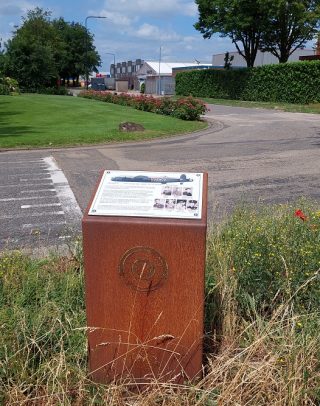
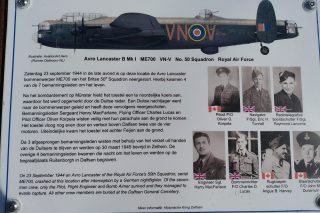
[Source www.tracesofwar.com Ed.]
Evasion.
Henry Macfarlane landed close to the bomb aimer, Charles Lucas, and the two found a hiding place in a house called ‘Vechthorst’ near Oudleusen which belonged to a couple called Ben and Annie de Haan. De Haan, a Policeman, hid the two airmen in a boathouse near the weir in the Vecht River. They would remain there until the end of October 1944. Then, after hiding at different addresses in Zwolle, they ended up on a boat, tucked away in the reeds, in a distributary inlet close to the mouth of the Vecht River. This distributary inlet connected the Zwartewater with the Genneger Zijl. The boat was used by a resistance group called ‘De Groene’. It was a hiding place for Dutchmen who were on the run, but also for Allied airmen. The boat was managed by a teacher from Rotterdam called Piet Stil (also known as Piet Boot).
Henry and Charles Lucas hid here for several weeks in the winter of 1944/1945, and they had to sleep on straw. Whilst at this hideout they were reunited with the other surviving crew member, Oliver Korpela, and from then on, they would stay together. In February 1945 the three were moved to Aalten. After a failed attempt to cross the River Rhine near Lobith with two other airmen, they ended up at Zelhem where they came into the care of Ale Jorritsma. In the following weeks the five moved, sometimes together, sometimes in twos or threes, to several addresses in the village. A Joh. H. Reussink wrote a detailed report after the war about the whereabouts of the five in the weeks before their liberation. The five were joined in this period by yet two more airmen and they were hidden with several different families including J.H. Reussink, Ale Jorritsma, E.J. Oosterink, A. Rijnders, Berkelder, Joh Buunk, Hemink and finally the Brekveld family all from around Zelhem.
Two of the airmen left in the last days before liberation, but the other five, including Henry Macfarlane, Charles Lucas and Oliver Korpela, were liberated in Zelhem on the 1st April 1945 as the advancing Allied troops reached them. Later, going via Eindhoven, they returned by Dakota to England. [Source: Studiegroep Luchtoorlog 1939-1945. Ed.]
The Remaining Crew.
The crew who perished in the attack and subsequent crash were laid to rest alongside each other in the General Cemetery at the nearby town of Dalfsen. The following is taken from the Commonwealth War Graves Commission website:
1. In Memory Of Flying Officer JOHN MURRAY DUNSMUIR Service Number: J/21396. No. 50 (R.A.F.) Squadron, Royal Canadian Air Force who died on 23 September 1944, Age 26. Son of John and Janet Adrian Dunsmuir, of Vancouver, British Columbia, Canada; husband of Thelma Adelaide Dunsmuir, of Edmonton, Alberta, Canada. The family requested the following inscription: AT LAST, O LORD, LET TROUBLE CEASE AND LET THY SERVANT REST IN PEACE. Remembered with Honour. Plot 6. Row 1. Grave 20.
2. In Memory Of Flight Sergeant ERIC HENRY TUNNELL Service Number: 1395660, No. 50 Squadron, Royal Air Force Volunteer Reserve who died on 23 September 1944, Age 23. Son of Frederick William and Florence Annie Tunnell, of Stamford Hill, London. The family requested the following inscription: GOD TOOK OUR LOVED ONE FROM OUR HOME BUT HE LIVES FOR EVER IN OUR HEARTS. Remembered with Honour. Plot 6. Row 1. Grave 21.
3. In Memory Of Flight Sergeant RAYMOND LARCOME Service Number: 1332939, No. 50 Squadron, Royal Air Force Volunteer Reserve who died on 23 September 1944, Age 21. Son of Alfred Henry and Beatrice Mary Larcome, of Farnborough, Hampshire. The family requested the following inscription: OUR DEARLY BELOVED SON, RAYMOND. WORTHY OF EVERLASTING REMEMBRANCE. Remembered with Honour. Plot 6. Row 1. Grave 22.
4. In Memory Of Flying Officer ANGUS BEVERLY HARVEY Service Number: J/38162. No. 50 (R.A.F.) Squadron, Royal Canadian Air Force who died on 23 September 1944, Age 25. Son of Henry W. and Jannette E. Harvey, of Winnipeg Beach, Manitoba, Canada. The family requested the following inscription: I AM THE RESURRECTION, AND THE LIFE. Remembered with Honour. Plot 6. Row 1. Grave 23.
Repatriated But Not Discharged.
Oddly, much later, when Henry applied to join the Hertfordshire Constabulary and he was asked to record his Military Service he wrote down that he had been a Prisoner of War in Germany and Holland for the 7 months he spent evading the Germans. Quite why he said this is unknown but there is little doubt that he was never a POW. When Charles Lucas was repatriated, he completed a General Questionnaire for British/American Ex-Prisoners of War. After completing his personal details his reply to Question 8. Place and Date of Original Capture, he replied, Evaded Capture (underlined in red) 23.9.44 to 1.4.45. There is no trace of similar forms for Henry or Oliver Korpela but the fact that Charles Lucas said what he did, goes a long way to validate all the other evidence that he had never been a POW.
Being repatriated was not the end of Henry’s Military service but it is unknown what he was doing or where he was stationed until he was posted to Egypt for six months after the end of the War. He was finally Discharged as a Class B Reservist on the 23rd September 1946 in order for him to join the Police. By the time he applied to join the Hertfordshire Constabulary he was no longer liable as a reservist for further service in H.M. Forces.
He was awarded the following medals: 1939-45 Star, France & Germany Star, Defence Medal and War Service Medal.
Marriage.
Published in the announcement’s column of The Nottingham Evening Post on Wednesday 4th September 1946: Macfarlane – Radford. September 23rd 1946, 12.30 p.m. St Martin’s Church, Bilborough, F/Sgt Harry Harrison Macfarlane, only son of Mr. and Mrs. H.H. Macfarlane, Aberfoyle, Perthshire, Scotland, and Brenda May only daughter of Mr. and Mrs. A. Radford, 5, Woodfield Road, Broxtowe.
Brenda May Radford was born on the 15th January 1928 at Belper, Derbyshire. Together they had three children, 2 boys and a girl.
Police Service.
When Henry joined the Police, for an unknown reason, he dropped his middle name of Harrison. All of the surviving Police documents only refer to him as Henry Macfarlane. He applied to and was Appointed as a Constable in the Metropolitan Police on 14th October 1946. Nothing is known about his service except that he resigned on the 30th March 1947. The reason given for his resignation was a shortage of housing.
On the 9th April 1947 he was Appointed as a Constable in the Nottingham City Police. Again, nothing is known about his service except he resigned on the 28th November 1948 again citing a shortage of housing as the reason.
Other Employment.
Between 1949 and 1950 Henry was employed as a Salesman by the Singer Sowing Machine Co., 60 Long Row, Nottingham. Once more he left due to the shortage of housing.
Between 1950 and 1951 he was employed as a timber feller by the Forestry Commission Scotland. He left their employment due to the very hard work and a desire to re-join the Police Force.
Re-joining The Police.
On the 22nd January 1951 Henry was re-Appointed as a Constable in the Metropolitan Police. There are again no details of his service until the 6th March 1952 when he transferred to the Hertfordshire Constabulary. The fact that by this time he had two children aged 3 and 1 and the chances of getting a good family home were more likely in Hertfordshire may have been the reason for his transfer request.
Hertfordshire Police Service.
Henry’s Application For Appointment As Constable has survived. It is a two page (4 sided) document that he completed on the 11th January 1952. The front page begins with his Conditions of Service to which he signed the following declaration: I hereby declare that I have received a copy of the Conditions of Service in accordance with Regulation 7(7) of the Police Regulations, 1948. Dated 11th January 1952 signed Henry Macfarlane.
There follows his Physical Qualifications. Instructions stated that he should take the form to his nearest Police Station where the officer in charge was requested to complete the following particulars:
Height: 5 feet 10 ¼ inches, Weight: 11 stone 2 pounds, Chest Measurements: 36 minimum 39 maximum. This was countersigned J. McAlpine, A.P.S. 5, Metropolitan 11.1.52.
The second page contains his application and as per the instructions he answered the following questions in his own handwriting.
Name: Henry Macfarlane, Present address: Police Section House, 64 Harrow Rd., Paddington, W2, Previous address: 2 Station Rd., Aberfoyle, Perthshire, Scotland, 1949 – 1952, Age: 26 years 9 months, Born: Cambusbarron, Stirling, Religion: Church of England, Occupation: Police Constable, Father’s occupation: Carpenter, Married or single: Married, Number of children: Two.
He then provided details of his education and academic qualifications as described previously.
The third page continued with further questions:
Give details of membership of any Cadet or Youth Organisation: Boys Brigade 1937 – 1939, Are you free of debt: Yes, Give details of sport or games in which you take part: Football and Golf.
He then provided details, as already described, of all of his employment since leaving school, including his previous Police Service and Military Service.
The fourth page begins with a request for two people who could supply a reference, but it has been crossed through, presumably being a serving Police Constable, he was told they were not required.
It then continued with a series of health questions to which Henry replied that he was in good health and had normal hearing and had not suffered from any of a list of ailments.
Henry then signed the following declaration: I hereby declare that the above answers are in my handwriting and were inserted by me on the 11th day of January 1952 and that they are true and full replies to the several questions above specified, and that I have read the Conditions of Service and, if Appointed, I hereby agree to serve as a member of the Hertfordshire Constabulary, under the conditions before mentioned, and subject to all Statutory Conditions now or hereafter to be made.
Following this was a declaration by the Police Surgeon: I have examined the above named candidate and consider him fit for Police duties. Dated 13th February 1952 signature unreadable.
On the same day at an Interview, almost certainly carried out at the old Headquarters in Hatfield, by Selection Board he was accepted by Chief Constable Wilcox.
Lastly is a record of his Attestation: Sworn in before us this date at Hitchin A.V. Wright Justice of the Peace, S.A. Garnham Justice of the Peace 7th March 1952.
At the very bottom of the page it states: Appointed Constable on 6th March 1952 (signed) Chief Constable Wilcox.
Record Of Service.
Henry’s Hertfordshire Constabulary Personal Record has survived and records the following information:
Name: Henry Macfarlane, No: 587, Dates of Birth: 25.4.25, Appointment: 6.3.52 squeezed above and below this was: For pension purposes 16.12.38 together with the dates he served in Notts. City and the Metropolitan Police. Place of birth: Stirling, Scotland, Height: 5 ft 10 ins, Eyes: Brown, Hair: Dark Brown, Complexion: Fresh.
He then gave details which mirrored his Application with respect to his marriage and family, education, religion, previous occupations, Military Service and Medals – with the only addition being that he was later awarded the Police Long Service and Good Conduct medal.
First Appointment.
Henry was first Appointed to E Division at Hitchin Police Station on the 6th March 1952 earning £420 per annum or £8/1/0 per week. From the 10th March until the 7th April 1952 he attended Local Training Course No. 34.
On the 27th September 1952 Henry qualified as a Third Class Police Driver. Then on the 6th October 1952 he was granted an exemption from the Promotion Examination Part 1 to Sergeant, possibly as he had already passed it whilst serving in another Force.
Change Of Address.
On the 4th November 1952 Henry moved to a Police owned property at 12 Pirton Road, Hitchin, prior to that it is assumed he was living in rented accommodation as he had been granted Rent Allowance of £1 per week from his Appointment. Some two weeks later his third child was born.
On the 18th July 1953 Henry passed his Group 1 Category Police Driving test. On the 19th January 1954 he was moved to Motor Patrol Duties.
On the 23rd January 1954 he passed the Part 2 Examination for Promotion to Sergeant.
Between June 1954 to August 1957 Henry made several separate applications to attend a C.I.D. Course, a Student Instructors Course at No. 5 District Police Training Centre, to perform C.I.D. Duties and Outstation Duties all apparently unsuccessfully.
Transfer.
On the 11th July 1955 Henry successfully objected to a proposed move to 105 Horseshoe Lane, Garston. A report by him was filed with a PC 525 records. [Possibly a PC D.S. Mitchell whose pension file has not survived. Ed.]
However, on the 11th August 1955 Henry was Transferred from Hitchin to C Division at Watford on Beat Duties.
Commendation.
On the 10th November 1955 Henry was Commended by the Chief Constable for the arrest of a man for larceny of a holdall at Watford.
From the 30th November to 10th December Henry was on a C.I.D. Aide.
A Slight Mishap.
On the 1st February 1958 following being involved in an accident whilst driving a Police vehicle index no. YNK848, Henry was suspended for 2 years from driving Police vehicles. On the 24th March 1959 he applied to have the suspension lifted but it is unknown if he was successful.
On the 31st December 1958 Henry applied to appear before the Promotion Selection Board which was refused.
Transfer.
On the 6th August 1959 Henry was transferred from Watford to F Division at Sandridge where he occupied 25 St. Leonard’s Crescent, Sandridge. From the 8th August he was granted a cycle and typewriter allowance.
Injury On Duty – Assault On Police.
On Christmas Day 1959 Henry suffered an injury to a hand whilst restraining a drunken man, he was off sick for four days.
From the 22nd to 26th February 1960 Henry attended a Road Safety Officer’s Course No. 24.
Henry was off sick for 29 days from the 15th October 1960 after the top of a finger was cut off. As it was not classed as an injury on duty it is presumed to have been accidental.
Change Of Address.
From the 2nd April 1962 Henry occupied 1A House Lane, Sandridge.
Commendation And Injury on Duty – Assault On Police.
On the 6th November 1963 Henry suffered cuts to his right wrist and left hand. He did not go off sick. Subsequently on the 14th December 1963 he was Commended by the Chairman of St. Albans County Magistrates Court for showing extreme courage in dealing with a man who attacked hm with a dagger.
Promotion To Sergeant.
On the 12 October 1964 Henry was promoted to Sergeant, earning £1090 per annum, and transferred from Sandridge to E Division at Stevenage on Supervisory Duties. He was instructed to occupy 32 Upper Sean, Stevenage.
On the 15th December 1964 he made another, apparently unsuccessful, application for a C.I.D. Course.
Transfer.
On the 31st May 1965 Henry applied to be transferred to Hitchin Section and to occupy 12 Pirton Road, Hitchin. This was approved and on the 9th July 1965 he was transferred from Stevenage to Hitchin.
Promotion Confirmed.
On the 7th September 1965 his promotion to Sergeant was confirmed.
From the 8th to 12th May 1967 Henry attended a Crime Prevention Course at Hatfield.
On the 8th November 1967 Henry was unsuccessful in his Police Subjects Examination for promotion to Inspector.
Change Of Address.
On the 13th December 1967 Henry occupied 30 Newton Road, Hitchin.
From the 2nd to 12th September 1969 Henry attended a Sergeant’s Refresher Course at HQ.
Letter Of Appreciation.
On the 12th July 1971 Henry was thanked by a Mrs. Tinker for assistance given by him when her son was involved in a motorcycle accident.
From the 8th to 12th May 1972 Henry attended a Sergeant’s Refresher Course at HQ.
Transfer.
On the 1st June 1972 Henry was posted to Rural Unit Duties.
From the 2nd to 6th October 1972 Henry attended a Sergeant’s Refresher Course at HQ.
A Minor Slip Up.
On the 19th February 1973 Henry was reprimanded for Neglect of Duty in that he did omit promptly and diligently to prefer a charge against a prisoner in accordance with Standing Orders. Paragraph 4(a) Police Discipline Regulations 1965.
Memorandum Of Appreciation – Sudden Death.
Published in the Biggleswade Chronicle on Friday 22nd March 1974 under the headline: Found Dead. Mr. Charles George David Lloyd (25). son of Lord and Lady Lloyd of Cloud Hill, Offley, was found dead in a spinney at Lilley on March 14 after being reported missing since March 12. Police said there were no suspicious circumstances. Mr. Lloyd was a nephew of Mr. Angus Ogilvy, husband of Princess Alexandra.
On the 29th May 1974 Chief Constable R.N. Buxton wrote a memorandum to the Chief Superintendent E Division headed Sergeant H. Macfarlane.
1. I met Lord Lloyd recently, and for the first time since the death of his son, and he thanked me at great length for the help he had received from the police generally and for the way they had gone about their duties during the operation.
2. In particular, he placed great emphasis upon the part played by Sergeant Macfarlane, mentioning his tact and consideration in dealing with the family, and also for the arrangements made at the Inquest which prevented Press from harassing Lord Lloyd and which resulted in minimum publicity.
3. I shall be pleased if you will convey these remarks to Sergeant Macfarlane as requested by Lord Lloyd. A suitable entry will be made on the officer’s personal records.
Transfer.
On the 25th November 1974 Henry was posted back to Supervisory Duties at Hitchin Town.
Retirement.
On the 28th February 1975 Henry retired on completion of his 30 years’ service.
Between 2002 and 2009 the Electoral Rolls list Henry as living at 29, Avocet, Letchworth, and between 2010 and 2013 he is shown as living at the Sloe Hill Residential Home, Mill Lane, St. Ippolyts, near Hitchin.
Henry Harrison Macfarlane died on the 10th June 2014 at the Gosmore Nursing Home near Hitchin.




Add your comment about this page