
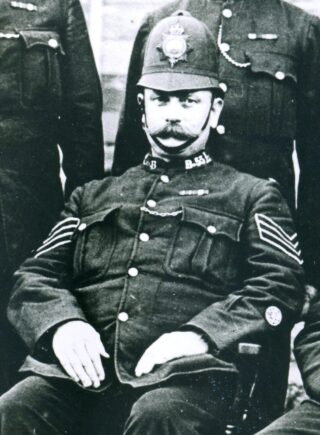
PS Frederick William Warren
Early Life.
Frederick William Warren was born in 1870 in Ivinghoe, Buckinghamshire. His father was James Warren who was born in 1850 also in Ivinghoe. His mother was Mary Pangborn born in 1848 in Kings Langley. At the time they married in Ivinghoe on the 12th December 1869 his father was a bachelor and his mother a spinster employed as a Bonnet Sewer.
They had four children: 1. Frederick William Warren 2. Frank Warren born in 1873 at Ivinghoe. 3. Charles Robert Warren born in 1876 at Watford. 4. Lucy Mary Warren born in 1879 at Watford.
In the 1871 census the family were living in Gore Gap, Ivinghoe. James was working as a Gardener and Mary was still a Bonnet Sewer. At the time of the 1881 census they had moved to 8, Estcourt Road, Watford and James was employed as a Coachman. Frederick was a scholar. In 1882 the following was published in the Death Notices in the Herts Advertiser on Saturday 18th November: Warren – November 2, at 8, Estcourt Road, Watford, James Warren, aged 32. Nothing more is known about Frederick until he left home and joined the Militia in 1888.
Early Army Service.
Frederick’s Militia Service Record, Army Form E.504, has survived and contains the following information.
On the 8th February 1888 Frederick Warren was Attested at Watford as Private 1521 in the 4th Bedfordshire Regiment. He stated he was born in Ivinghoe, Cheddington, Herts., that he was British and living at 25 Albert Street, Watford. He was 18 years 4 months old and he was not an apprentice but employed as a Labourer by a Mr. Perkes of Watford. He said he was single, had no children and had never been in prison. He was not currently a member of the Military and had never been discharged from the Military, was not in receipt of a pension for any Military Service and had not been rejected for Military Service owing to being unfit.
His Description on Enlistment was as follows: Age apparently: 18 years 4 months, height: 5 ft 8 ¾ ins., chest: 34 ins., complexion: fair, eyes: grey, hair: brown, Religious denomination: Church of England, Distinctive marks: Brown mark on right arm 3 ins. above elbow, very slight varicella on left side, four dots tattooed back of left forearm.
On the 2nd April 1888 Frederick was medically examined at Hertford and found to be fit for the Militia.
His Statement of Service shows he was promoted to Corporal on the 28th May 1888 and Attested for the Militia Reserve on the 21st June 1889. He attended annual training in 1888, 1889 and 1890.
Amy Form E.522 Attestation for the Militia Reserve records that 1521 Frederick Warren of the 4th Battalion Bedfordshire Regiment said he was still living at 9 Water Lane, Watford. That he had never served in the Military and that he was willing to serve for the unexpired portion of his Militia engagement and that his answers were truthful.
His Description on Enlistment in the Militia Reserve was as follows: Age apparently: 19 years 8 months, height: 5 ft 8 ¾ inches, complexion: fresh, eyes: grey, hair: dark brown, Religious denomination: Church of England, Distinctive marks: none.
Next of kin was shown as his mother, Mary Warren of 9 Water Lane, Watford.
On the 21st June 1889 he was medically examined at Aldershot and found to be fit for the Militia Reserve. Frederick then opted to join the Regular Army and his Service Record, Army Form B.265, has survived and contains the following information.
On the 11th July 1890 Frederick William Warren joined as Gunner 79907 in the Royal Artillery at Dover enlisting for Short Service of 7 years in the Colours and 5 years in the Reserve. On his Attestation he stated he was born in Ivinghoe, Tring, Bucks., that he was British, he was aged 19 years 9 months and was employed as a Groom. He stated he had not lived away from home, he was not an Apprentice, was not married and had never been sentenced to imprisonment. He was a member of the Militia, the 4th Bedfordshire Regiment, but he not served in the Regular Army or been Discharged from the Army. He declared that his answers were truthful and that he had never been turned down for the Army due to being unfit.
His Description on Enlistment was as follows: Age physically equivalent to 19 years 9 months, height: 5 ft 10 ½ ins., weight: 144lbs., Chest measurement: 35/37, complexion: fair, eyes: blue, hair: brown, religion: Church of England, distinctive marks: scar forehead, anchor cross heart and arrow right forearm, dot left forearm.
He was Medically Examined on the 9th July 1890 at London and declared fit for the Army.
His Statement of Service, Military History Sheet and 1891 census record the following: 21st October 1890 Transferred (unreadable).
17th December 1890 posted.
1891 census Gunner Frederick Warren, single, age 20 is recorded as living at the Royal Artillery Barrack, Artillery Place, Woolwich. 5th March 1892 appointed Bombardier. 21st March 1892 passed 3rd class Certificate of Education. 9th July 1892 granted Good Conduct Pay of 1d (per day). 23rd September 1892 service in India commenced. 11th December 1893 passed 2nd class Certificate of Education. 5th January 1894 reverted Gunner. 20th January 1894 forfeited Good Conduct Pay. 20th July 1894 restored Good Conduct Pay. 24th October 1895 appointed Bombardier. 30th June 1896 Exam for Corporal. 20th July 1896 granted Good Conduct Pay of 2d. 24th September 1897 promoted Bombardier. 31st December 1897 posted Dep (meaning unknown). 23rd January 1898 service at home commenced. 25th January 1898 transferred as Bombardier to 1st Class Army Reserve.
Police Service.
Frederick was believed to have been Appointed as Constable 55 in the Hertford County Constabulary on the 29th January 1898. His Police Service Record has not survived but from other sources it has been possible to build up quite a detailed account of his service. His decision to join the Police must have been made and the application process started before he left India, this was not uncommon as can be seen in the life story of PC 312 Daniel Cattermole who was, according to his Army Service Record, medically examined on behalf of Hertfordshire Constabulary whilst he was still serving in India.
An Early Blemish.
Frederick’s first Station was Hitchin which can be deduced by the following newspaper article. Published in the Herts & Cambs Reporter & Royston Crow on Friday 22nd April 1898. Frederick William Warren was charged by Superintendent Reynolds with that he being one of the constables of the county of Herts., unlawfully was guilty of neglecting his said office by being absent from Hitchin on April 12th. Mr. Passingham, solicitor, defended. The Magistrates found the charge proved. The Chairman said he had by his advocate admitted being off duty, but they did not consider that was the most serious part of the case. He had made a false entry in the book to shield himself. The Magistrates must show their opinion of such conduct by severe punishment. He would be fined £5. On the application of Mr. Passingham a week was allowed for payment.
Marriage.
In the first quarter of 1899 Frederick married at Hitchin Ethel Mary Green who was born on the 17th October 1879 at Campton, Bedfordshire. They had two children: 1. Reginald Sydney Clifford Warren born on the 2nd July 1899 at Hinxworth. 2. Cecil James Fred Warren born on the 14th June 1900 at Campton.
Recalled to the Army – Boer War.
Frederick’s Army Service Record shows the following:
9th October 1899 Recalled to Army Service under Special Army Order 7th October 1899 as Bombardier Royal Horse Artillery, 1 C.B. Ammunition Column. 24th October 1899 commenced service in South Africa. 10th February 1900 posted 3 C.B. (meaning unknown).
In the 1901 census Frederick’s wife Ethel and her two sons, Reginald and Cecil, were living with her parents in Main Road, Campton.
31st August 1901 posted R.S.V.A. a/Dep. (meaning unknown). 22nd September 1901 posted N. (meaning unknown). 21st September 1901 commenced service at Home.(1 year 322 days served in South Africa.) 22nd October 1901 reverted to Gunner at own request. 22nd October 1901 granted Good Conduct pay at 2d. 3rd April 1902 transferred 1st Class Army Reserve Section B. 8th July 1902 discharged 1st period. (12 years’ service).
Intended residence Police Station Baldock. South African War Gratuity paid by District Paymaster, Woolwich.
Frederick, as a Bombardier of the No. 3 Ammunition Column Royal Horse Artillery was awarded the following medal: The Queen’s South African Medal with clasps for Paardeberg, Johannesburg, Diamond Hill, Wittebergen, the Relief of Kimberley and 1901.
Re-Joining The Police.
The precise date that Frederick re-joined the Police is not known. However, it is possible to make a calculated estimate using information from his Army Service Record and the below General Order.
General Order 22 of the 9th October 1902 announced that under the provisions of the Police Reservists Act 1902, the Police Authority for the County has decided that the Army Service of those Police who were called upon to re-join the Colours as Reservists during the late war shall count as approved service for Pension or Gratuity under the provisions of the Police Act 1890. This order affects the undermentioned Sergeant and Constables.
PC Hyiatt 91 D Division Service with Regiment 2 Yrs 294 days PC Wood 172 B Division Service with Regiment 1 Yr 24 days PC Warren 55 E Division Service with Regiment 1 Yr 350 days PC Hunt 134 D Division Service with Regiment 351 days PC Pusey 183 F Division Service with Regiment 2 Yrs 183 days PC Hammond 89 B Division Service with Regiment 2 Yrs 218 days PC Burgess 107 D Division Service with Regiment 236 days PC Field 234 A Division Service with Regiment 31 days PS Wilcox 138 B Division Service with Regiment 340 days PC Stevens 60 A Division Service with Regiment 1 Yr 185 days
His Army Service Record states that he was recalled on the 9th October 1899 and 15 days later on the 24th October commenced Military Service in South Africa. He served 1 year 322 days in South Africa before returning and commencing duties at Home on the 21st September 1901 which totals 1 year and 337 days (he only returned when he did as he had completed his 12 years’ service for which he had originally enlisted). From the above General Order he was allowed to count 1 year and 350 days Army Service meaning that after returning home he remained in the Army for a further 13 days bringing him to the 4th October 1901. So, if as it is believed that his Police Service was continuous with his Army Service, he would have re-joined the Constabulary on the 5th October 1901.
As to where he was going to be stationed it has already been shown that he had been stationed at Hitchin. However, when he was demobilised he gave the Army his intended address as Baldock Police Station. Though, his first son Reginald, was born on the 2nd July 1899 and baptised on the 3rd September 1899 at Hinxworth near Baldock. At this time Constables lived where they worked which means that he must have become the village Constable in Hinxworth, probably in the middle of 1899, and the likelihood is that he would have returned to Hinxworth. This supposition is supported by the following:
Transfer.
General Order 3 of the 20th February 1902 announced the transfer of five Constables to take place as soon as they can be arranged. This included PC 55 Warren moving from Hinxworth to Hitchin.
Mutual Aid Bedfordshire.
General Order 8 of the 26th April 1902 ordered the undermentioned party of Police to be detailed for duty in Bedfordshire (under agreement Section 25 of the Police Act 1890) at the Pony and Galloway Races to be held in Luton Hoo Park on Wednesday 7th May 1902, to parade on the course at 11 a.m. Supt. J. Reynolds D.C.C., Sgt. Clark 126A, Sgt. Elderton 164A, Sgt. Whitbread 139E, and 25 Constables including PC Warren 55E. Dress: As usual for Race Meetings. Each Officer will supply himself with food for the day. Applications for railway fares to be submitted immediately after the duty is performed.
General Order 19 of the 6th May 1902 announced that a Sergeant and six Constables would receive an increase in pay from the 20th May 1902. They included PC Warren 55 from 25/8 to 26/10 per week.
Reorganisation Of The Mounted Police.
General Order 20 of the 8th October 1902 was an Order by the Chief Constable, Lieutenant Colonel Henry Smith Daniell, which reorganised the Mounted Police in Hertfordshire and stated that the following list would comprise the ordinary Mounted Police Force of the County: Superintendent Henry Duke, Inspector George Reed, PC 61 William Stevens, PC 179 Alfred Field, PC 148 Joseph Huggins, PC 212 Chisman, PC 199 Joseph Briden, PC 233 William Bethell, PC 167 Percival Hair, PC 116 Arthur Hughes, PC 55 Frederick Warren, PC 137 John Moles
PC Moles was told to wear Acting Sergeant stripes on his mounted tunic and cloak and to act as Sergeant when mounted. Two Sergeants and ten Constables were selected to form a Mounted Police Reserve. They would be utilised as Mounted Police on horses which would be provided for them when necessary. They would be provided with a complete mounted kit which they had to keep by them, and they had to parade in mounted order once in every month before the Superintendent who had to report their kit as complete and in good repair. Their saddlery would be kept at their Divisional Superintendents Station and the Superintendent’s Groom would be responsible for it being kept clean and in good order when not in use. It would be cleaned and stowed away by the Mounted Reserve man after use.
Superintendents were told to submit the names of Sergeants and Constables fit for this duty giving preference to Cavalry, Horse Artillery and Mounted Infantry men.
Mutual Aid to Cambridge Police.
The Cambridge Borough Police called upon local Police Forces to assist with the Policing of a visit by General Sir John French to Cambridge in 1903.
(Abridged) Published in the Cambridge Daily News on Tuesday 20th January 1903 under the headline Sir John French At Cambridge. Civic Honours. The Freedom Of The Borough: This morning in Cambridge, through her representatives, the Town Council, conferred upon General Sir John French the greatest honour in her power to bestow the Freedom the Borough. Lord Kitchener is the first name the first on the roll of Cambridge Freemen, and it is particularly fitting that the name of General French should follow that of his illustrious Commander in the South African War. seeing that the reason officially stated for conferring the freedom upon him is his “conspicuous and gallant services in South Africa.”
General Order 1 of the 17th January 1903 announced the details of a contingent of Herford County Constabulary Officers who were detailed to attend as follows: The undermentioned party (25) of Police are detailed for duty in the Borough of Cambridge to parade at the Borough Police Office at 5.45 p.m. on Monday 19th January 1903 on the occasion of the visit of Lieut. General Sir john French. (Under agreement Sect. 25 of the Police Act 1890).
Supt J. Reynolds DCC (In charge), Sgt. Elderton 164A, Sgt. Draper 4B, Sgt. Perry 108F and 21 Constables including PC Warren 55E.
Dress: Undress trousers (1902 issue), Tunic, Great coat, Leggings, Capes rolled and usual appointments. Black gloves. Applications for railway fares to be submitted to this office as soon as possible on return to their stations.
Another Transfer.
General Order 28 of the 22nd June 1903 announced that six Constables were to be transferred as soon as the Superintendents of A and E Divisions could arrange them. They included PC Warren 55E who was to move to Stevenage and transferred to the Mounted Reserve. It also stated that he was promoted to 28/- per week from his last pay day.
Moved Again.
General Order 51 of 30th December 1903 announced further transfers to take place as soon as possible. PC Warren 55E was to move to Whitwell.
General Order 15 of the 27th June 1906 announced ten Constables would receive an increase of pay effective from the 7th June 1906. They included PC Warren 55E who would go from 28/- to 29/2 per week.
General Order 11 of the 3rd March 1908 announced that nine Constables would receive an increase in pay with effect from the 13th February 1908. PC Warren 55E was to go from 29/2 to Merit Class 1/- per week extra.
Promotion To Acting Sergeant.
General Order 22 of the 29th December 1908 announced that subject to the sanction of the Finance and the Standing Joint Committees, Inspector Barnes will be employed by the County Council (Additional Constables) as Local Taxation Clerk at Headquarters, with effect from the 1st January 1909. In anticipation of, and subject to the sanction of the above named Committees as regards Inspector Barnes. The following Acting Promotions are made as from the 1st January 1909:
Sergeant Barron 34G to be Acting Inspector. PC Warren 55E to be Acting Sergeant. Acting Inspector Barron will remain at Harpenden. Acting Sergeant Warren will remain in E Division. (A further six Officers then followed).
A record has not been found but it would appear from the following newspaper articles that on his promotion he was transferred to Letchworth.
Hatfield House Ball.
General Order 9 of the 9th January 1909 instructed that the undermentioned party of Police will parade at Headquarters at 8 p.m. on Thursday 14th January 1909 for duty viz:
Acting Superintendent G. Reed G Division in charge, Inspector Spriggs E Division, Sgt. Ebling 142 F Division, Acting Sergeant Warren 55 E Division, together with 19 Constables from A, E, F and G Divisions.
Dress Night Uniforms with Capes and Lamps to return to their Stations first train on the following morning.
Plain Clothes inside House Superintendents W. Reynolds & J.S. Hassell.
Nominal Roll of Officers to be sent into Headquarters by the morning of the 12th Inst. Report Forms 115, Special Duty, showing amount of rail fares incurred to be submitted as soon as possible after duty is performed.
Promotion Substantiated.
General Order 1 of 1910 announced that Acting Inspector Barron is promoted to Inspector on £102/10/0 per annum from 1st January 1910. Acting Sergeant Warren 55E is promoted on 30/4 per week from 1st January 1910.
Transfer.
General Order 10 of the 5th March 1910 announced a retirement, promotions and transfers from the 1st April 1910 including Sergeant Warren 55E is transferred to B Division Sawbridgeworth.
Murdered Baby?
The events described in the following newspaper article took place before his transfer to Sawbridgeworth. Published in the Herts & Cambs Reporter & Royston Crow on Friday the 15th April 1910 – Garden City Sensation. Another chapter in the remarkable case of Canning Town kidnapping, and the subsequent discovery of infant’s dead body buried in an allotment at Letchworth, was opened at Hitchin Police Court on Saturday last, when a late Great Northern Railway goods clerk named Beeton was brought up and charged with the murder, on or about Sept. 10th, 1909, of Margaret Ruby Anna Young, the infant whose body was found buried on his allotment ground at Letchworth. The prisoner had been serving three months in the second division at Wormwood Scrubs in connection with the Canning Town kidnapping case and was transferred on Friday from there to St. Albans prison for discharge. On Saturday morning about 8.45, Beeton stepped out of St. Albans prison, and was immediately confronted by PS. Warren, of Letchworth, and a constable, who informed him that he would be taken to Hitchin. Although startled at the turn of events, Beeton said nothing, and quietly accompanied the Police to the station, where a train was taken for Hitchin, and later in the day he was charged before the Hitchin Bench. Prisoner appeared to be very despondent and took very little interest in what transpired.
A remarkable feature in the case is the testimony of a man who was confined in Wormwood Scrubs Prison at the same time as Beeton. According to his evidence Beeton confessed to him that he had killed the child. It is said that this witness, whose name was not disclosed at the Coroner’s inquiry, is “a man of culture, who had filled an important position in London life before his conviction last year.” Mr. Richard Edwin Thacker, the Letchworth stationmaster, proved the letting of an allotment belonging to the Great Northern Railway Company at Letchworth to the prisoner, who was chief goods clerk at Letchworth, in March 1908. Beeton only retained possession of the allotment until January of this year, although he had paid the rent up to March, the reason for this being that he had left the Company’s service. In reply to the Clerk, witness stated that he knew of no one else having used the allotment during the time prisoner had possession of it until about the middle of March last, when he allowed a new tenant to occupy it. Witness had seen prisoner working on it. He grew vegetables on the land.
PS Frederick William Warren deposed that about midday on March 19th he received instructions to dig over the allotment at Letchworth, which had been in the occupation of Frederick George Beeton. The allotment was situated in the goods yard of the Letchworth Station. After digging had proceeded an hour witness saw the skull of a child about 2ft. below the surface, and later a body was found, Dr. MacFadyen, of Letchworth, being present. The body was wrapped in an old pink flannelette nightgown, and round its stomach was a flannel binder and a white twill napkin. The body was discovered in about the middle of the allotment. As the Police Officer gave his evidence, the prisoner appeared to be deeply affected, covering his face with his hand and leaning heavily on his right arm. In reply to the Chairman as to whether he would care to cross examine the witnesses, the accused firmly answered, “No, sir,” and made a similar reply to a query as to whether he had anything to say against being remanded until Friday. Prisoner, who was remanded until this day (Friday), was then removed to the cells, and later on taken again to St. Albans prison.
Murder Trial.
Published in the Tenbury Wells Advertiser on Tuesday the 28th June 1910 – Buried Baby Case – Not Guilty. Frederick George Beeton was charged at the Hertford Assizes on Tuesday with the murder of Margaret Young (three months old) at Letchworth, the allegation being that he buried the body of the child in his allotment. Beeton, who is a married man, was alleged to have been the father of the child, the mother being a young woman named Rose Young. The evidence for the prosecution was that Beeton took the child from Letchworth on the pretence of handing it over to the care of a relative. When the mother became anxious to see her child again he kidnapped a baby from Canning Town and brought it to her to pacify her. He was arrested, and the child was returned to its distracted parents.
When he was in prison he made statement to a fellow prisoner, in consequence of which the allotment was dug over and the body of a baby found. Rose Young admitted that when Beeton took away the baby he wrapped it in his overcoat. She thought it could breathe freely. Thomas Jas. Stockall, at one time a Clerkenwell jeweller, gave evidence as to his conversation in prison with Beeton. “I did away with the child and then buried it,” was what Beeton told him, he said. He explained later that he had drowned the child. After the cross examination of the witness the Judge stated that he intended to tell the jury that unless the strongest corroboration of Stockall’ s evidence was forthcoming they ought not to accept it.
A fresh witness was Annie Reid, the matron of Stepney Workhouse, who remembered Beeton and Young visiting the workhouse in December and attempting to identify a child which had been found in the street. Later Young wrote stating that she was certain the child was hers. The Guardians were not satisfied and refused to hand the child over to her.
Dr. MacFadyen said that the body had been so long in the ground that he was unable to tell the cause of death. The post mortem signs were not inconsistent with death by drowning. Beeton gave evidence that while he was taking the child to Hitchin station to “abandon it” in a train going to London, he looked at it and found it was dead. He was frightened and hid the body among some lettuce for three days, subsequently burying it in his garden. He denied that he told Stockall that he had murdered the baby. Their conversations were conducted in “snatches and whispers.” The jury returned a verdict of not guilty, and Beeton was acquitted.
Published in the Northern Whig on Wednesday 22nd June 1910 – The Letchworth Mystery. At Hertford Assises yesterday Frederick George Beeton was charged with wilfully murdering his illegitimate child at Letchworth last September. The jury returned a verdict of not guilty, and prisoner was sentenced to nine months’ imprisonment for not notifying the Coroner that the child had died a violent death.
General Order 4 of the 1st February 1911 announced that Sgt. Warren 55B and five Constables would receive an increase of pay from the 12th January 1911. Sgt. Warren was to go from 30/4 to 31/6 per week.
The 1911 census records that Police Sergeant Frederick Warren, his wife and two sons , were living at Sawbridgeworth.
Mutual Aid At South Wales Miners’ Strike.
General Order 16 of 1st July 1911 instructed the following: All Superintendents. The undermentioned Detachment of this Force will proceed to Cardiff on Wednesday 5th July 1911 for duty.
Inspector Sullivan A Division in charge, Sergeant Warren 55 B, Sergeant Elderton 164 D, Sergeant Palmer 122 F Sergeant Ephithite 150 C, PC Carter 53 A, PC Megaughey 24 A, PC Hyiatt 91 A, PC Gallen 162 B, PC Johnson 177 C, PC Barker 97 C, PC Cousins 57, PC Morley 219 C, PC Grange 151 C, PC Kendall 129 C, PC Robinson 125 D, PC Turner 32 D, PC Lilley 241 D, PC Blake 156 D, PC Saunders 174 E, PC Bradford 26 E, PC Winchester 260 E, PC Clark 102 E, PC Kirby 207 E, PC Payne 107 E, PC Corney 81 F, PC Dean 228 F, PC Pitcher 41 G, PC Stacey 63 G, PC Reynolds 38 R.
The Deputy Chief Constable will superintend the departure from Paddington Station. The detachment will parade in Paddington Station at 11 a.m. on 5th July. The train will leave at 11.30 a.m. arriving at Cardiff at 2.22 p.m. Every man will take a change of clothing, second suit of uniform, great coat, helmet, cape, leggings, night belt and lamp, truncheon & warrant card, whistle and chain and handcuffs. PC Reynolds will act as Clerk to the Detachment. The men detailed for duty have been carefully selected and any neglect of duty or misconduct tending to bring the Hertfordshire Constabulary into disrepute on the part of any Officer or Constable of the detachment while on duty in another County will meet with the severest notice of the Constable. Special arrangements will be made for the payment of fares to and from Cardiff. Inspector Sullivan will be given a special advance from which he is authorised to pay back officers a sum not exceeding 5/- per week and this advance will also be available for any necessary expenditure of an extraordinary nature. Receipts to be submitted to the office. The wives of officers proceeding with the Detachment will be paid £1 per week from the officers pay during their absence. Food and lodgings will be provided.

At Gilfach Colliery
The officers were detailed to perform duty at the Gilfach Goch Colliery. James can be seen in this photograph: Front row left to right: PC 91A James Hyiatt, Sergeant 55B Frederick William Warren, PC 174E Lewis Saunders. Back row left to right: PC 241D Ferdinand Whittaker Lilley PC 156D Alfred John Blake, PC 37C Alfred Ernest Cousins, PC 107E Edward Albert Payne, PC 26E Philip James Bradford.
Qualified For Inspector.
General Order 4 of the 27th January 1914 announced that following the recent examination the below Sergeants had qualified to the rank of Inspector:
Sergeant 55 F.W. Warren G Division. Sergeant 142 W. Ebling G Division.
Promotion To Acting Inspector And Another Move.
General Order of the 27th January 1914 announced the following to take effect from the 5th February 1914: To be Acting Inspector Sergeant Frederick William Warren 55 G Division. Acting Inspector Warren is posted to E Division station Letchworth.
General Order 28 of the 12th February 1915 stated that Inspector F.W. Warren E Division would receive an increase in his rate of pay from £105 to £108 per annum from the 5th February 1915.
The Death Of A Retired Police Sergeant.
Published in the Hertfordshire Mercury on the 20th November 1915. The death took place on Saturday, after a short illness, of Sergt. Thomas Whitbread, at his residence in Baldock. The deceased, after four years’ service in the Herts. Constabulary, transferred into the Hertford Borough Police, being at once appointed to the rank of Sergeant. When the borough force was disbanded, and the duties taken over by the county, Sergt. Whitbread was re-transferred to the County Constabulary, together with the present Deputy Chief Constable, Supt Wood, who was a Sergeant in the Hertford force at the same time as the deceased. For a number of years Sergt. Whitbread was stationed at Baldock, at which period Supt. Reed was Sergeant in charge of the Royston district. In August 1907, he retired on pension, together with Sergt. Brice, of Stevenage, after 26 years’ service. In his younger days Sergt. Whitbread was in the Army as a bandsman. He was twice married, and by his first wife had one son and two daughters, who survive him. The deceased was a very popular and efficient officer, and by his tact and unfailing courtesy made many friends, to whom his death at the age of 58 has come as a shock. The funeral took place on Thursday afternoon at Baldock cemetery, the first portion of the service being held at the Parish Church, the Rev. Canon Nairn officiating. A force of police, under Supt. Reed, was in attendance, four of whom acted as bearers. Inspectors Warren and Bowyer were also present as personal friends of the deceased. There were a large number of floral tributes, including one from his late colleagues.
General Order 23 of the 28th February 1916 stated that Inspector F.W. Warren E Division would receive an increase in his rate of pay from £108 to £111 per annum from the 5th February 1916.
Acting Superintendent.
General Order 29 of the 24th July 1916 instructed that during the absence on leave of Superintendent G. Reed from the 5th August to 29th August 1916, inclusive, Inspector Warren E Division will take charge and act as Superintendent of the E or Hitchin Division. Inspector Warren will proceed to Hitchin on Monday 7th August 1916 and personally go through books, documents and correspondence with Superintendent Reed. Inspector Warren will be required to reside at the place where he is posted temporarily.
General Order 14 of the 9th February 1917 stated that Inspector F.W. Warren E Division would receive an increase in his rate of pay from £111 to £114 per annum from the 5th February 1917.
General Order 18 of the 16th February 1918 stated that Inspector F.W. Warren E Division would receive an increase in his rate of pay from £114 to £117 per annum from the 5th February 1918.
Letchworth Burglar Admits Offence.
Published in the Hertfordshire Express and General Advertiser on Saturday the 4th January 1919 – Belgian’s £700 Theft, Letchworth Case at Quarter Sessions £143 Still Missing. A Belgian’s theft of £700 at Letchworth, with its singular sequel of a confession of the crime, came before the Justices at the Herts. Quarter Sessions, at Hertford on Monday, Sir Alfred Reynolds (deputy chairman) presiding.
The accused, Alphonse Waighe, was indicted on charges of breaking and entering the office of Messrs. Kryn & Lahy’s Works at Letchworth on November 15, and of stealing the sum of £7OO there from. Waighe. who presented a somewhat woebegone appearance in the dock, had the charge interpreted to him, and pleaded guilty.
Mr. St. John Morrow, barrister, who appeared for the prosecution, outlined the circumstances of the case. He said Waighe was employed by the firm as an electrician, his duty being to look after the lights of the works. On the evening of November 15 he was working in a corridor immediately outside the cashier’s office on the first floor of the works at Letchworth. The cashier had that evening been paying the workpeople their week’s wages and at 10 o’clock he reckoned up the money he had over. This consisted of £75 in £5 notes, £995 in £1 Treasury notes, and £118 10s. in 10s. notes, besides some silver and copper. The money was put away in a large tin box.
The prisoner according to the confession which he afterwards made, saw the money being put into the box, and later on he broke the window of the office; went in and took away from the money in the box, the sum of £7OO. The money was, of course, missed next morning. The police interviewed the accused, and he was under suspicion for some time. “At length,” said counsel, “”the man’s conscience was troubled, and he sent a message to the police. The police, in consequence of the message, went to his house and , found £557 of the £7OO which was missing.
Waighe made a statement to Inspector Warren, admitting the whole of the facts as to the theft, acknowledging that he broke into the premises and that he stole the money. Nothing, counsel added, ,was known against the man. He had been employed for a considerable time at Messrs. Bryn and Lahy’s works.
The Chairman, “Is anything known as to what became of the balance of £143?” Counsel, “That has not been explained.” The Chairman, “Does he offer any explanation?” Counsel, “No.” The Chairman, “So the firm are losers to the extent of £143 at present?” “Yes.” Counsel. The facts as given by counsel were interpreted to the prisoner, who was then asked if he had anything to say. Through ‘the interpreter, Waighe said he had restored all that he had stolen. The Chairman, “Tell him there was £7OO stolen and only £557, recovered, which leaves a deficit of £143.” Prisoner (through the interpreter), “All that I have stolen I have brought back.” The Chairman, “Well, we must deal with him as we find him. He has pleaded guilty to the theft of £700.”
In passing sentence of twelve months, hard labour, the chairman told Waighe that he had committed two serious offences breaking and entering, and then stealing a very large sum of money. He was liable to be sent to penal servitude, and the court considered that they were dealing very leniently with him. The interpreter, “He wishes me to tell you that he has never been in prison before.” The Chairmen, “That is one reason why we are dealing leniently with him.” Waighe was removed after pointing out that he had already been six weeks in prison.
Prisoners Confession. The statement which was made by the prisoner to Inspector Warren (as above referred to) was read at the hearing of the case at Hitchin Sessions. It was as follows: “Friday night, November 15. 1918, I was at work at the factory, and I had occasion to go up to the corridor to repair the electric light. I saw the cashier put the money away in a box. I then went into the next office and put the catch back at 2.30 a.m. I went out of the factory and fetched a ladder from the new building, put it up against the window and got in. I broke the glass panel in the cashier’s office door, went in, and broke open the box with a piece of iron. I took the notes. I then replaced the ladder and at 6.30 a.m. I hid the money in a spinney on the way to Baldock. I went and fetched the money tonight (Tuesday November 19) about 6.30 p.m. with the intention of taking it to the Police Station. On the way back I fell off my bicycle and cut myself, I went home and told Doris to send for the police. I couldn’t rest since I did it and wanted to confess. It was a great temptation to me to see the money there and to know it was left in the box all night with no one to look after it.”
General Order 41 of the 15th February 1919 stated that Inspector F.W. Warren E Division would receive an increase in his rate of pay from £197/14/2 to £203/18/10 per annum from the 5th February 1919.
Promotion To Superintendent And A Transfer.
General Order 98 of 23rd April 1919 instructed Superintendent Warren E Division to transfer from Letchworth to Hitchin on the 1st May 1919.
In 1919 the Electoral Roll lists Frederick William and Ethel Mary Warren as living at the Police Station Bancroft, Hitchin.
Published in the Hertfordshire Express and General Advertiser on Saturday the 10th May 1919 – Superintendent Warren – Leave Taking At Letchworth. Special Constables Presentation. How greatly the work of Inspector Warren has been appreciated at Letchworth, and how the town shares with him the pleasures of promotion to Superintendent was abundantly proved (through the timely and generous thoughtfulness of Mr. W. H. Gaunt and his large force of Special Constables) at the Howard Hall on Wednesday evening, last week, when the hall was filled by Urban Councillors, members of the two forces and their wives, members of the Fire Brigade, of the staff of First Garden City Ltd., and other well known public men. Mr. Gaunt himself, with his usual tact and geniality, took conduct of the proceedings, and the result was that the whole proceedings were a model of what such an occasion should be.
A pianoforte solo by Mr. Clark, songs by Messrs. Hudson, J. van Hooydouk, Jack Dent, and Swanson, and exceedingly clever conjuring by a member of the Maskelyne & Cook Company, were all much enjoyed, and the excellent catering of Mr. Nott also played its part in the evening’s enjoyment. Mr. Gaunt said they had met to bid goodbye to Inspector Warren and to congratulate him on his promotion to Superintendent. They were very proud indeed that his record at Letchworth had been so good that the authorities had promoted him. They were still more pleased that instead of going to another post in the county he would be near to them for (he hoped) many years to come.
The Special Constables, who had all enjoyed working with Inspector Warren, had arranged that meeting. Speaking as their head, he congratulated them on the solid amount of work they had done during the war for the town. They had created confidence, instead of panic, during the air raids, and their work had engendered a useful, companionable feeling among men who would not otherwise have met. No fewer than 170 men had been in their force, of whom 50 had joined the Forces and one or two (notably Mr. Riddell) had died for their country. He wished particularly to thank Messrs. Fisher, Trevor, Swaine, Ball, Wright and A.J. Howard for their great help. He wished also to congratulate Constable Dean on his Promotion to sergeant. He had never met a better man in his own quiet, plodding, way. They had met to say goodbye and good luck to Superintendent Warren. They were all in complete accord as to his good qualities, and they wished him every possible success. They had contributed to the purchase of a case of knives and a , tantalus for him and a few spoons for Sergeant Dean. Mrs. Gaunt then made the presentation. Superintendent Warren being greeted with the singing of “For he’s a jolly goodfellow,” and three cheers, Which were repeated for Mrs. Warren. Mr. Ball, in a speech full of interesting reminiscences of “night watches” and air raids, re-echoed Mr. Gaunt’s speech, and also what he had said about the Special Constables, not one of whom regretted the work of the past four and a half years. Mrs. Gaunt deserved a special word of praise she had been the good fairy of the business.
They all felt the greatest respect for Superintendent Warren, and, as chairman of the Urban District Council he assured the police that they had got the good wishes and thorough appreciation of the Council. Superintendent Warren’s promotion had been earned by loyalty and conscientious work Mr. van Hooydonk concluded a humorous speech by saying that Superintendent Warren had proved to be a good man, who with a good staff had done the work quietly and well. Superintendent Warren who was very heartily greeted, thanked them for the present. It was a great surprise, and it would remind him of the happy time at Letchworth. He could not have carried on during the war with such a small staff but for the help of the Special Constables. Mr. Salsmans (the Belgian Special Constable) expressed the warm feelings of his countrymen towards the Superintendent, and a happy evening was brought to a close.
Published in the Hertfordshire Express and General Advertiser on Saturday the 10th May 1919 – The Police Promotions. In connexion With the recent Police promotion’s, it is interesting to note that Superintendent F.W. Warren, removed from Letchworth to Hitchin to succeed Superintendent G. Reed, Inspector William Wade, removed from Harpenden to Letchworth to take the place of Superintendent Warren, and Sergeant H. Wright removed from Hertford to replace Inspector Wade at Harpenden, all received their training in Police duties under the ex-Deputy Chief Constable Superintendent John Reynolds in the Hitchin Division.
Confirmed In Rank As Superintendent.
General Order 62 of the 12th April 1920 announced the confirmation of promotion of two Acting Superintendents including Frederick William Warren, E Division, who was promoted to the substantive rank of Superintendent and was granted an increase of pay from £400 to £415 per annum with effect from the 1st April 1920.
County Council Elections 1921.
General Order 38 of the 20th March 1921 gave instructions for the running of the County Council Elections 1921, the 18th or Hitchin (Northern) Bye Election which was to be held between 8.00 a.m. and 8.00 p.m. on 23rd March 1921. Superintendent F.W. Warren was in charge of the Election.
In the 1921 census Frederick shown as being a Police Superintendent, was living with his wife and son Cecil, at the Police Station in Bancroft, Hitchin.
General Order 51 of the 7th April 1921 stated that Superintendent F.W. Warren E Division would receive an increase in his rate of pay from £415 to £430 per annum from the 1st April 1921.
Annual Leave.
General Order 100 of the 23rd June 1921 stated that during the absence of Supt. F.W. Warren E Division between the 25th June to the 10th July 1921, Inspector E.G. Rolph E Division will reside at Hitchin and will take charge of and act as Superintendent of the E or Hitchin Division. Inspector Rolph will proceed to Hitchin on 24th June 1921 and will personally go through books, documents etc. with Superintendent Warren.
General Order 159 of the 17th September 1921 stated that during the absence of Supt. F.W. Warren E Division between the 2nd October to the 15th October 1921, Inspector E.G. Rolph E Division will reside at Hitchin and will take charge of and act as Superintendent of the E or Hitchin Division. Inspector Rolph will proceed to Hitchin on 1st October 1921 and will personally go through books, documents etc. with Superintendent Warren.
County Council Elections 1922.
General Order 28 of the 1st March 1922 gave instructions for the running of the County Council Elections 1922 which were to be held between 8.00 a.m. and 8.00 p.m. on 4th March 1922. Superintendent F.W. Warren was in charge of the Hitchin (Northern) and (Southern) and the Baldock Electoral Divisions.
General Order 46 of the 8th April 1922 stated that Superintendent F.W. Warren E Division would receive an increase in his rate of pay from £430 to £445 per annum from the 1st April 1921.
Retirement On Pension
General Order 2 of the 12th January 1923 announced the retirement on pension of Superintendent F.W. Warren E Division from the 1st March 1923 having completed 25 years of Approved Service. He was granted an annual pension of £275/18/0.
General Order 5 of the 12th January 1923 sated that Superintendent Frederick William Warren, E Division, having submitted an application for consent to retire on pension, the resignation is accepted and will take effect on 28th February 1923. Superintendent Warren will be paid up to the 28th February 1923 inclusive and his name will be struck off the establishment of the Force the same day. The Chief Constable desires to place on record his high appreciation of the long and faithful services performed by this Officer.
According to the Electoral Roll in the Spring of 1923 Frederick and family were still residing at the Police Station in Bancroft, Hitchin but by the Autumn they had moved to 13 Balmoral Road, Hitchin and then by the Autumn of 1924 they were living at 22 Ickleford Road, Hitchin.
Frederick William Warren of 22 Ickleford Road, Hitchin, died on the 2nd June 1931 at Hitchin. His effects were left to his widow Ethel Mary and his son Reginald Warren a Police Constable.
In the 1939 Register Ethel Mary Warren was living at 22 Ickleford Road, Hitchin. Her son, Reginald who was a Police Constable, was living with his wife at 118 Lincoln Street, Norwich.
Ethel Mary Warren of 22 Ickleford Road, Hitchin died on he 11th February 1959 she left her effects to her sons Reginald Sydney Clifford Warren a Police Officer and Cecil James Fred Warren a coach driver.




Add your comment about this page