
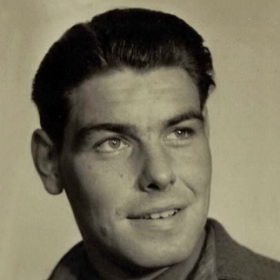
Early Life.
Oswald, although he was also known sometimes as John or Ozzie Thorne, was born on the 31st December 1922 in the village of Bierton, Buckinghamshire. His father was Owen Thorne, who was born on the 27th October 1874 at Aston Clinton, was a carpenter and joiner and supplemented his income as a gardener. He married Ada Maud Richardson, who was born on the 20th July 1899 at Abington, Northamptonshire, on the 17th April 1922 at Newport Pagnell. At the time of her marriage, she was an Assistant Matron at the Newport Pagnell Union Workhouse. Oswald also had a brother Aubrey, born in 1933, who also joined the Hertfordshire Constabulary and retired as a Sergeant.
For the first part of his life Oswald had an idyllic but financially tough upbringing in the very rural surroundings of Bierton. Then in 1935, owing to the depression, his father became unemployed and the family moved to Garston and lived initially with his grandmother who ran a nursing home. Aged 13 ½ Oswald left school and he sought full time employment and eventually became a relief shop manager.
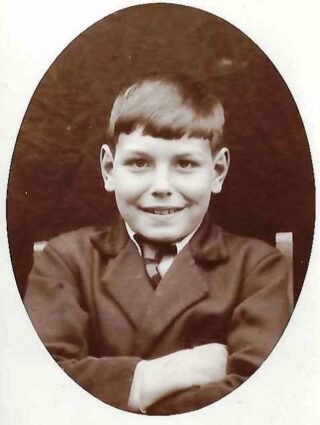
Oswald John Thorne c. 1930
Military Service.
On the outbreak of the Second World War Oswald was 16 and, following a call by Winston Churchill for volunteers to form a Home Defence Force, later to be renamed the Home Guard, he joined the London, Midland and Scottish Railway, Watford Section, which was based in an old railway carriage situated between the four sets of tracks at Hunton Bridge, just north of the Watford three mile tunnel.
Like all of the volunteers they were eventually kitted out and received weapons training as well as training in the search and rescue of victims of the German bombers. This stood him in good stead as following a bombing raid he located and rescued an 11 year old boy from the remains of his demolished home.
On his 19th birthday on the 31st December 1941 Oswald received his call up papers for the Army and he travelled by train to Chelmsford where, as Private 5961232, he joined X Company of the 6th Battalion Bedfordshire and Hertfordshire Regiment. He was immediately posted to the Grand Hotel, Southwold, Suffolk where he began his training.
Eventually he was posted to Support Company Ack-Ack Platoon at the St. Felix School for Girls which was located a few miles from Southwold where his training with Bren guns was continued. At one point he and five others were sent to Harwich where they joined a Royal Navy destroyer as extra anti-aircraft protection and were soon out on North Sea patrols. Shortly after returning to his Unit the Regiment moved to the Guards Barracks at Caterham where training continued including a conversion from an anti-aircraft role to an anti-tank role. Manoeuvres in Wales followed at Fishguard, Haverfordwest and Harlech ranges. On returning from Wales he was posted to Beckenham where they were equipped with larger calibre six pounder guns. More weeks of training followed.
War In Europe.
Just before D Day his Regiment was disbanded and the men were told that they would be used as replacements following the expected heavy casualties during the invasion. All their equipment save for their personal kit and rifles was handed in. They were eventually transported to a temporary camp near Southampton until, on or about the 10th June 1944, they embarked on a ship and sailed only to anchor again a short while later waiting for other ships to join them. The next day they sailed for France and arrived at Arromanches and a temporary Mulberry Harbour where they disembarked and marched to a holding camp.
Towards the end of August 1944, he was posted to the 1st Battalion The Royal Leicestershire Regiment near Rouen as a replacement for anti-tank personnel. They formed part of the 49th West Riding Division (Polar Boar Division) of the Canadian Army. Not long afterwards they took part in the attack on Le Havre. After heavy fighting the battle ended on the 12th September 1944. After a short rest they advanced through Belgium towards Brussels. They then advanced to the River Rhine in Holland fighting battles in the areas of Turnhout, Eindhoven, Tilburg, Breda and Roosen-dal. The Battle of Arnhem was by now in progress and they were part of the column trying desperately to reach them. By the end of September 1944, they had reached the River Waal near Nijmegen, just in time to see the remains of the Airborne survivors crossing the wide expanse of water west of the Town.
There then followed several months of inertia which was disrupted once when he received a minor shrapnel wound in his right lower leg from a German artillery shell. On another occasion he was ‘volunteered’ to form part of a night patrol of five men led by a Corporal. He and another man became separated and realised they were behind German lines and were subsequently hidden in an underground tank by a Polish woman who was a forced labour worker. The importance of this meeting will become clear later. After several days they managed to escape back to Allied lines when the Germans withdrew. Following weeks of suffering freezing cold duty in the front line on about the 14th April 1945 they boarded a landing craft, moored not far from Nijmegen Bridge, and travelled towards Arnhem. They disembarked in the outskirts of the town. They then advanced towards Oosterbeck and later continued towards Amersfoort.
The Armistice.
At the end of April 1945 war activities slowed to a standstill while negotiations between the Generals worked out the cease fire. Then on the 4th May the German’s surrendered.
That wasn’t the end of his Military Service though and he was moved on again this time towards Hilversum where they were tasked with disarming the German Army in Holland. Whilst doing this he was caught in the explosion of a pile of German Teller Mines, which were deliberately detonated by a German soldier of the Herman Goering Regiment using a grenade. The blast tore off all of his clothes except his boots and put him in hospital for three days suffering from perforated eardrums, blast injuries and shock.
Having recovered, Oswald’s regiment moved into Germany to Hemer in Westphalia where they were tasked with guarding Russian POW’s who had been abandoned by their country. As these men recovered local German farms started to be raided and eventually British soldiers, including Oswald, were forced to guard them. One night the farm Oswald was stationed at was attacked by men with automatic weapons. During the fight Oswald received a stab wound five inches long in his left arm which earned him a week’s stay in hospital.
Marriage And Returning Home.
He was promoted to Lance Corporal and then was made a Technical Storeman Corporal as part of the Quartermaster’s Staff allowing him unrestricted travel. One day he was sent to Iserlohn to transport stores to a nearby camp. Arriving at the gate Polish guards directed him to a nearby office where there was an interpreter. On entering the only person there was seated with their back to him. As they turned round he got the greatest shock of his life, as it was the lady who had hidden him in the tank so many months before. The lady was Maria Teresa Szczepanska from Lvov, Poland. Over several months and despite being moved to Padderborn, a relationship developed between them. The relationship continued to grow and eventually they decided to marry which was an enormously complicated thing to do at the time. It wasn’t helped by another move for Oswald to Lingen, but they were finally able to marry at Lingen Garrison Church on the 12th October 1946. Oswald was delighted to be told by his Captain Quartermaster that he had procured a wedding vehicle, it turned out to be no less than Hermann Goering’s open-topped Mercedes Benz, complete with a driver. Their first home was at 20 Rhein-strasse, Lingen whilst waiting to be discharged. Finally on the 15th May 1947 they travelled to Harwich via the Hook of Holland.




Add your comment about this page